
spec sheet10 rows
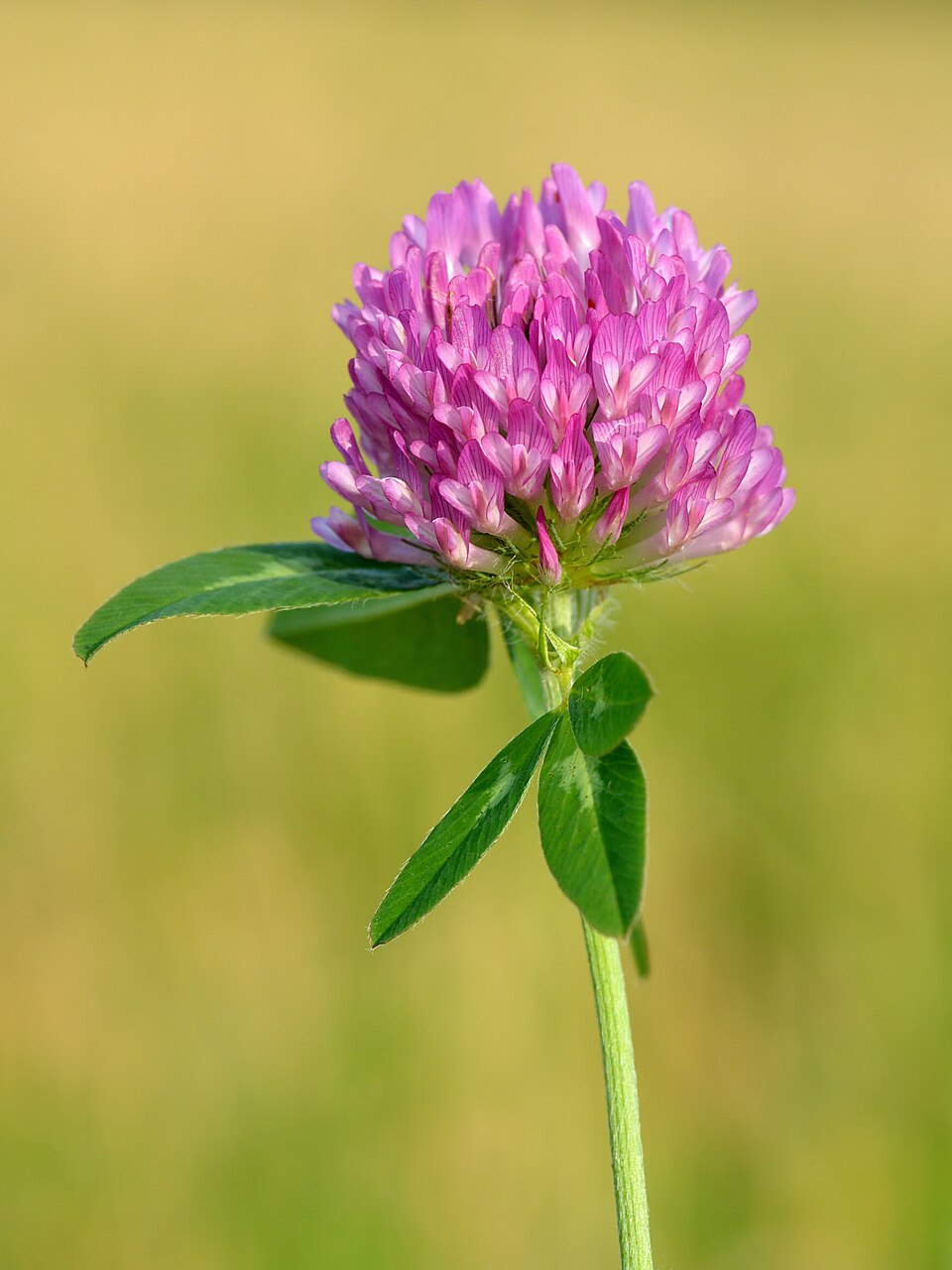
Red clover (Trifolium pratense) is a short-lived perennial legume in the family Fabaceae, native to Europe, western Asia, and northwest Africa and widely grown as a forage and cover crop. Its flowers are a rich source of isoflavones, plant compounds that resemble estrogen, which has made red clover a popular dietary supplement for menopausal symptoms. Evidence for its benefit on hot flashes is mixed but points to a modest effect.
- May ease hot flashes
- Possible mood support in menopause
- Weak estrogenic activity
- Possible bone and vascular support
- Mild digestive upset in some people
- Theoretical caution in hormone-sensitive conditions because of its estrogen-like activity
- Possible interactions with blood-thinning or hormonal medications
Overview
Red clover is a herbaceous, short-lived perennial of the bean family, variable in size, with a deep taproot, three-part leaves often marked by a pale crescent, and dense heads of pink to purple flowers. It is native to Europe, western Asia, and northwest Africa and has become naturalized across much of the Americas and Oceania. In agriculture it is valued as a nitrogen-fixing fodder crop and green manure.
The plant's flowers and leaves contain isoflavones, a group of phytoestrogens that includes biochanin A and formononetin, along with other flavonoids and saponins [2]. Because these compounds are structurally similar to estrogen, red clover extracts are marketed as a botanical option for easing the symptoms of menopause [1]. The plant also has a long history of folk use, and its flowers are edible and appear in teas and preserves.
Clinical research on red clover has centered on menopausal hot flashes. A systematic review and meta-analysis of randomized trials found a modest but statistically significant reduction in the frequency of hot flashes compared with placebo [1]. A separate randomized, placebo-controlled trial reported that red clover isoflavones improved both menopausal symptom scores and blood lipid levels in postmenopausal women [2]. Evidence for the genitourinary symptoms of menopause remains limited and inconsistent [3]. Red clover is sold as a dietary supplement rather than as an approved medicine, and professional bodies have generally not endorsed it as a standard treatment [3].
Mechanism
Red clover's activity is attributed chiefly to its isoflavones, plant compounds whose structure resembles the hormone and which can bind weakly to estrogen receptors in the body [1][2]. Through this phytoestrogenic action they are thought to partly mimic , which may help offset the decline in the hormone that drives menopausal symptoms such as hot flashes [1]. The same isoflavone content has been associated in trials with favorable shifts in cholesterol and other blood lipids [2]. Because the effect at receptors is comparatively mild, the overall clinical impact tends to be modest [1].
receptor fingerprint
receptor betapartial agonist
receptor alphaweak agonist
Bone turnovermodulates
Vascular tissuesupports
Dosingtypical ranges, not medical advice
interested in protocols and clinical dosages? make an account to see them! ^_^
Safetyrisks and cautions, not medical advice
Red clover is generally well tolerated; side effects are usually mild, like headache or GI upset. Because it has estrogenic activity, it's cautioned in people with hormone-sensitive conditions such as certain breast or uterine cancers, and it may interact with hormonal medications and blood thinners. It's best used under guidance if you have any hormone-related history.
Subjective profileweighing the evidence above
A mild phytoestrogen that may help menopausal mood and hot flashes for some women, but the evidence is inconsistent. Not for people with hormone-sensitive concerns without medical advice.
Resources
This entry is here for reference.
Research
- 1.The effectiveness of red clover on hot-flash in menopausal women: a GRADE-assessed systematic review and meta-analysis
- 2.Isoflavones obtained from red clover improve both dyslipidemia and menopausal symptoms in menopausal women: a prospective randomized placebo-controlled trial
- 3.Complementary and Alternative Therapies for Genitourinary Syndrome of Menopause: An Evidence Map
3 listed here; entry last updated July 2026
Reviews
My notesprivate to this device
FAQ
How does red clover affect mood?
Mostly indirectly, by easing menopausal symptoms. It's not a general antidepressant.
Is it safe if I've had breast cancer?
Its estrogenic activity means caution is warranted. Talk to your oncologist before using it.
Why do results vary so much?
Isoflavone potency depends partly on gut bacteria converting them to active forms like equol, which differs between people.
Does it help hot flashes?
Some studies show modest benefit, others little. It may help certain women more than others.
Can men take it?
It's mostly studied in women for menopause. Men rarely have a reason to use it, and the estrogenic angle is a consideration.
Adverse effects
- Mild digestive upset in some people
- Theoretical caution in hormone-sensitive conditions because of its estrogen-like activity
- Possible interactions with blood-thinning or hormonal medications
Notes and cautions
- Generally well tolerated in short-term use