
spec sheet7 rows
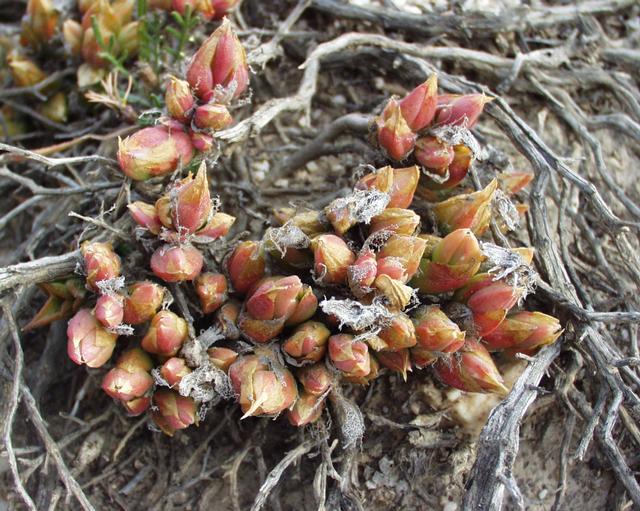
Sceletium tortuosum, commonly known as kanna, is a small succulent plant of the family Aizoaceae native to South Africa, traditionally chewed or fermented by the region's Khoisan peoples as a mood-altering and stress-relieving remedy. Its psychoactive effects are attributed to mesembrine-type alkaloids, chiefly mesembrine and mesembrenone, which act on serotonin transport and the enzyme phosphodiesterase 4 (PDE4). A standardized extract known as Zembrin has been studied for anxiety, stress, and cognition.
- Stress and anxiety relief
- Mood lift
- Social ease
- Some cognitive support
- Mild nausea or stomach upset
- Headache
- Risk of serotonin syndrome if combined with serotonergic drugs
Overview
Sceletium tortuosum, now also classified as Mesembryanthemum tortuosum and popularly called kanna, is a succulent forb in the family Aizoaceae that is endemic to the Cape region of South Africa [1]. Its pharmacology is driven by a group of mesembrine-type alkaloids, of which around twenty-five have been described across several structural classes, with mesembrine, mesembrenone, and mesembrenol among the most important [1]. In fresh plant material mesembrine tends to predominate [1].
The plant has a long ethnobotanical history. Indigenous San and Khoikhoi peoples used it for centuries as a masticatory and medicine, chewing or fermenting the plant to relieve thirst, hunger, and fatigue, to ease pain, and for social and spiritual purposes, with the earliest written record dating to the seventeenth century [1]. Traditional preparation often involves a fermentation, or bruising and drying step, which shifts the alkaloid balance and is thought to enhance the psychoactive effect [1].
Modern interest centers on the plant's effects on mood and stress. Laboratory studies show that a standardized extract inhibits the serotonin transporter and, distinctively, also inhibits phosphodiesterase 4, a dual action that has been proposed to underlie its anxiolytic and antidepressant potential [2]. Some work suggests that high-mesembrine extracts act primarily as monoamine-releasing agents, upregulating the vesicular monoamine transporter, with serotonin-reuptake inhibition a secondary effect [3].
Clinical research has largely used the proprietary extract Zembrin. A three-month randomized, double-blind, placebo-controlled study in healthy adults found it well tolerated, with some participants reporting improved coping with stress and sleep [4]. A pharmaco-fMRI study reported that a single dose reduced reactivity of the amygdala, a brain region involved in threat processing, and weakened its coupling to the hypothalamus, offering a neurobiological rationale for anxiolytic effects [5]. Reviews note that clinical testing so far has been mainly in healthy volunteers, so evidence in diagnosed anxiety or depression remains limited [1].
Kanna is available as dried plant material, teas, tinctures, capsules, and standardized extracts, and it can be chewed, brewed, or taken as a snuff [1]. It is sold as a botanical supplement rather than an approved medicine. Animal and human safety data to date are reassuring at the doses studied, though caution is advised about combining it with serotonergic drugs [1][4].
Mechanism
The effects of Sceletium tortuosum stem from its mesembrine-type alkaloids acting on signaling and cyclic nucleotide metabolism [2]. Standardized extracts are potent inhibitors of the transporter, which increases serotonin availability at synapses in a manner broadly similar to conventional serotonin-reuptake inhibitors, and they simultaneously inhibit phosphodiesterase 4, an enzyme that breaks down cyclic AMP, thereby prolonging intracellular signaling linked to mood and cognition [2].
Mesembrine is the most active alkaloid at the transporter, while mesembrenone is active against both the transporter and PDE4 [2]. Cellular studies indicate that high-mesembrine extracts additionally promote monoamine release by upregulating the vesicular monoamine transporter-2, suggesting the plant behaves as a broader monoamine modulator rather than a pure [3]. In the brain, these actions are associated with reduced amygdala reactivity to threatening stimuli, consistent with an anxiolytic profile [5].
receptor fingerprint
transporter (SERT)Reuptake inhibition
PDE4 (mesembrenone)Inhibition
Dosingtypical ranges, not medical advice
interested in protocols and clinical dosages? make an account to see them! ^_^
Safetyrisks and cautions, not medical advice
Traditional use is long and reassuring, and standardized extracts have looked well tolerated in small trials. The same serotonergic caution applies: do not combine with SSRIs, SNRIs, MAOIs, or other serotonin drugs. Mild nausea, headache, or appetite changes are the usual complaints. It is sold as a supplement in many places.
Subjective profileweighing the evidence above
A pleasant, low-risk mood and stress supplement with more clinical backing than most botanicals in the category, and the standardized extract is what was actually studied. The firm rule is not to combine it with SSRIs, SNRIs or MAOIs; it inhibits serotonin reuptake in its own right.
Resources
This entry is here for reference.
Research
- 2011first citedPharmacological actions of the South African medicinal and functional food plant Sceletium tort…
- 2022most recentSceletium tortuosum: A review on its phytochemistry, pharmacokinetics, biological, pre-clinical…
- 1.Sceletium tortuosum: A review on its phytochemistry, pharmacokinetics, biological, pre-clinical and clinical activities
- 2.Pharmacological actions of the South African medicinal and functional food plant Sceletium tortuosum and its principal alkaloids
- 3.High-mesembrine Sceletium extract (Trimesemine) is a monoamine releasing agent, rather than only a selective serotonin reuptake inhibitor
- 4.A randomized, double-blind, parallel-group, placebo-controlled trial of Extract Sceletium tortuosum (Zembrin) in healthy adults
- 5.Acute effects of Sceletium tortuosum (Zembrin), a dual 5-HT reuptake and PDE4 inhibitor, in the human amygdala and its connection to the hypothalamus
5 listed here; entry last updated August 2026
Reviews
My notesprivate to this device
FAQ
What is Kanna used for?
A traditional South African mood and stress herb; standardized extracts are studied for anxiety, mood, and cognition.
How does Kanna work?
Its alkaloids inhibit serotonin reuptake and PDE4, hitting mood, stress, and cognition pathways without heavy sedation.
Is Kanna well-researched?
There is long traditional use plus small human trials on standardized extracts like Zembrin; moderate overall.
What are the main side effects?
Mild nausea, headache, or appetite changes; avoid combining with SSRIs, SNRIs, or MAOIs.
Adverse effects
- Mild nausea or stomach upset
- Headache
- Risk of serotonin syndrome if combined with serotonergic drugs