
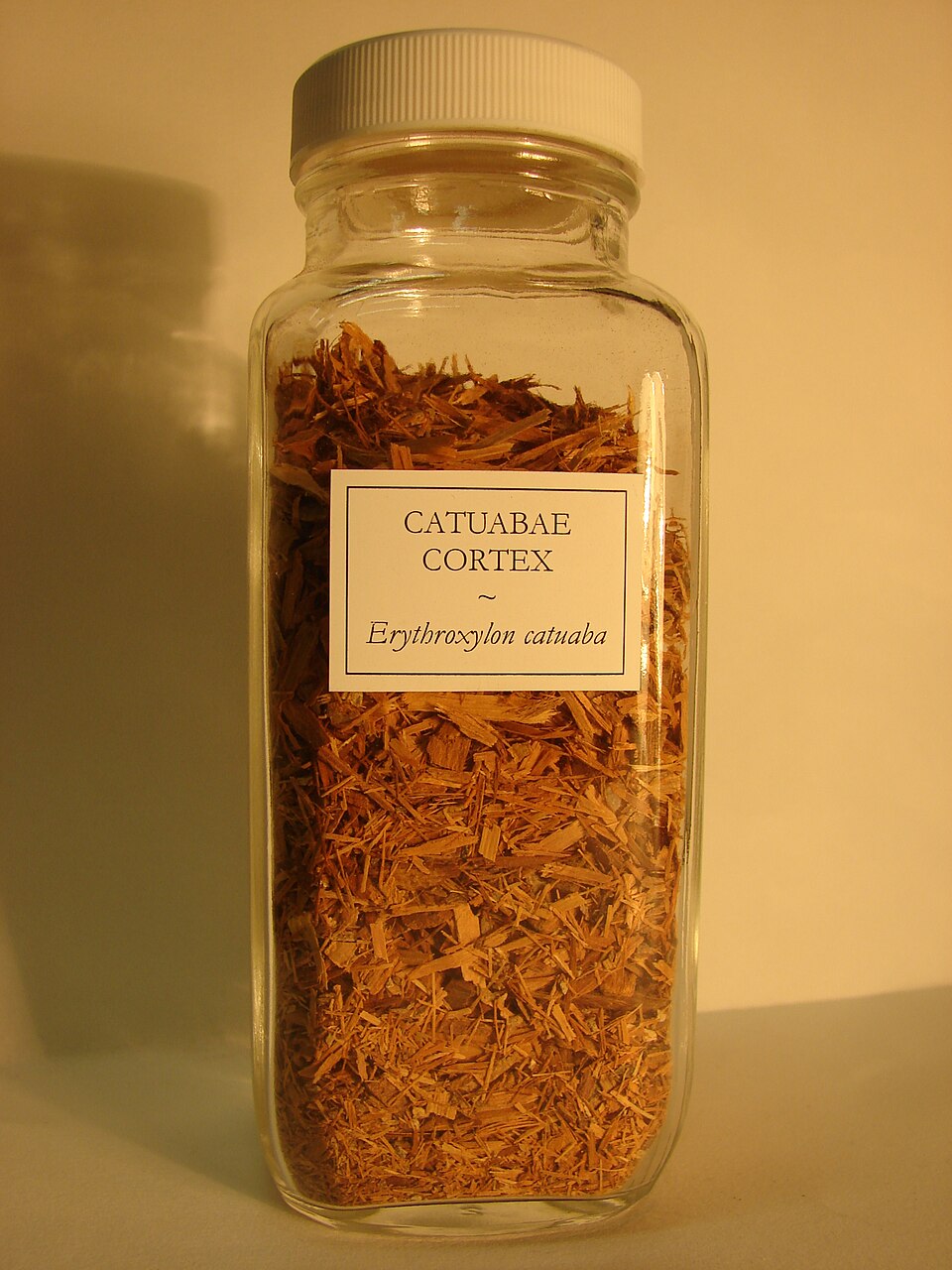
spec sheet10 rows
Catuaba is a common name for the bark of several Brazilian trees, most often Trichilia catigua and Erythroxylum vaccinifolium, used in folk medicine as an aphrodisiac and general tonic. Prepared traditionally as a bark infusion, it is taken for fatigue, low libido, and nervousness, and is sold internationally as a dietary supplement. Preclinical studies, chiefly on Trichilia catigua, report antidepressant-like, antioxidant, and neuroprotective effects, but there is little clinical evidence in humans, and products vary widely because the name covers more than one plant.
- Traditional libido support
- Mild mood lift
- Energy and anti-fatigue
- Antioxidant activity
Overview
Catuaba is a common name applied to the bark of several unrelated Brazilian trees rather than to a single plant, and it is one of the best-known aphrodisiac and tonic herbs of Brazilian folk medicine [2]. The name, of Guarani origin, refers to the medicinal bark preparation itself; the two species most often sold and studied as catuaba are Trichilia catigua, of the mahogany family Meliaceae, and Erythroxylum vaccinifolium, of the coca family Erythroxylaceae, though barks from genera such as Anemopaegma and Ilex are also traded under the same name [2]. An often-cited species name, Erythroxylum catuaba, was described only once, in 1904, and is not recognized as valid today.
In traditional use, catuaba bark is prepared as an infusion and taken as an aphrodisiac and mild central nervous system stimulant, as well as a general tonic for fatigue, sexual weakness, poor memory, and nervousness [2]. It is a common ingredient in Brazilian herbal products, including the multi-herb tonic Catuama, which blends catuaba with guarana, muirapuama, and ginger.
The chemistry of catuaba depends on which plant it comes from. The most thoroughly studied species, Trichilia catigua, is rich in polyphenols, including flavan-3-ols, procyanidins, and characteristic compounds called cinchonains, which are linked to its antioxidant activity [2]. Erythroxylum species, by contrast, contain tropane alkaloids such as the catuabines. This variation in active constituents is one reason catuaba products can differ substantially from one another.
Most scientific study of catuaba has been done on Trichilia catigua in cells and animals. Extracts have shown antidepressant-like effects in rodent models, an action traced largely to increased release and reduced reuptake of the neurotransmitters dopamine and serotonin [1]. Other work reports antioxidant activity, inhibition of the enzymes acetylcholinesterase and monoamine oxidase A, partial antifatigue effects, and protection of brain tissue against oxidative and ischemic damage, findings that lend some support to the plant's traditional use as a neuroactive tonic [2][3][4]. These results, however, come from laboratory and animal experiments; well-designed clinical trials in humans are essentially lacking [2].
Catuaba is sold as a dietary supplement, typically as bark capsules, powders, teas, or tinctures, and is not an approved medicine. Because the name covers multiple species with different chemistry, product quality and content vary. Safety data in humans are limited, and one animal study found that a Trichilia catigua extract impaired early pregnancy in female rats, so caution is warranted during pregnancy and in anyone using it for a specific medical purpose [5].
Mechanism
Because catuaba is not a single plant, its pharmacology is best described for its most-studied source, Trichilia catigua, whose actions have been examined mainly in cells and rodents [1][2]. In tests of antidepressant-like activity, extracts of T. catigua reduced immobility in the forced-swim model, and mechanistic experiments showed that the extract inhibits the reuptake and increases the release of monoamine neurotransmitters, especially and to a lesser extent ; blocking dopamine signaling reversed the effect, pointing to a dopamine-mediated mechanism [1].
The bark's abundant polyphenols, such as cinchonains and procyanidins, act as antioxidants that scavenge free radicals, which is thought to underlie its protection of brain tissue against oxidative and ischemia-reperfusion injury in laboratory models [2][4].
Additional studies found that T. catigua extract inhibits monoamine oxidase A, an enzyme that breaks down neurotransmitters, and , which breaks down , offering a plausible basis for mood-related and memory-related effects [3]. The traditional aphrodisiac reputation of catuaba has not been clearly tied to a defined mechanism, and for Erythroxylum-based catuaba the tropane alkaloids present are a distinct set of active compounds whose actions differ from those of Trichilia [2]. Overall, the neuroactive and antioxidant effects observed in the laboratory provide only a partial and preliminary explanation for the plant's folk uses [2].
receptor fingerprint
reduces
reuptakeinhibits
reuptakeinhibits
/ vascular tonemodulates
Dosingtypical ranges, not medical advice
interested in protocols and clinical dosages? make an account to see them! ^_^
Safetyrisks and cautions, not medical advice
Considered generally safe in traditional use, with little formal toxicity data. Side effects are not well documented but could include mild stimulation or GI upset. Product adulteration and species mislabeling are real concerns, so source quality matters; avoid in pregnancy.
Subjective profileweighing the evidence above
A traditional libido and energy tonic with charming folklore but weak clinical backing; low risk to try.
Resources
This entry is here for reference.
Research
- 2005first citedAntidepressant-like effects of Trichilia catigua (Catuaba) extract: evidence for dopaminergic-m…
- 2018most recentIn vitro multimodal-effect of Trichilia catigua A. Juss. (Meliaceae) bark aqueous extract in CN…
- 1.Antidepressant-like effects of Trichilia catigua (Catuaba) extract: evidence for dopaminergic-mediated mechanisms
- 2.Antioxidant, anticholinesterase and antifatigue effects of Trichilia catigua (catuaba)
- 3.In vitro multimodal-effect of Trichilia catigua A. Juss. (Meliaceae) bark aqueous extract in CNS targets
- 4.Catuaba (Trichilia catigua) prevents against oxidative damage induced by in vitro ischemia-reperfusion in rat hippocampal slices
- 5.The exposure to Trichilia catigua (catuaba) crude extract impairs fertility of adult female rats but does not cause reproductive damage to male offspring
5 listed here; entry last updated August 2026
Reviews
My notesprivate to this device
FAQ
Is catuaba a proven aphrodisiac?
No. The libido reputation is traditional; controlled human evidence is essentially lacking.
Why do sources disagree on the plant?
Several unrelated plants are sold as catuaba, so chemistry and effects vary between products.
Will it give me a buzz?
Some people find it mildly energizing or mood-lifting, but effects are subtle.
Is it safe?
Traditional use suggests low risk, but formal safety data is limited, so use reputable sources and avoid in pregnancy.
Limitations of the evidence
- Human safety data are limited, and most research is from animal and laboratory studies
Notes and cautions
- Products vary widely because catuaba can come from several different plant species
- An animal study found a Trichilia catigua extract impaired early pregnancy, so it is best avoided in pregnancy
- Because it may affect dopamine and other neurotransmitters, caution is sensible alongside medications acting on the brain
- It is sold as a supplement rather than an approved medicine, so quality and content are not guaranteed