
spec sheet11 rows
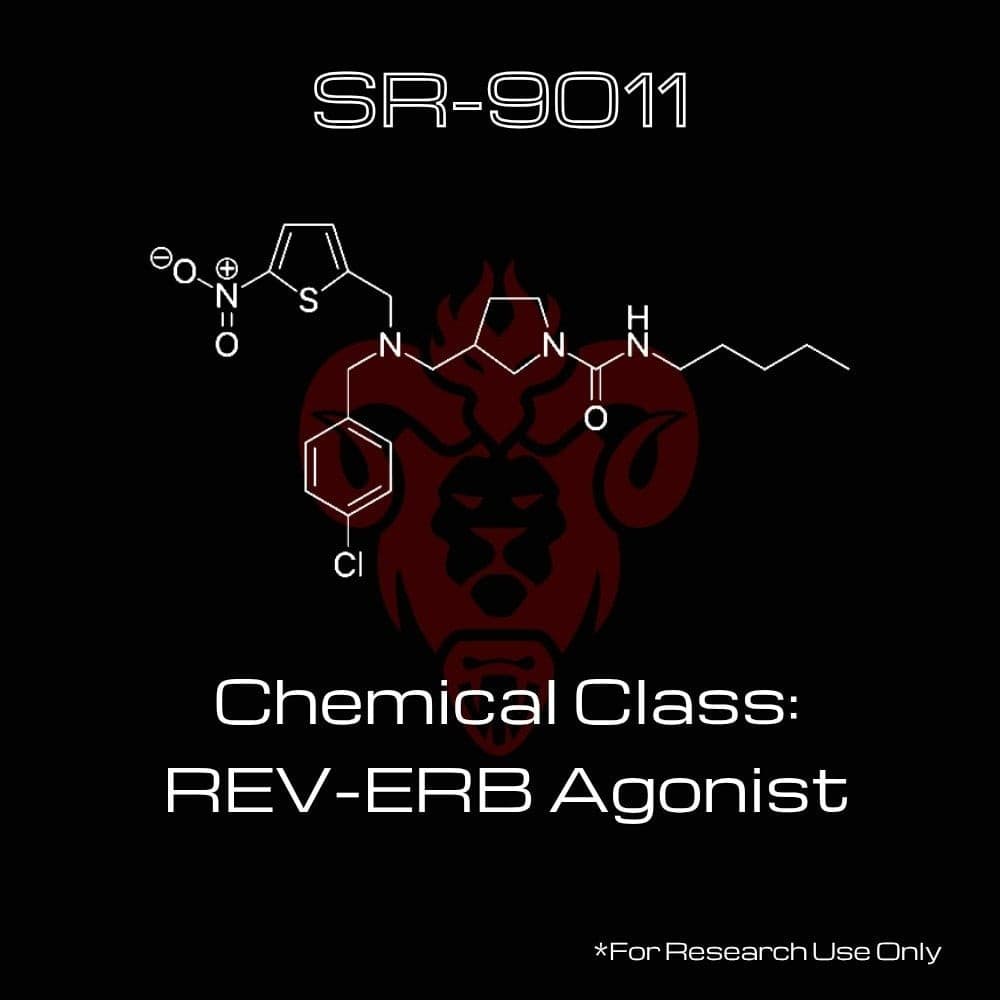
SR-9011 is a synthetic agonist of the REV-ERB nuclear receptors and a close structural analogue of SR-9009. Acting on these circadian clock receptors, it reprograms fuel metabolism across the day, and in rodents it raises energy expenditure and fat oxidation while reducing body weight. It is widely used as a research tool for dissecting how the body clock connects to metabolism, immunity, sleep, and cell proliferation.
- Burned more fat in rodent studies
- Raised daily energy expenditure in animals
- Body weight fell in rodent models
- Reprograms fuel use across the body clock
- Agonist at the REV-ERB circadian receptors
- A favourite tool for clock and metabolism research
- Can disrupt sleep by shifting the clock
Overview
SR-9011 is a synthetic agonist of the REV-ERB nuclear receptors, developed alongside and closely related in structure to SR-9009 in the Scripps program on circadian pharmacology [1]. Like its analogue, it enhances the repressive activity of REV-ERB-alpha and REV-ERB-beta, the clock-linked transcriptional repressors that coordinate rhythms of behavior and metabolism [1].
Its documented research applications are wide-ranging. The foundational report showed that synthetic REV-ERB agonists, including SR-9011, altered circadian behavior and the rhythmic expression of metabolic genes in liver, muscle, and fat, increasing energy expenditure and reducing obesity, dyslipidemia, and hyperglycemia in diet-induced obese mice [1]. Beyond metabolism, SR-9011 has been used to probe immunometabolism in microglia, where it disturbed clock gene rhythms and reduced phagocytosis and mitochondrial respiration [3]; oncology, where REV-ERB agonists were selectively lethal to cancer and senescent cells [2] and suppressed breast cancer cell proliferation [4]; and neuroscience, where REV-ERB agonists regulated sleep architecture and reduced anxiety-like behavior [5].
SR-9011 is an unapproved investigational research chemical with no clinical authorization, and its long-term metabolic effects in humans are unknown [1][3]. Like SR-9009 it is prohibited in sport, and analytical studies have characterized the metabolites of both compounds to support doping control [6]. It is typically supplied as a research-grade material. Its value is as a chemical probe for the intersection of the circadian clock with metabolism, inflammation, sleep, and cell growth, a set of connections it helped to reveal [1][2][5].
- SR-9011 and its sibling SR-9009 were among the first compounds shown to shift the body's circadian clock with a small molecule, altering when metabolic genes switch on across the day.
- In diet-induced obese mice, REV-ERB agonists of this class reduced fat mass and improved blood lipids and glucose without changes in food intake.
- REV-ERB agonists have been reported to selectively kill certain cancer and senescent cells while sparing normal cells, a finding that surprised researchers.
Mechanism
SR-9011 binds and activates the REV-ERB nuclear receptors, which are transcriptional repressors at the core of the molecular clock. By augmenting REV-ERB activity, it represses core clock genes such as Bmal1 and the downstream metabolic and inflammatory genes under circadian control, shifting the daily program of gene expression in both the brain and peripheral tissues [1]. This is the same mechanism that defines its analogue SR-9009, and the two are frequently studied together [1][6].
The metabolic effects that make SR-9011 notable follow from this clock reprogramming. In the foundational study, treatment altered the circadian expression of metabolic genes across liver, skeletal muscle, and adipose tissue and increased energy expenditure, and in diet-induced obese mice it reduced fat mass and improved dyslipidemia and hyperglycemia [1]. In the broader literature these actions are associated with increased fat oxidation and reduced body weight, which underlies the compound's framing as a metabolic modulator [1].
Because the circadian machinery is woven into immunity, proliferation, and sleep, SR-9011 produces effects well beyond fuel metabolism. In it disrupted clock gene rhythms and decreased phagocytic activity, respiration, and ATP production, illustrating a direct link between the clock and immune cell energetics [3]. REV-ERB agonists including SR-9011 were selectively lethal to malignant and senescent cells and arrested breast cancer cell proliferation by targeting cyclin A, while sparing normal cells [2][4], and pharmacological REV-ERB activation induced wakefulness, reduced REM and slow-wave sleep, and lessened anxiety-like behavior in mice [5]. Human quantitative data do not exist because SR-9011 has not been tested clinically, so the strongest defensible evidence is the increased energy expenditure and reduced adiposity seen in rodent models, tempered by the recognized risk of circadian disruption [1][3].
receptor fingerprint
REV-ERB-alphaagonist
REV-ERB-betaagonist
BMAL1 expressionsuppresses
Lipid metabolism genesmodulates
Dosingtypical ranges, not medical advice
interested in protocols and clinical dosages? make an account to see them! ^_^
Safetyrisks and cautions, not medical advice
No human safety data at all. REV-ERB agonists broadly disrupt circadian and metabolic gene programs, which is inherently risky. Animal work shows sleep disruption. Treat as experimental with unknown long-term harms.
History
SR-9011 emerged from medicinal chemistry work at The Scripps Research Institute in Florida, in the laboratory of Thomas P. Burris, which was developing synthetic ligands to probe the REV-ERB nuclear receptors at the heart of the circadian clock. It was described in a foundational 2012 paper in Nature by Solt and colleagues alongside its close analogue SR-9009, where the two compounds were shown to alter circadian behavior and reprogram metabolism in mice. The stated purpose of the work was to create pharmacological tools that could target the body clock for the study and potential treatment of sleep and metabolic disorders. SR-9011 was never intended as a finished drug and has not undergone clinical development or human trials. It remains, together with SR-9009, a research chemical used to dissect how the circadian machinery connects to fuel metabolism, immunity, and cell proliferation.
Reputation
SR-9011 holds a notable place in circadian biology as one of the first synthetic REV-ERB agonists potent enough to work in living animals, and it helped open an entire field exploring the clock as a druggable target. In rodent studies it is admired for reprogramming daily metabolism, raising energy expenditure, and reducing fat mass, results that have made it a frequent subject of interest among researchers and metabolism enthusiasts. Its value is best understood as that of a research tool: it has taught scientists a great deal about how timing genes govern the body's use of energy. Honesty requires noting that all of its documented effects come from cell and animal experiments, with no human data and a recognized potential to disrupt healthy circadian rhythms. For that reason it is regarded as a compelling scientific probe rather than an established supplement.
Where to buy
Suppliers
Vendors carrying SR-9011, with live product details and codes. Links are affiliate links that support the wiki at no cost to you.
Kimera Chems
SR-9011
Research
- 2012first citedRegulation of circadian behaviour and metabolism by synthetic REV-ERB agonists.
- 2020most recentThe Effect of Rev-erbα Agonist SR9011 on the Immune Response and Cell Metabolism of Microglia.
- 1.Regulation of circadian behaviour and metabolism by synthetic REV-ERB agonists.
- 2.Pharmacological activation of REV-ERBs is lethal in cancer and oncogene-induced senescence.
- 3.The Effect of Rev-erbα Agonist SR9011 on the Immune Response and Cell Metabolism of Microglia.
- 4.Anti-proliferative actions of a synthetic REV-ERBα/β agonist in breast cancer cells.
- 5.Pharmacological targeting of the mammalian clock regulates sleep architecture and emotional behaviour.
- 6.In Vitro Metabolic Studies of REV-ERB Agonists SR9009 and SR9011.
6 listed here; entry last updated August 2026
Reviews
My notesprivate to this device
FAQ
Is SR-9011 safe to take?
No; there is no human safety data and it disrupts core circadian genes. It is a research chemical.
How is it different from SR-9009?
Both are REV-ERB agonists from the same research line; SR-9009 is better known but shares the same experimental status and poor bioavailability.
Will it burn fat?
It increased fat oxidation in mice, but that does not translate to a safe or proven human effect.
Is it legal?
It is not approved for human consumption and is sold only as a research chemical; legality varies by region.
Limitations of the evidence
- No human data yet, research use only
Adverse effects
- Can disrupt sleep by shifting the clock
Notes and cautions
- Long term metabolic effects unknown
- Prohibited in sport