
spec sheet10 rows
SLU-PP-332 is the founding compound of the estrogen-related receptor (ERR) agonist class of exercise mimetics, a synthetic pan-agonist with the highest potency for ERR-alpha. By activating the nuclear receptors that master mitochondrial metabolism, it switches on a genetic program resembling acute aerobic exercise, boosting endurance, mitochondrial function, and fat oxidation in animal models. It is the molecule that opened the door to pharmacologically capturing the benefits of exercise.
- Exercise in a molecule; the original mimetic
- Boosts endurance the way training does
- Turns fat burning way up
- Fires up mitochondria at the master switch
- Orally active in animal studies
Overview
SLU-PP-332 is a synthetic small-molecule agonist of the estrogen-related receptors (ERR-alpha, ERR-beta, and ERR-gamma), a family of orphan nuclear receptors that act as master regulators of mitochondrial metabolism and the transcriptional response to exercise [1][3]. It was identified by the Burris laboratory and collaborators as a pan-ERR agonist with the greatest potency at ERR-alpha, a subtype that had long resisted drug development, and it is described in the literature as an exercise mimetic [1].
Its research applications cluster around metabolism, muscle, and endurance. In the foundational report, SLU-PP-332 increased mitochondrial function and cellular respiration in muscle cells, expanded oxidative type IIa muscle fibers, and enhanced running endurance in mice through an ERR-alpha-dependent acute aerobic exercise gene program [1]. Follow-on work showed that it alleviates metabolic syndrome in diet-induced obese mice, increasing energy expenditure and fatty acid oxidation while reducing fat mass and improving insulin sensitivity [2]. Medicinal chemistry has since mapped the structure-activity relationships of the scaffold to guide next-generation ERR agonists [3], and systematic reviews now treat it, alongside its successor SLU-PP-915, as a prototype exercise-mimetic strategy [4].
SLU-PP-332 is an investigational research compound with no regulatory approval and no human clinical use; it is not a supplement or medicine [1][3]. A practical limitation noted in later research is that it has poor oral bioavailability and has largely been dosed by injection in animal studies, which motivated the development of orally active analogues [4]. Because ERR agonists trigger physiological processes that resemble physical training, they are viewed as relevant to sports drug testing, and analytical methods for detecting SLU-PP-332 and its metabolites have already been reported [5].
- SLU-PP-332 was the first synthetic agonist able to potently activate ERR-alpha, a nuclear receptor long considered difficult to drug.
- In mice it triggered a gene program resembling a bout of aerobic exercise and increased running endurance without any actual physical activity.
Mechanism
SLU-PP-332 works by directly activating the -related receptors, nuclear receptors that control the genes for biogenesis, oxidative phosphorylation, fatty acid oxidation, and the Krebs cycle in tissues with high energy demand such as skeletal muscle and heart [1][3]. Genetic evidence had established that ERRs are essential for the muscle adaptations that improve exercise capacity, but pharmacological activation was difficult because ERRs are constitutively active orphan receptors; SLU-PP-332 overcame this by binding and boosting the activity of all three ERR subtypes, with the strongest effect at ERR-alpha [1].
The result is that the compound induces a transcriptional state resembling acute aerobic exercise without the physical activity itself. In muscle cells it increased function and cellular respiration, and in mice it raised the proportion of oxidative type IIa muscle fibers and enhanced running endurance, effects that were shown to depend specifically on ERR-alpha activation [1]. This acute aerobic exercise gene program includes induction of exercise-responsive genes, and later work confirmed robust induction of markers such as Ddit4 that also rise with treadmill running [4].
These mechanisms produce measurable metabolic benefits. In mouse models of obesity and metabolic syndrome, SLU-PP-332 increased whole-body energy expenditure and fatty acid oxidation, decreased fat mass accumulation, reduced obesity, and improved sensitivity, mirroring the systemic advantages of exercise training [2]. Because it engages the physiological machinery of endurance rather than a stimulant pathway, it does not rely on central nervous system arousal to produce its effects [1][2]. Human quantitative data are not yet available because the compound remains preclinical, so the strongest defensible numbers are the demonstrated increases in endurance, oxidative fiber content, and energy expenditure in rodent studies [1][2], while structure-activity and metabolism research continues to refine the class [3][5].
receptor fingerprint
-related receptors (ERR alpha/beta/gamma)agonist
Fatty acid oxidation / oxidative muscle fibersboosts
Energy expenditure / sensitivityraises
Safetyrisks and cautions, not medical advice
There are no human safety data; SLU-PP-332 is preclinical only. Animal work has not flagged major toxicity, but its effects, dosing, and interactions in people are unknown. Research-only.
History
SLU-PP-332 was developed in the laboratory of Thomas Burris with collaborators spanning Saint Louis University, Washington University in St. Louis and the Salk Institute, emerging from a long effort to find a drug-like activator of the estrogen-related receptors. Genetic studies had shown ERRs to be essential for the muscle adaptations that improve exercise capacity, but they proved difficult to drug because they are constitutively active orphan receptors, and creating potency at the ERR-alpha subtype in particular had been a persistent obstacle.
The breakthrough was reported by Billon and colleagues in 2023 in ACS Chemical Biology, which identified SLU-PP-332 as the first synthetic pan-ERR agonist with its highest potency at ERR-alpha and showed it enhanced endurance in mice. A 2024 follow-up extended these findings to models of obesity and metabolic syndrome. It remains a preclinical compound with no human data.
Reputation
SLU-PP-332 is celebrated as the founding compound of the estrogen-related receptor agonist class of so-called exercise mimetics, the molecule often credited with opening the door to pharmacologically capturing benefits of aerobic training. Its appeal is genuinely striking; by switching on the nuclear receptors that master mitochondrial metabolism, it induced a transcriptional state resembling acute exercise, boosting endurance, oxidative muscle fibers, energy expenditure and fat oxidation in animals without relying on stimulant-style central nervous system arousal.
Because it engages the physiological machinery of endurance rather than appetite suppression, it has attracted intense interest for obesity and metabolic health. The important caveat is that all of this remains in cells and rodents; there are no human efficacy or safety data yet, so its promise, while real, is unproven in people.
Subjective profileweighing the evidence above
Preclinical only, and the exercise-mimetic framing is doing a lot of work; the endurance and fat-burning gene program is real in mice and entirely untested in people. No human safety data, no dosing, no interactions mapped. A research compound, not a fat-loss option.
Where to buy


Suppliers
Vendors carrying SLU-PP-332, with live product details and codes. Links are affiliate links that support the wiki at no cost to you.
| supplier | size | price | $/mg |
|---|---|---|---|
| Moglabslowest | 20mg | $80.00 | $4.00/mg |
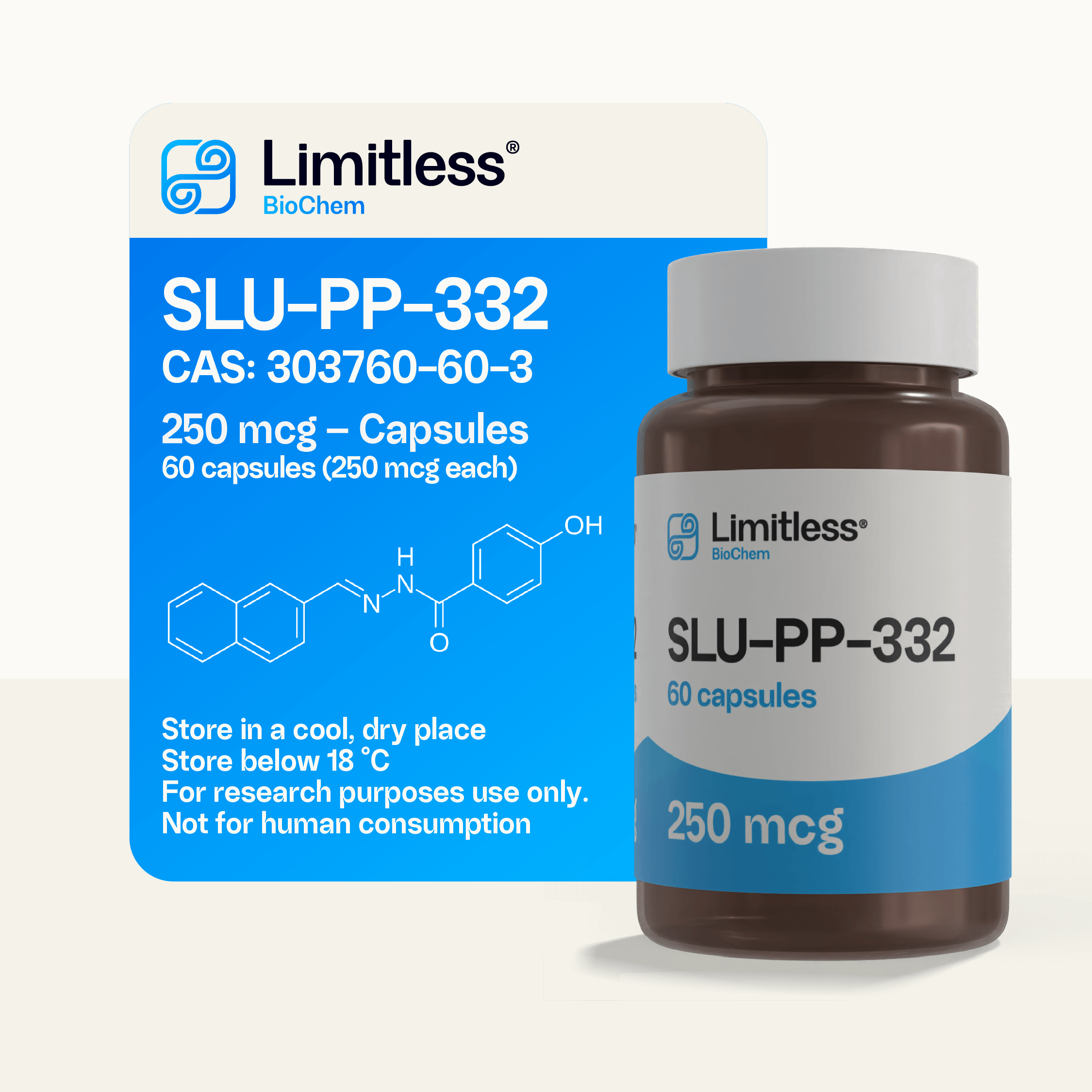
| Limitless Biochem | 250mcg | $95.90 | $383.60/mg |
Kimera Chems
SLU-PP-332
Moglabs
SLU-PP-332
Limitless Biochem🌐
SLU-PP-332
Exceed Enhancement
SLU-PP-332
Research
- 2023first citedSynthetic ERRα/β/γ Agonist Induces an ERRα-Dependent Acute Aerobic Exercise Response and Enhanc…
- 2026most recent[Pharmacological Activation of ERRα/β/γ as an Exercise Mimetic: Potential Therapeutic Applicati…
- 1.Synthetic ERRα/β/γ Agonist Induces an ERRα-Dependent Acute Aerobic Exercise Response and Enhances Exercise Capacity.
- 2.A Synthetic ERR Agonist Alleviates Metabolic Syndrome.
- 3.Chemical optimization of the exercise mimetic SLU-PP-332 enables insight into estrogen-related receptor signaling.
- 4.[Pharmacological Activation of ERRα/β/γ as an Exercise Mimetic: Potential Therapeutic Applications].
- 5.In Vitro Metabolism and Analytical Characterization of SLU-PP-332 and SLU-PP-915: Novel Pan-ERR Agonists With Doping Potential.
- 6.Novel Pan-ERR Agonists Ameliorate Heart Failure Through Enhancing Cardiac Fatty Acid Metabolism and Mitochondrial Function.
- 7.An orally active estrogen receptor-related receptor agonist, SLU-PP-915, enhances aerobic exercise capacity.
- 8.Estrogen-Related Receptor Agonism Reverses Mitochondrial Dysfunction and Inflammation in the Aging Kidney.
- 9.Development and pharmacological evaluation of a new chemical series of potent pan-ERR agonists, identification of SLU-PP-915.
- 10.The Estrogen Receptor-Related Orphan Receptors Regulate Autophagy through TFEB.
- 11.Nuclear Receptor-Targeted Therapies: Reprogramming Metabolism with TRβ, ERRα, and LXR Modulators.
- 12.Analysis and Identification of In Vitro Metabolites of Exercise Mimetic SLU-PP-332 ERRα/β/γ Agonist for Doping-Control Purposes.
13 listed here; entry last updated August 2026
Reviews
My notesprivate to this device
FAQ
What is SLU-PP-332?
It is an experimental compound that activates the ERR (estrogen-related receptor) pathway, sometimes called an exercise mimetic. It is orally active in animal studies.
What does the research show?
In rodents it has boosted endurance and fat metabolism. Human data is essentially absent.
Is it safe for people?
Its human safety is unknown because it has not been tested clinically. It should be treated as purely experimental.
Is it an approved supplement or drug?
No, it is a research compound only. It is not approved for human use.
Limitations of the evidence
- No human data yet, research use only
Notes and cautions
- Human effects still unknown
- Long term effects unstudied
- Flagged as relevant to sports doping control