
spec sheet11 rows
SR-9009, also known as Stenabolic, is a synthetic agonist of the nuclear receptors REV-ERB-alpha and REV-ERB-beta, core repressive components of the circadian clock that link the body's timekeeping to metabolism. By activating REV-ERB, it reprograms clock and metabolic gene expression across the hypothalamus, liver, skeletal muscle, and adipose tissue; in mice it increases energy expenditure, reduces fat mass, improves dyslipidemia and hyperglycemia, alters sleep architecture, and raises mitochondrial content and endurance capacity through the Rev-erb-alpha to LKB1-AMPK-SIRT1-PGC-1alpha pathway. Pharmacological REV-ERB activation has also proven selectively lethal to cancer cells and oncogene-induced senescent cells by suppressing autophagy and de novo lipogenesis. Studies using conditional REV-ERB knockouts have shown that some of SR-9009's actions persist without the receptors, indicating REV-ERB-independent off-target effects and reinforcing its status as a research tool rather than an approved therapeutic.
- Rewires the body clock to burn fuel
- Endurance and running capacity rose in mice
- Less fat mass, higher energy burn in animals
- Mitochondrial biogenesis in working muscle
- Blood lipids improved across rodent work
- The go to circadian metabolic research tool
- Some off target effects shown in cells
- Could shift circadian rhythm
Overview
SR-9009, popularly called Stenabolic, is a synthetic small-molecule agonist of the REV-ERB nuclear receptors, REV-ERB-alpha and REV-ERB-beta, which are ligand-dependent transcriptional repressors and integral components of the circadian clock [1]. It was developed in the Burris and Kamenecka laboratories at Scripps as a pharmacological tool to target the clock, and it is described in the literature as both a circadian modulator and a metabolic agent [1].
Its research profile is broad. The foundational study showed that synthetic REV-ERB agonists alter circadian behavior and the clock-driven expression of metabolic genes in liver, skeletal muscle, and adipose tissue, increasing energy expenditure and, in diet-induced obese mice, reducing fat mass and improving dyslipidemia and hyperglycemia [1]. Subsequent work extended REV-ERB agonism into inflammation, showing that SR-9009 attenuates experimental colitis by repressing the NF-kappaB/NLRP3 axis [3], into cancer biology, where REV-ERB agonists proved selectively lethal to tumor and senescent cells [2], and into comparative metabolism, where SR-9009 promoted a negative energy balance in fish [4].
SR-9009 is not an approved medicine and has no clinical authorization; it is an investigational research chemical, and a well-documented limitation is its poor oral bioavailability, which restricts its practical use as an oral agent [1][5]. It is nonetheless marketed in illicit performance products, and it is prohibited in sport, with anti-doping laboratories having characterized its metabolites and detected it in black-market preparations [5]. It is typically encountered as a research-grade powder or solution of variable purity. Its interest lies in the striking metabolic and endurance phenotypes it produces in animals by pharmacologically tuning the circadian clock [1][2].
- The natural ligand of the REV-ERB receptors that SR-9009 targets is heme, the same iron-containing molecule that carries oxygen in blood, which links the body's clock directly to its metabolic state.
- Pharmacological REV-ERB activation has been shown to be selectively lethal to cancer cells and to oncogene-induced senescent cells while sparing healthy cells, an effect tied to impaired autophagy and fat synthesis.
Mechanism
SR-9009 acts as an of the REV-ERB nuclear receptors, which sit at the heart of the molecular circadian clock. REV-ERB-alpha and REV-ERB-beta are transcriptional repressors whose natural is heme; by binding these receptors and enhancing their repressive activity, SR-9009 suppresses target genes including core clock components such as Bmal1 and a wide array of metabolic genes [1]. This resets the circadian pattern of gene expression in the and in peripheral tissues, effectively reprogramming the daily rhythm of fuel handling [1].
The metabolic consequences of this reprogramming are the source of SR-9009's appeal. In the landmark study, administration to mice altered the circadian expression of metabolic genes across liver, skeletal muscle, and adipose tissue and increased total energy expenditure; in diet-induced obese animals it decreased fat mass and markedly improved dyslipidemia and hyperglycemia [1]. These changes are accompanied in the broader literature by increased content and enhanced endurance capacity, which is why SR-9009 is described as an exercise mimetic, although its defining datasets are preclinical [1].
REV-ERB activation reaches well beyond metabolism because the clock intersects with inflammation, proliferation, and cell survival. SR-9009 repressed the NF-kappaB/NLRP3 inflammasome axis and attenuated experimental colitis in mice, with the protective effect lost when REV-ERB or NLRP3 was absent, confirming target specificity [3]. REV-ERB agonists including SR-9009 also proved selectively lethal to cancer cells and oncogene-induced senescent cells by impairing and de novo lipogenesis, while sparing normal cells [2]. Human quantitative effect sizes are unavailable because the compound has not undergone clinical trials, so the strongest defensible evidence remains the increased energy expenditure and reduced fat mass documented in rodent models, together with the noted caveat of poor oral and off-target effects seen in some cell studies [1][5].
receptor fingerprint
REV-ERB alpha / betaAgonist that represses clock and metabolic genes
biogenesis (LKB1--PGC-1a axis)Upregulates mitochondrial content in muscle
Pro-inflammatory cytokinesSuppresses IL-6, IL-1b, and MCP-1 output
Dosingtypical ranges, not medical advice
interested in protocols and clinical dosages? make an account to see them! ^_^
Safetyrisks and cautions, not medical advice
SR-9009 (Stenabolic) is a research REV-ERB agonist with no human studies and no regulatory approval; it is not a medicine. It also has very poor oral bioavailability, so oral products are unlikely to deliver meaningful active drug, while injected use is entirely unstudied in people. Because REV-ERB influences circadian and metabolic pathways throughout the body, the effects and risks of chronic use in humans are unknown.
History
SR-9009, popularly called Stenabolic, was developed in the laboratory of Thomas Burris and colleagues at the Scripps Research Institute as a synthetic agonist of the REV-ERB nuclear receptors, and its metabolic effects were reported in a landmark 2012 study in Nature. That work showed that activating REV-ERB in mice reprogrammed circadian and metabolic gene expression, increased energy expenditure, and reduced fat mass, which established the compound as a tool for probing the link between the circadian clock and metabolism. It was created as a research probe rather than a drug candidate, and it has never entered human clinical trials or received approval. Its poor oral bioavailability and evidence of REV-ERB-independent off-target effects reinforce its status as a laboratory reagent, even as it circulates in the performance market as an exercise mimetic.
Reputation
SR-9009 earned its exercise-mimetic reputation honestly in the laboratory, where it raised endurance capacity and mitochondrial content in mice and improved markers of metabolic disease, and that preclinical story is what makes it so interesting to researchers and enthusiasts alike. The scope of REV-ERB biology it has helped reveal is remarkable, spanning metabolism, inflammation, and even selective lethality toward cancer and senescent cells. The candid counterpoint is that essentially all of this evidence is preclinical: there are no human trials, oral bioavailability is poor, and conditional-knockout experiments show some of its effects persist without REV-ERB, indicating off-target activity. It is best appreciated as one of the most instructive circadian research tools available rather than a proven therapeutic.
Subjective profileweighing the evidence above
Skip it, and the reason is almost funny; oral bioavailability is so poor that capsules are unlikely to deliver meaningful drug at all. Every endurance and fat loss result comes from mice, there is no human data, and injecting it instead only trades one unknown for a worse one.
Where to buy

1 other outlet
Suppliers
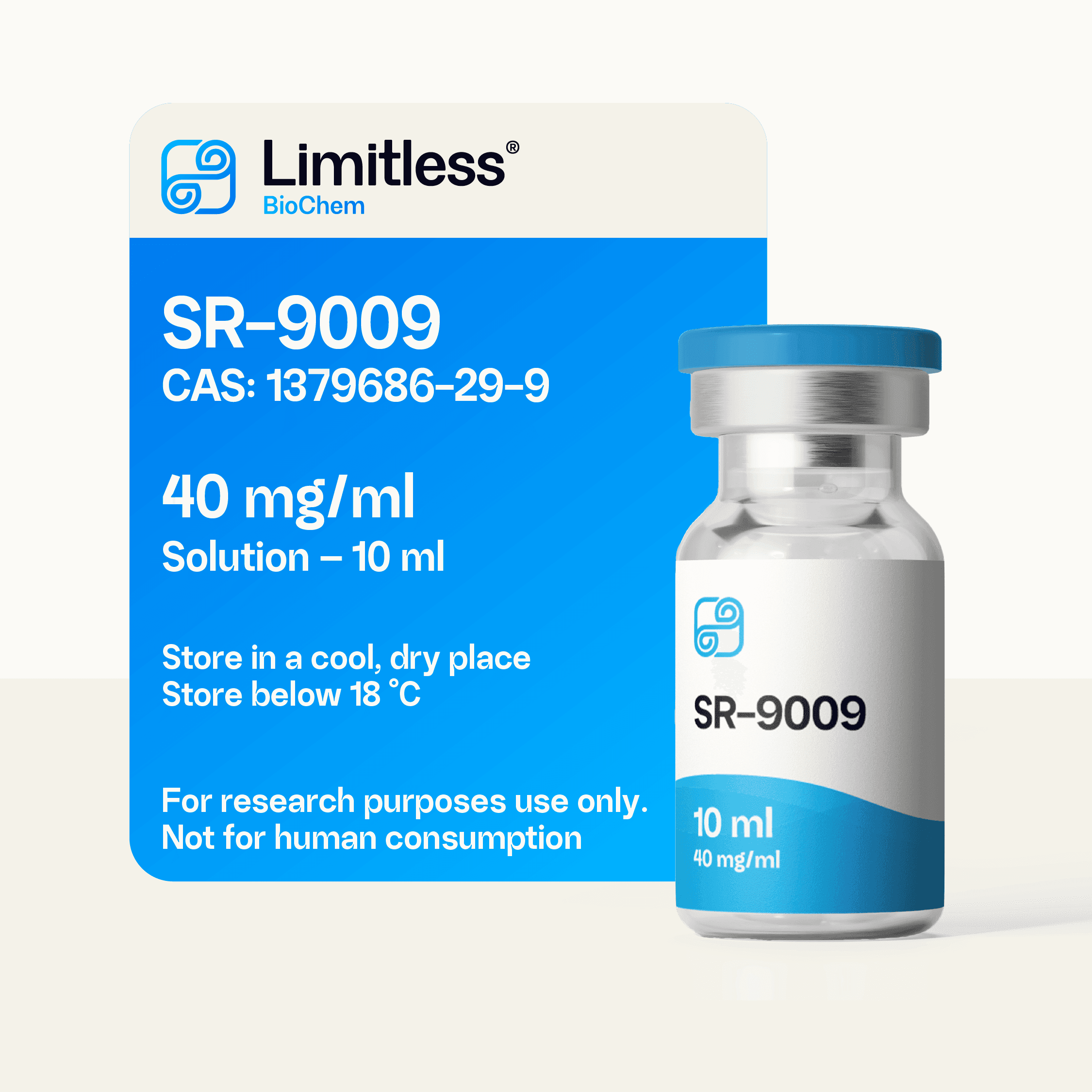
Vendors carrying SR-9009, with live product details and codes. Links are affiliate links that support the wiki at no cost to you.
Kimera Chems
SR-9009
Limitless Biochem🌐
SR-9009
Research
- 2012first citedRegulation of circadian behaviour and metabolism by synthetic REV-ERB agonists.
- 2018most active year3 papers
- 2025most recentThe Circadian Clock Component REV-ERB Is an Analgesic Target for Cancer-Induced Tactile Pain Hy…
- 1.Regulation of circadian behaviour and metabolism by synthetic REV-ERB agonists.
- 2.Pharmacological activation of REV-ERBs is lethal in cancer and oncogene-induced senescence.
- 3.REV-ERBα integrates colon clock with experimental colitis through regulation of NF-κB/NLRP3 axis.
- 4.REV-ERBα Agonist SR9009 Promotes a Negative Energy Balance in Goldfish.
- 5.In Vitro Metabolic Studies of REV-ERB Agonists SR9009 and SR9011.
- 6.Rev-erb-α modulates skeletal muscle oxidative capacity by regulating mitochondrial biogenesis and autophagy.
- 7.SR9009 induces a REV-ERB dependent anti-small-cell lung cancer effect through inhibition of autophagy.
- 8.Pharmacological targeting of the mammalian clock regulates sleep architecture and emotional behaviour.
- 9.REV-ERBβ is required to maintain normal wakefulness and the wake-inducing effect of dual REV-ERB agonist SR9009.
- 10.SR9009 has REV-ERB-independent effects on cell proliferation and metabolism.
- 11.REV-ERB is essential in cardiac fibroblasts homeostasis.
- 12.The Circadian Clock Component REV-ERB Is an Analgesic Target for Cancer-Induced Tactile Pain Hypersensitivity
12 listed here; entry last updated August 2026
Reviews
My notesprivate to this device
FAQ
Is SR-9009 a SARM?
No; it is a REV-ERB agonist, not an androgen receptor compound. It is often lumped in with SARMs by sellers but works through a completely different pathway.
Does oral SR-9009 actually work?
Its oral bioavailability is poor, so oral products likely deliver very little active compound. The original studies used injection in animals.
Has it been tested in humans?
No. Every efficacy and safety finding comes from mice or cell studies, so human effects are unknown.
Why do people split the dose?
The half-life is short, so community users take it multiple times a day to keep levels up. This is anecdotal practice, not a clinical guideline.
Limitations of the evidence
- No human data yet, animal and cell based
Adverse effects
- Some off target effects shown in cells
- Could shift circadian rhythm
Notes and cautions
- Research grade purity varies
- Prohibited in sport