
spec sheet11 rows
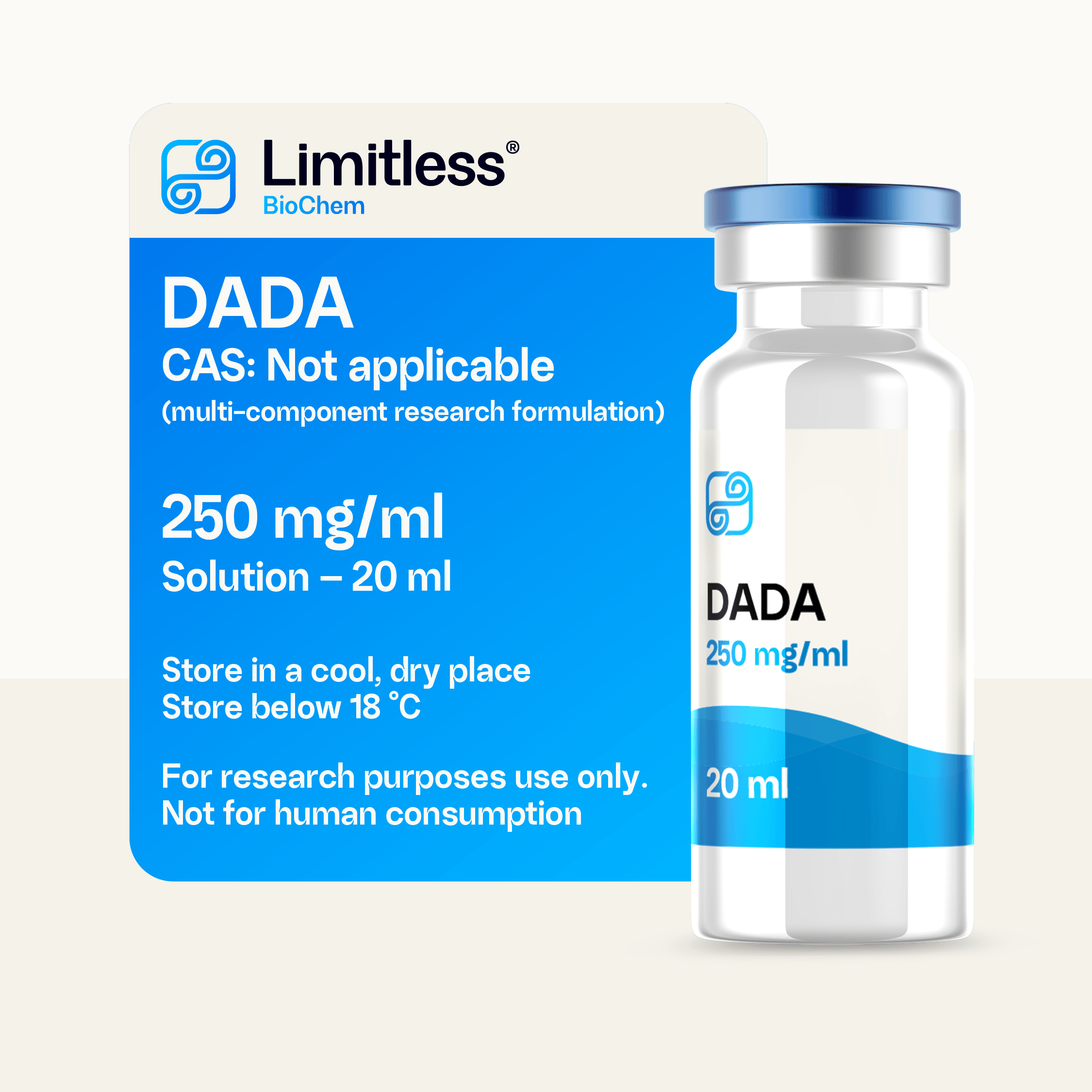
DADA is diisopropylamine dichloroacetate, an old liver drug sold in Japan for decades as Liverall and also sold in the West under the discredited "vitamin B15" or pangamic acid label; it is a simple salt that separates in the body into diisopropylamine and dichloroacetate. The dichloroacetate half blocks an enzyme called pyruvate dehydrogenase kinase, which pushes cells away from making lactate and toward burning fuel in the mitochondria; that single mechanism is why nearly all recent work on it is cancer and immune metabolism research in mice and cell dishes. Human evidence is thin; the only controlled human trial found is a 2005 Chinese study in fatty liver disease that compared 60 mg and 120 mg per day against each other with no placebo group, so it cannot show the drug beats doing nothing. It is not a dopamine drug, has no reported activity at dopamine receptors, and no study of any kind was found testing it for memory, mood, focus, or athletic performance.
- Pushes fuel straight into the mitochondria
- Steers cells away from lactate buildup
- Restored the PDH energy enzyme in models
- Decades of use as a Japanese liver drug
- Small, clean, well-defined molecule
- The dichloroacetate component can cause peripheral nerve effects, such as numbness or tingling, with prolonged use
- Occasional digestive upset
Overview
DADA is the common abbreviation for diisopropylamine dichloroacetate, the diisopropylamine salt of dichloroacetic acid. Chemically it pairs the dichloroacetate anion, the active metabolic component, with a diisopropylamine counter-ion, and it is closely related to the more widely studied compound dichloroacetate (DCA), of which it can be considered a derivative [2]. The dichloroacetate portion is responsible for its defining pharmacology as an inhibitor of pyruvate dehydrogenase kinase.
The compound has a long clinical history in Japan, where it has been marketed for decades as an over-the-counter agent for chronic liver disease, a background that gives it an unusually established safety record for a molecule of continuing research interest [2][6]. Modern investigation was reinvigorated by work at Tokushima University identifying DADA specifically as an inhibitor of pyruvate dehydrogenase kinase 4 (PDK4), the isoform that rises in states of metabolic stress; in a mouse model of severe influenza, DADA restored the activity of the pyruvate dehydrogenase complex and improved survival [1].
Since then DADA has been examined across several fields. In oncology it has been studied for anti-tumor and radiosensitizing effects in breast, esophageal, and lung cancer models, generally exploiting the shift from glycolysis back to mitochondrial oxidation to raise reactive oxygen species and impair tumor growth [2][3][6]. In neurology it has been paired with melatonin to support remyelination in a model of multiple sclerosis [4], and reviews of influenza pathophysiology propose it as a way to correct the mitochondrial energy crisis that drives multiorgan failure [5]. DADA is not an approved drug in Western markets and is used there as a research chemical; it is typically encountered as a crystalline dichloroacetate salt.
- DADA has been sold over the counter in Japan for chronic liver disease for decades, even as it is now being studied afresh as a pyruvate dehydrogenase kinase 4 inhibitor in cancer and severe infection.
- In a breast cancer cell model DADA was more potent than its parent compound dichloroacetate, with a half-maximal inhibitory concentration of about 7.1 millimolar versus about 15.6 millimolar.
Mechanism
The action of DADA turns on a single metabolic checkpoint: the pyruvate dehydrogenase complex (PDH), the gatekeeper enzyme that converts pyruvate, the end product of glycolysis, into acetyl-CoA for full oxidation in the mitochondria. PDH is switched off when pyruvate dehydrogenase kinase (PDK) phosphorylates it. By inhibiting PDK, and in particular the stress-induced isoform PDK4, DADA keeps PDH in its active state, so cells burn pyruvate in the mitochondria rather than diverting it into lactate [1]. The practical consequence is a shift away from inefficient anaerobic glycolysis toward oxidative phosphorylation, with lower lactate production and restored ATP output [1][3].
This metabolic redirection produces different benefits depending on context. In severe influenza, where a surge in PDK4 starves vital organs of energy, DADA restored PDH activity and ATP levels across muscle, heart, liver, and lung and markedly improved survival in infected mice [1]. In cancer, the same forced return to metabolism raises mitochondrial reactive oxygen species and undermines the glycolytic phenotype that many tumors depend on; in a breast cancer model DADA was more potent than its parent dichloroacetate, with a half-maximal inhibitory concentration of about 7.1 millimolar against MDA-MB-231 cells versus about 15.6 millimolar for dichloroacetate, and it suppressed tumor growth more effectively at the same dose [2]. It has also sensitized esophageal cancer cells to radiation by increasing [3].
Beyond infection and oncology, the ability of DADA to relieve PDK4 inhibition of PDH has been used to support fatty acid synthesis and remyelination in a multiple sclerosis model when combined with melatonin [4], and it is discussed as a general strategy to resolve the energy failure seen in metabolic disease [5]. For the user, the appeal is a clean mechanistic story: DADA nudges metabolism back toward efficient fuel use, the same rationale that draws interest from the longevity and mitochondrial-health community, backed by a long real-world track record in liver medicine [1][2].
receptor fingerprint
Pyruvate dehydrogenase kinase 4 (PDK4)Inhibitor
Glucose and lactate metabolismShift toward oxidation
Pyruvate dehydrogenase kinase (PDK; PDK4 emphasised, PDK1 also cited)Inhibitor
Pyruvate dehydrogenase complex (PDH, E1 alpha subunit)Indirect activation, downstream of PDK inhibition
Inhibitor (single old report, unreplicated)
Hepatic energy metabolismModulation
Dosingtypical ranges, not medical advice
interested in protocols and clinical dosages? make an account to see them! ^_^
Safetyrisks and cautions, not medical advice
REPORTED ADVERSE EFFECTS (Japanese Liverall label): headache; abdominal pain, dry mouth, loss of appetite; dry skin, gingival swelling. All listed as infrequent. In the 2005 NAFLD trial (PMID 15727691), 1 of 61 and 1 of 62 patients reported dry mouth (1.6%) over 8 weeks at 60 to 120 mg/d and no serious adverse reactions were recorded. GENOTOXICITY: DADA and its diisopropylamine component are both mutagenic in the Ames Salmonella assay (PMID 6752894); no carcinogenicity bioassay on DADA itself was found. Diisopropylamine is a vasodilator and a Russian clinical paper reports hypotensive activity of DADA in stage I to I-II hypertension (PMID 7047212, no abstract indexed), so a blood pressure effect is plausible but poorly characterised.
CLASS LEVEL CAUTION, LABELLED AS SUCH: chronic sodium dichloroacetate at 12.5 to 25 mg/kg/day causes dose dependent reversible peripheral neuropathy, shown in a randomised controlled MELAS trial stopped early for that reason (PMID 16476929, a DCA study, not a DADA study); DCA is cleared by GSTZ1, inhibits its own clearance, and GSTZ1 haplotype strongly changes exposure. By stoichiometry a 60 mg dose of DADA carries roughly 33 mg of dichloroacetate, about 0.5 mg/kg for a 70 kg adult, which is 25 to 50 times below those trial doses; that arithmetic is the reason label dose DADA is not expected to reproduce DCA neuropathy, but it is arithmetic and not a safety study.
REGULATORY: not a controlled or scheduled substance in any jurisdiction found. United States: no FDA approval; FDA Compliance Policy Guide 457.100 treats pangamic acid and pangamic acid products, which it describes as containing indiscriminate amounts of diisopropylammonium dichloroacetate, as unsafe for food and drug use and as unapproved new drugs, with an import alert dating to 1971. Japan: Japanese Accepted Name and long marketed, but Alfresa Pharma announced discontinuation of Liverall tablets 20 mg and Liverall powder 10% in January 2025 with an effective date of 1 November 2025, so the reference product is being withdrawn.
WADA: DADA and dichloroacetate are not named on the Prohibited List as far as could be checked, but this is UNVERIFIED because WADA's own list PDF and every national mirror tried blocked automated retrieval; S4.4 metabolic modulators is an open ended category, so a competing athlete should not treat "not named" as "permitted" without checking Global DRO. HORSE RACING: diisopropylamine is a prohibited substance in racing, DADA is metabolised to it, and detection methods target that metabolite (PMID 3215480; a 2023 metabolite identification paper, PMID 37459832, covers DIPA rather than DADA and is deliberately not listed as a DADA study above).
History
DADA (diisopropylamine dichloroacetate) is a salt combining diisopropylamine with dichloroacetate, and it has a long real-world history in Japan, where it has been available for decades as an over-the-counter agent for chronic liver disease, marketed under names such as Liverall. Interest in its metabolic mechanism grew as researchers recognized that its dichloroacetate moiety inhibits pyruvate dehydrogenase kinase, shifting cellular metabolism away from lactate and back toward mitochondrial oxidation. In more recent years it has been re-examined specifically as an inhibitor of the stress-induced isoform PDK4, with published work spanning severe infection, cancer, and metabolic disease. This combination of a long over-the-counter track record and renewed mechanistic research gives it an unusual dual profile among metabolic modulators.
Reputation
DADA is viewed favorably in mitochondrial-health and metabolic circles for its clean, well-precedented mechanism: relieving PDK inhibition of pyruvate dehydrogenase to restore efficient oxidative metabolism. Researchers have found it attractive as a more potent relative of dichloroacetate, and recent studies report benefits ranging from improved survival in severe influenza models to enhanced anti-tumor immunity and radiosensitization of cancer cells.
Its decades-long availability in Japan lends a reassuring safety context that many experimental metabolic agents lack. At the same time, honesty requires noting that most of the exciting oncology and infection data come from cell and animal models rather than large human trials, and its established human use is specifically for liver support. It is an elegant metabolic switch with a strong mechanistic rationale and an expanding, still-maturing evidence base.
Subjective profileweighing the evidence above
The mechanism is elegant and it has a long over-the-counter history in Japan for liver disease, but the dichloroacetate half carries dose-dependent peripheral neuropathy on prolonged use, plus unresolved carcinogenicity questions from animal work. Not a compound to run continuously for endurance or metabolic gains.
Where to buy
1 other outlet
Suppliers
Vendors carrying DADA, with live product details and codes. Links are affiliate links that support the wiki at no cost to you.
Kimera Chems
DADA
Limitless Biochem🌐
DADA
Research
- 1982first citedMutagenicity of diisopropylamine dichloroacetate, the "active constituent" of vitamin B15 (pang…
- 2005controlled trial[Diisopropylamine dichloroacetate in the treatment of nonalcoholic fatty liver disease: a multi…
- 2016most active year3 papers
- 2026most recentDADA Enhances CD8+ T Cell Stemness to Improve Anti-Tumor Immunity and Immunotherapy Efficacy.
- 1.Diisopropylamine dichloroacetate, a novel pyruvate dehydrogenase kinase 4 inhibitor, as a potential therapeutic agent for metabolic disorders and multiorgan failure in severe influenza
- 2.Superior anti-tumor efficacy of diisopropylamine dichloroacetate compared with dichloroacetate in a subcutaneous transplantation breast tumor model
- 3.Diisopropylamine dichloroacetate enhances radiosensitization in esophageal squamous cell carcinoma by increasing mitochondria-derived reactive oxygen species levels
- 4.PDK4 Inhibition Ameliorates Melatonin Therapy by Modulating Cerebral Metabolism and Remyelination in an EAE Demyelinating Mouse Model of Multiple Sclerosis
- 5.Energy metabolic disorder is a major risk factor in severe influenza virus infection: Proposals for new therapeutic options based on animal model experiments
- 6.Fenbendazole and Diisopropylamine Dichloroacetate Exert Synergistic Anti-cancer Effects by Inducing Apoptosis and Arresting the Cell Cycle in A549 Lung Cancer Cells
- 7.DADA Enhances CD8+ T Cell Stemness to Improve Anti-Tumor Immunity and Immunotherapy Efficacy.
- 8.[Diisopropylamine dichloroacetate in the treatment of nonalcoholic fatty liver disease: a multicenter random double-blind controlled trial].
- 9.The antitumor effect of diisopropylamine dichloroacetate on non-small cell lung cancer and its influence on the tumor immune microenvironment.
- 10.Synergistic anti-tumor effect of fenbendazole and diisopropylamine dichloroacetate in immunodeficient BALB/c nude mice transplanted with A549 lung cancer cells.
- 11.Mutagenicity of diisopropylamine dichloroacetate, the "active constituent" of vitamin B15 (pangamic acid).
- 12.The detection, pharmacokinetics and behavioral effects of diisopropylamine dichloroacetate (DADA) in the horse: a preliminary report.
14 listed here; entry last updated August 2026
Reviews
My notesprivate to this device
FAQ
What is DADA here?
Based on the vendor listing it is diisopropylamine dichloroacetate, a dichloroacetate-family PDK inhibitor; if a source means a different peptide, be cautious since the name is ambiguous.
What does it do metabolically?
By inhibiting PDK4 it lets pyruvate dehydrogenase run, pushing fuel into mitochondrial oxidation instead of fermenting to lactate.
Is it safe to take?
It is labeled research-only and not for human use; the dichloroacetate class is also linked to peripheral neuropathy with prolonged exposure.
Limitations of the evidence
- Long-term human safety data outside its historical liver-disease use are limited
Adverse effects
- The dichloroacetate component can cause peripheral nerve effects, such as numbness or tingling, with prolonged use
- Occasional digestive upset
Notes and cautions
- Not approved as a drug in Western markets