
spec sheet12 rows
SkQ1 is a mitochondria-targeted antioxidant, a synthetic compound built by attaching the plant antioxidant plastoquinone to a positively charged carrier that accumulates inside mitochondria. Developed by a Russian team led by Vladimir Skulachev, it is designed to neutralize reactive oxygen species at their main source and has been studied for aging and age-related conditions. Its best-known application is a dilute eye-drop formulation approved in Russia to treat dry eye syndrome.
- antioxidant delivered right inside the mitochondria
- registered dry eye drops with controlled trials behind them
- recharged by the respiratory chain rather than used up once
- protects cardiolipin and membrane lipids from peroxidation
- striking protection in animal models of aging; human work is early
- a genuinely novel piece of chemistry, not another vitamin
- as eye drops, possible transient irritation or discomfort
Overview
SkQ1, chemically plastoquinonyl decyltriphenylphosphonium, is a member of a family of so-called SkQ compounds that pair the antioxidant plastoquinone with a lipophilic triphenylphosphonium cation [1]. The positively charged cation, sometimes called a Skulachev ion, is drawn into mitochondria because these organelles carry a strong negative charge relative to the rest of the cell, so the antioxidant is concentrated precisely where much of the cell's reactive oxygen species is generated [1]. The compound was developed by a group at Lomonosov Moscow State University led by the bioenergeticist Vladimir Skulachev [1].
The rationale for SkQ1 grows out of the idea that mitochondrial reactive oxygen species contribute to aging and to a range of age-related pathologies, and that concentrating an antioxidant in mitochondria could counter this more effectively than untargeted antioxidants [1]. In laboratory studies SkQ1 lowers mitochondrial oxidant levels and has been reported to extend lifespan and delay signs of aging in organisms ranging from fungi and invertebrates to fish and mice [3]. In a mouse model of accelerated aging driven by mitochondrial DNA mutations, treatment delayed features such as hair loss, weight loss, and organ damage and modestly lengthened survival [3].
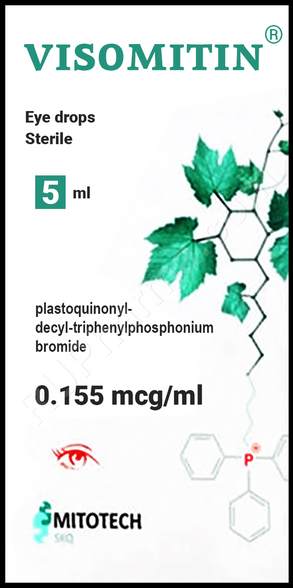
The most developed practical use of SkQ1 is in ophthalmology; a very dilute solution is formulated as eye drops, marketed as Visomitin, for dry eye syndrome [1]. A multicenter, randomized, double-masked, placebo-controlled trial found that these drops improved measures of tear film stability and reduced corneal damage and dry eye symptoms compared with placebo [2]. On the basis of such work the drops were registered in Russia, which led the developers to describe SkQ1 as the first mitochondria-targeted compound to enter medical practice [1].
Beyond the approved eye drops in Russia, SkQ1 remains largely an investigational compound, with much of the evidence for its broader effects coming from animal and cell studies rather than large human trials [3]. It is not an approved systemic medicine in most countries, and its long-term effects in people are not well characterized outside the ophthalmic setting [1].
Mechanism
SkQ1 exploits the electrical properties of mitochondria to deliver an antioxidant to their interior; its triphenylphosphonium cation carries a delocalized positive charge that is driven electrophoretically across the membrane into the negatively charged matrix, accumulating the attached plastoquinone many times over [1]. Once there, the plastoquinone moiety acts as a rechargeable antioxidant, accepting and donating electrons to scavenge reactive oxygen species and to interrupt the chain of lipid peroxidation, including damage to the lipid cardiolipin [3]. By limiting oxidative injury at its source, SkQ1 helps preserve structure and function, which is proposed to slow oxidative components of aging and tissue damage [3]. In the eye, this reduction of on the ocular surface is thought to underlie its benefit in dry eye disease [2].
receptor fingerprint
inner membraneAccumulates via membrane-potential-driven TPP+ targeting
Cardiolipin and membrane lipidsIntercepts lipid peroxyl radicals
NLRP3 inflammasomeSuppresses inflammasome and inflammatory signaling
Dosingtypical ranges, not medical advice
interested in protocols and clinical dosages? make an account to see them! ^_^
Safetyrisks and cautions, not medical advice
SkQ1 is best documented as a topical ophthalmic agent (Visomitin eye drops), where controlled trials in dry eye disease found it generally well tolerated, with the most common complaints being transient eye irritation, burning, or stinging on instillation. It is approved as a drug only in Russia and is otherwise treated as a research-grade material; oral and systemic human safety data are very limited, and mitochondria-targeted antioxidants can in principle shift cellular redox balance or act as pro-oxidants at higher concentrations. It should not replace proven medical care, interactions with other drugs are essentially uncharacterized, and consumer-grade powders lack pharmaceutical quality control, so any systemic use should be regarded as experimental and undertaken only with medical guidance.
History
SkQ1 (10-(6'-plastoquinonyl)decyltriphenylphosphonium) is a mitochondria-targeted antioxidant designed by the Russian bioenergetics researcher Vladimir Skulachev and colleagues at Moscow State University. Building on the Skulachev ion concept, they conjugated the plant antioxidant plastoquinone to a lipophilic triphenylphosphonium cation so that the molecule accumulates selectively within mitochondria, driven by the mitochondrial membrane potential. The approach was formalized in the 2000s, and an eye-drop formulation, Visomitin (Vizomitin), became the first registered drug of this class, approved in Russia in 2012 for dry eye disease.
Reputation
SkQ1 is well regarded within the mitochondrial-medicine and longevity research fields as a leading example of targeted antioxidant delivery, supported by a substantial body of preclinical work and by clinical registration of its ophthalmic formulation in Russia. Outside that context its reputation is more speculative; claims of systemic anti-aging benefit rest largely on animal studies, Western regulatory approval is absent, and human evidence beyond the eye-drop indication is thin, so enthusiasm is tempered by the gap between mechanism and proven systemic outcomes.
Subjective profileweighing the evidence above
Worth taking seriously as registered dry-eye drops, where controlled trials actually exist, and not much beyond that. The anti-aging case is speculative, systemic human safety data is very thin, and consumer-grade powders are not pharmaceutical quality. Buy the eye formulation or leave it alone.
Where to buy

Suppliers
Vendors carrying SkQ1, with live product details and codes. Links are affiliate links that support the wiki at no cost to you.
RUPharma🌐
Visomitin
Research
- 2012first citedWhat is "phenoptosis" and how to fight it?
- 2015controlled trialResults of a Multicenter, Randomized, Double-Masked, Placebo-Controlled Clinical Study of the E…
- 2017most recentImproved health-span and lifespan in mtDNA mutator mice treated with the mitochondrially target…
- 1.What is "phenoptosis" and how to fight it?
- 2.Results of a Multicenter, Randomized, Double-Masked, Placebo-Controlled Clinical Study of the Efficacy and Safety of Visomitin Eye Drops in Patients with Dry Eye Syndrome
- 3.Improved health-span and lifespan in mtDNA mutator mice treated with the mitochondrially targeted antioxidant SkQ1
3 listed here; entry last updated August 2026
Reviews
My notesprivate to this device
FAQ
How does SkQ1 get into mitochondria?
Its positively charged triphenylphosphonium ion is pulled across the inner membrane by the membrane's own voltage, so it piles up inside mitochondria far more than in the rest of the cell.
How is it different from MitoQ?
Both use the same targeting cation, but SkQ1 carries a plastoquinone antioxidant instead of ubiquinone, which gives it a somewhat broader effective window.
What is it actually approved for?
In Russia it is registered as Visomitin eye drops for dry eye; that ophthalmic use has the strongest human evidence.
Is it a proven anti-aging pill?
No. The broad longevity claims come from animal studies; human systemic use is not well established and its oral pharmacokinetics are largely unknown.
Limitations of the evidence
- systemic long-term safety in humans is not well established
Adverse effects
- as eye drops, possible transient irritation or discomfort
Notes and cautions
- most evidence beyond dry eye comes from animal studies