
spec sheet10 rows
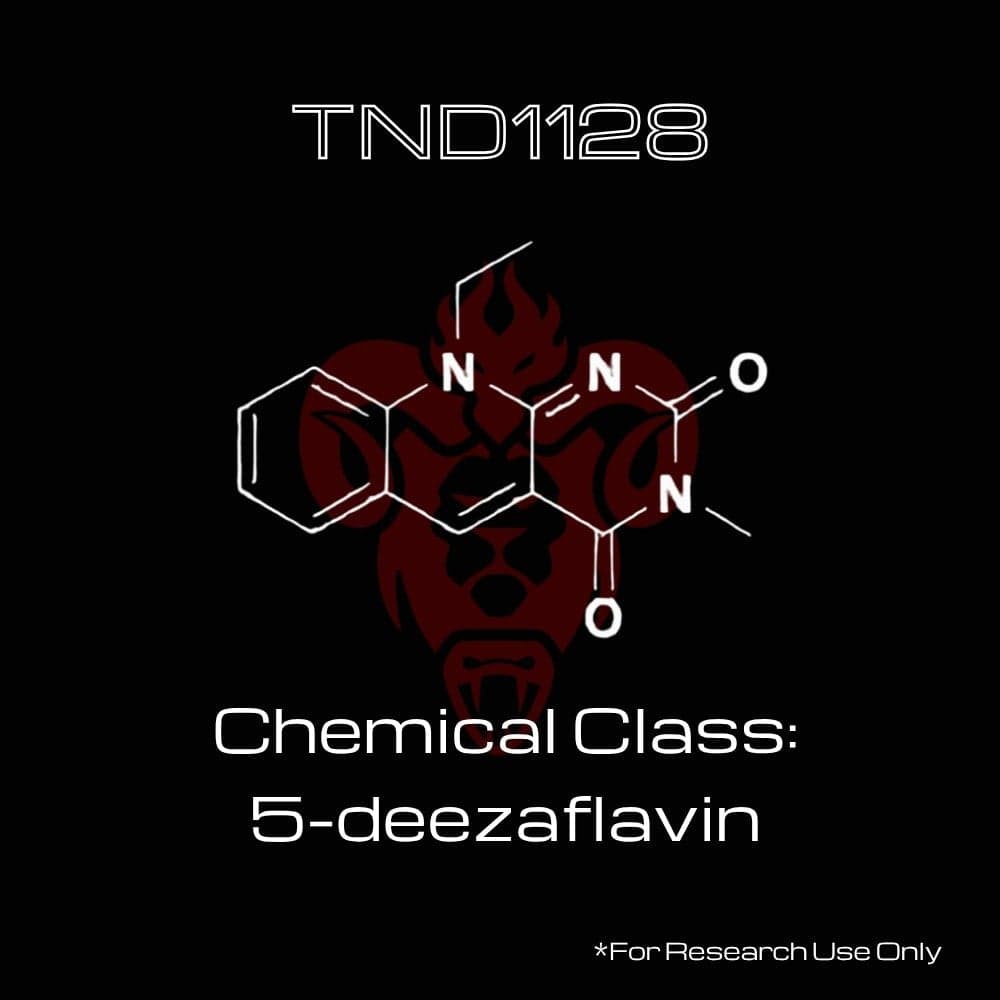
TND-1128 (TND1128) is a lipophilic 5-deazaflavin derivative developed in Japan as a mitochondrial activator with efficient self-redox ability. In preclinical work it enhances mitochondrial membrane potential and on-demand ATP synthesis in mouse brain tissue, and it is being explored as a neuro-energetic agent for conditions linked to mitochondrial dysfunction, including neurodegeneration and depression [1][2].
- Lipophilic 5-deazaflavin built as a mitochondrial activator
- Raised membrane potential and ATP output in mouse brain tissue
- Blunted calcium overload during repeated neuronal firing
- Antioxidant protection in preclinical cell assays
- All data so far are preclinical; human work is ahead
- Genuinely novel Japanese chemistry with real papers behind it
Overview
TND-1128 was engineered by adding lipophilicity to the 5-deazaflavin core so that the molecule can enter cells and reach mitochondria, where its self-redox chemistry can feed electron-transfer reactions. Studies from Tokyo Medical University and collaborators used mouse brain slices to show that pretreatment with TND1128 raises mitochondrial membrane potential and increases an ATP synthesis index in a dose- and time-dependent manner [2].
In a comparative study, TND1128 (0.01-1 mg/kg subcutaneously) mitigated calcium overload in both cytoplasm and mitochondria of neurons during repeated depolarising stress, and at these low doses it outperformed beta-NMN (nicotinamide mononucleotide) on mitochondrial calcium handling [1]. The authors framed TND1128 as a candidate for rescuing deteriorating neurons in aging and in diseases such as Alzheimer type dementia.
Additional preprint work reports that TND1128 and hybrid analogs are cytoprotective against hydrogen peroxide induced oxidative stress [3]. All current evidence is preclinical; there are no human clinical trials, and the antidepressant and neuroprotective framing derives from mechanism and animal-tissue findings rather than from patient data.
- In mouse brain slices, TND1128 improved mitochondrial calcium handling at doses far lower than the NMN it was compared against.
- The compound is essentially a 'drug-ified' version of a natural microbial redox cofactor, made lipophilic so it can reach mitochondria.
Mechanism
TND-1128 retains the two-electron, hydride-transfer redox chemistry of the 5-deazaflavin scaffold and, owing to added lipophilicity, distributes into cells and mitochondria [1]. There it is proposed to integrate with the tricarboxylic acid cycle and electron transport chain, facilitating polarization of membrane potential and enhancing on-demand ATP synthesis [2]. By improving energy status and stabilising calcium handling, it reduces the calcium overload that accompanies excitotoxic or depolarising stress in neurons [1]. Its self-redox capacity also confers antioxidant, cytoprotective effects against reactive oxygen species [3].
receptor fingerprint
membrane potentialfacilitates polarization
On-demand ATP synthesisincreases
calcium overloadmitigates
Dosingtypical ranges, not medical advice
interested in protocols and clinical dosages? make an account to see them! ^_^
Safetyrisks and cautions, not medical advice
TND-1128 is an experimental, preclinical compound. Its safety has been assessed only in cell and rodent-tissue studies at low milligram-per-kilogram doses; there are no human safety, tolerability or long-term data. Purity, dosing and interactions for human use are undefined, and it should be regarded as a research chemical rather than a validated supplement. Anyone considering it should recognise the absence of clinical evidence and consult a healthcare professional.
History
TND-1128 emerged from Japanese medicinal chemistry efforts to turn the naturally redox-active 5-deazaflavin scaffold into a cell-permeable mitochondrial activator. Groups associated with Tokyo Medical University, Sojo University and Kumamoto Kinoh Hospital published the principal characterisations between 2022 and 2024, motivated by the idea that reactivating dysfunctional mitochondria could slow neuronal decline in aging and neuropsychiatric disease.
Reputation
In nootropic circles TND-1128 is discussed as a cutting-edge mitochondrial enhancer, sometimes compared favourably with NMN for neuronal energy support based on the low-dose rodent findings. That reputation rests on a small but coherent Japanese preclinical literature; it has no clinical validation, and marketing claims about mood or cognition in humans are extrapolations.
Subjective profileweighing the evidence above
Interesting mitochondrial chemistry with three studies behind it, all preclinical, and no human safety, dosing or interaction data of any kind. Nothing about it is ready to be taken; this is a research compound, not a supplement.
Where to buy
Suppliers
Vendors carrying TND-1128, with live product details and codes. Links are affiliate links that support the wiki at no cost to you.
Kimera Chems
TND-1128
Research
- 1.Effects of TND1128 (a 5-deazaflavin derivative), with self-redox ability, as a mitochondria activator on the mouse brain slice and its comparison with β-NMN.
- 2.TND1128, a 5-deazaflavin derivative with auto-redox ability, facilitates polarization of mitochondrial membrane potential (ΔΨ(m)) and on-demand ATP synthesis in mice brain slices.
- 3.5-Deazaflavin (TND1128) and its hybrid analogs are cytoprotective against hydrogen peroxide-induced oxidative stress (preprint, 2024)
3 listed here; entry last updated August 2026
Reviews
My notesprivate to this device
FAQ
Is TND-1128 approved or clinically studied in humans?
No. All published work is in cells and rodent brain tissue; there are no human clinical trials.
How does it differ from NMN?
NMN is an NAD+ precursor, while TND-1128 is a redox-active deazaflavin that acts more directly on mitochondrial electron transfer; in low-dose rodent tissue it affected mitochondrial calcium handling more than NMN.
Limitations of the evidence
- No human data: Side-effect profile in people is entirely unknown.
Notes and cautions
- Research-grade uncertainty: Sourcing, purity and dosing are not standardised.