
data + articles · 14 listed
newest 2023spec sheet12 rows
J-147 J147 is an experimental neuroprotective compound that grew out of a curcumin-like scaffold, designed at the Salk Institute through phenotypic screens that mimic the aging brain rather than any single Alzheimer's protein. In mice it is potent, orally active, and brain-penetrant: it enhances memory, raises the neurotrophic factors BDNF and NGF, and can rescue cognition even when given late, after pathology is already advanced. Its molecular target was a mystery for years until 2018, when it was identified as the mitochondrial ATP synthase; gently modulating that enzyme flips on the AMPK/mTOR longevity pathway, tying Alzheimer's and ordinary brain aging to a shared mechanism. Crucially, essentially all of this is preclinical; a phase 1 safety study was reportedly initiated but no human efficacy results have been published. Treat J147 as a promising research compound, not a proven drug.
- Purpose-built for the aging brain
- Memory gains in animal models
- Raises BDNF and NGF, the brain's growth factors
- Tunes mitochondrial ATP synthase, a novel target
- Strong antioxidant neuroprotection
- Curcumin-derived, orally active, brain-penetrant
- Perturbs mitochondrial function at high concentrations (cell toxicity only at high doses)
Overview
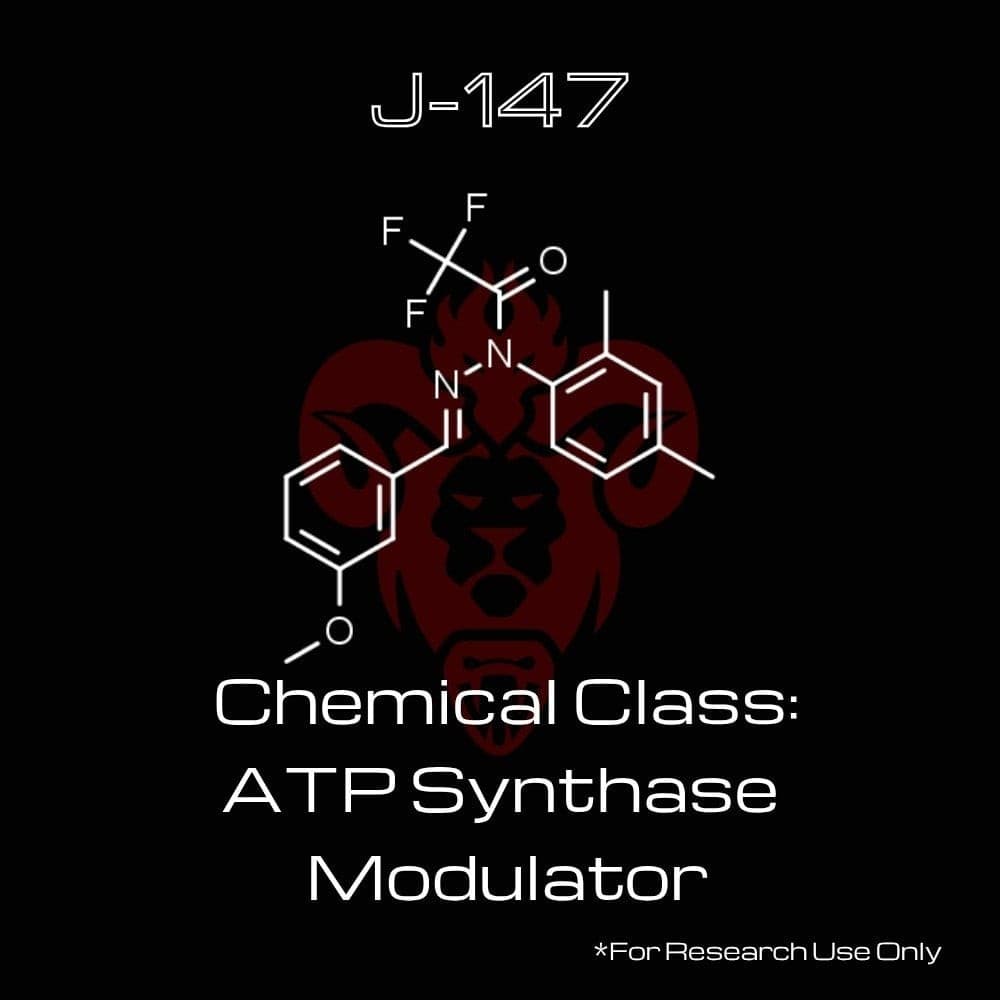
J-147 is a synthetic small molecule developed at the Salk Institute as an experimental therapeutic for Alzheimer's disease and the cognitive decline of aging. It was created by chemical optimization of curcumin, the active component of turmeric, and its immediate parent compound CNB-001; the goal was to keep curcumin's neuroprotective activity while producing a more potent, orally bioavailable, and brain-penetrant molecule. Chemically, J-147 is a phenyl hydrazide, systematically named (E)-N-(2,4-dimethylphenyl)-2,2,2-trifluoro-N'-(3-methoxybenzylidene)acetohydrazide [5].
What distinguishes J-147 is the strategy behind its discovery. Instead of designing against a single disease target such as amyloid-beta, its developers used phenotypic screens based on the brain toxicities associated with old age, on the premise that aging itself is the primary risk factor for Alzheimer's disease. In rapidly aging SAMP8 mice, J-147 reduced cognitive deficits while restoring numerous molecular markers of human Alzheimer's pathology, vascular dysfunction, impaired synaptic function, and inflammation toward a younger phenotype [1]. It also enhanced memory, improved dendritic architecture, and stimulated cell division in the neurogenic regions of very old mouse brains, and its derivative CAD-031 was optimized to extend this neurogenic activity [2].
Mechanistic work later identified the molecular target of J-147 as the mitochondrial ATP synthase, placing it within a broader effort to treat dementia through mitochondrial and metabolic pathways [3][4][6]. J-147 has been widely discussed as an anti-aging and nootropic candidate, but it is an investigational compound; it has not completed the clinical trials required for approval and is not an approved medicine.
- J-147 was engineered from the curcumin molecule but is far more potent and stable, and unlike curcumin it is well absorbed when taken orally.
- It was discovered by screening for protection against the toxicities of old age rather than against amyloid, the target that dominated Alzheimer's drug research for decades.
- Detailed target hunting traced its wide-ranging effects to a single protein, the mitochondrial ATP synthase, the cell's molecular machine for making ATP.
Mechanism
J147 is a synthetic molecule loosely derived from curcumin, but it was not chosen for any curcumin-like chemistry; it was pulled out of phenotypic screens built to mimic the toxicities of the aging brain, such as , energy failure, and protein toxicity. In aged Alzheimer's-model mice it is orally active and brain-penetrant, and, unusually, it rescues memory even when dosing starts after pathology is advanced; that benefit tracks with induction of the neurotrophic factors and and several BDNF-responsive proteins tied to learning [1]. Independent toxicology work characterized it as a broad-spectrum neuroprotective phenyl hydrazide with a wide therapeutic window between its neuroprotective/neurotrophic potency and any cellular toxicity [2].
For years J147's actual target was unknown. In 2018 it was identified as the alpha-F1-ATP synthase (ATP5A), the enzyme (complex V) that makes cellular ATP [3]. Rather than shutting the enzyme down, J147 modestly inhibits it; this nudges up intracellular calcium, which through CAMKK2 sustains activation of the / pathway, a longevity mechanism conserved from worms to mammals [3][4]. By modulating the ATP synthase, J147 preserved homeostasis, prevented age-associated drift of the hippocampal transcriptome and plasma metabolome, and even extended lifespan in fruit flies [3]. The finding fit a broader view that the ATP synthase itself is a shared, and under-appreciated, drug target linking dysfunction in aging and dementia [5].
Downstream, J147 looks like a metabolic drug as much as a neuro drug. In rapidly aging SAMP8 mice it reduced cognitive, metabolic, and transcriptional markers of brain aging by regulating acetyl-CoA metabolism, inhibiting acetyl-CoA carboxylase 1 (ACC1), raising acetyl-CoA and boosting memory-linked histone H3K9 acetylation [6]. It also stimulates cell division in the brain's germinal zones and improves dendritic structure in very old mice, which is why an optimized derivative (CAD-031) was pursued for [7]. The same /ACC1 switch shows up in the periphery: J147 lowers blood free fatty acids by acting on the liver, a candidate biomarker of target engagement [8]. Other rodent studies report antidepressant- and anxiolytic-like effects tied to increased brain monoamines and monoamine-oxidase-A inhibition at higher doses [9], and J147-derived analogues can inhibit beta-amyloid aggregation and toxicity in vitro [10]. The parent molecule's structure has been solved by crystallography [3], and its breadth across neurological models is summarized in a narrative review [6].
What is missing is people. Almost everything above is mouse, fly, or cell-culture data; a phase 1 human safety study was reportedly initiated, but no human efficacy results have been published, so any claim about what J147 does in humans is currently unproven [6].
receptor fingerprint
ATP synthase (alpha-F1 / ATP5A, complex V)modest inhibition / modulation
/ neurotrophic signalinginduces
Acetyl-CoA / ACC1 metabolismraises acetyl-CoA (ACC1 inhibition)
/ oxytosisprotects
Beta-amyloid aggregation (analogues)reduces (in some studies)
Dosingtypical ranges, not medical advice
interested in protocols and clinical dosages? make an account to see them! ^_^
Safetyrisks and cautions, not medical advice
J147 has essentially no human safety data; it is a research-use-only compound. Its preclinical profile looks benign, with a wide margin between neuroprotective doses and any cellular toxicity, and it was not genotoxic in standard assays [2]; the main flag is that, at high concentrations, it does perturb mitochondrial function, which is unsurprising given its target is the ATP synthase [2][3]. But 'clean and potent in mice' is not 'safe in people'. Pharmacokinetics, tolerability, drug interactions, and long-term effects in humans are unknown, and reliable, well-characterized material is hard to obtain. Treat it as an experimental chemical, not a supplement, and skip it entirely in pregnancy or breastfeeding for lack of any data.
History
J-147 was created in the laboratory of David Schubert and Pamela Maher at the Salk Institute for Biological Studies as part of a deliberate effort to design neuroprotective drugs for Alzheimer's disease and brain aging. Rather than screening against amyloid, the team optimized compounds in cell-based assays that model the toxicities associated with old age, and J-147 emerged as a potent, orally active derivative of the curcumin scaffold, first reported around 2011. Subsequent work demonstrated that in aged Alzheimer's-model mice it enhanced memory, improved dendritic architecture, and stimulated the birth of new neurons, effects rarely seen with conventional candidates.
A major advance came when target-identification studies traced its activity to the mitochondrial alpha-F1-ATP synthase, linking its broad benefits to a single, well-defined molecular target and to the AMPK-mTOR energy-sensing axis associated with longevity. This mechanistic clarity distinguished it from the many Alzheimer's candidates whose actions remain diffuse. J-147 has been advanced toward clinical development, and it remains an investigational compound rather than an approved medicine.
Reputation
J-147 has earned considerable interest among researchers of aging and neurodegeneration for taking a fundamentally different route to neuroprotection than the amyloid-focused drugs that dominated the field. Its appeal lies in a compelling package of preclinical results: improved memory, healthier dendritic structure, restored markers of vascular and inflammatory health, and the unusual ability to stimulate neurogenesis in the aged brain.
Perhaps most persuasive is that these varied effects were eventually tied to one molecular target, the mitochondrial ATP synthase, giving the compound a coherence that many experimental neuroprotectants lack. By engaging the shared mitochondrial biology of aging, it mimics aspects of caloric restriction at the level of cellular energy sensing. It is honest to emphasize that this evidence is preclinical; efficacy and safety in humans have not been established. As a mechanistically distinct, well-characterized research candidate, however, it remains a genuinely intriguing prospect.
Subjective profileweighing the evidence above
One of the more compelling preclinical neuroprotection stories going, with an identified target and late-stage rescue in aged mice; none of that is human evidence. It perturbs mitochondria at high concentrations, and sourcing well-characterised material is its own problem. Experimental, not a longevity staple.
Where to buy
Suppliers
Vendors carrying J-147, with live product details and codes. Links are affiliate links that support the wiki at no cost to you.
Kimera Chems
J-147
Research
- 2013first citedThe neurotrophic compound J147 reverses cognitive impairment in aged Alzheimer's disease mice
- 2023most recentCurrent evidence for J147 as a potential therapeutic agent in nervous system disease: a narrati…
- 1.A comprehensive multiomics approach toward understanding the relationship between aging and dementia.
- 2.Selecting for neurogenic potential as an alternative for Alzheimer's disease drug discovery.
- 3.ATP Synthase, a Target for Dementia and Aging?
- 4.Elevating acetyl-CoA levels reduces aspects of brain aging.
- 5.The structure of the anti-aging agent J147 used for treating Alzheimer's disease.
- 6.ATP synthase and Alzheimer's disease: putting a spin on the mitochondrial hypothesis.
- 7.The mitochondrial ATP synthase is a shared drug target for aging and dementia
- 8.Targeting of intracellular Ca2+ stores as a therapeutic strategy against age-related neurotoxicities
- 9.The neurotrophic compound J147 reverses cognitive impairment in aged Alzheimer's disease mice
- 10.J-147 a Novel Hydrazide Lead Compound to Treat Neurodegeneration: CeeToxSafety and Genotoxicity Analysis
- 11.The Alzheimer's disease drug candidate J147 decreases blood plasma fatty acid levels via modulation of AMPK/ACC1 signaling in the liver
- 12.Activation of monoaminergic system contributes to the antidepressant- and anxiolytic-like effects of J147
14 listed here; entry last updated August 2026
Reviews
My notesprivate to this device
FAQ
How is it related to curcumin?
It's a synthetic derivative designed to improve on curcumin's stability and brain effects. It targets aging-related pathways.
What did animal studies find?
In Alzheimer's models it supported mitochondrial function and memory. These are promising but preclinical results.
Is it an approved drug?
No, it's an investigational research compound. Human data are limited.
What does it target?
It's studied for mitochondrial support and neuroprotection in the aging brain. Its mechanisms are still being characterized.
What is J147?
A curcumin-inspired synthetic compound designed at the Salk Institute to fight the aging brain and Alzheimer's; it's neuroprotective and boosts BDNF. All the promising data is from mice, flies, and cells.
What's its target?
For years nobody knew; in 2018 it was pinned to the mitochondrial ATP synthase. Gently dialing that enzyme down nudges the AMPK/mTOR longevity pathway, the same pathway tied to lifespan across species.
Is there human data?
Essentially none. A phase 1 safety trial was reportedly started, but no human efficacy results have been published, so treat it as a research compound, not a proven drug.
How is it different from curcumin?
It was built off a curcumin-like scaffold but is far more stable, orally bioavailable, and brain-penetrant; it isn't just 'curcumin', and its main action (hitting ATP synthase) isn't curcumin's.
Can I take it?
It's a research chemical with no established human dose, safety, or purity standards. Not a supplement.
Limitations of the evidence
- Human safety data are limited, and most evidence is from mice and cell studies
- Long-term effects in humans are unknown
- No human safety data
- Pharmacokinetics and long-term effects in people unknown
Adverse effects
- Perturbs mitochondrial function at high concentrations (cell toxicity only at high doses)
Notes and cautions
- An investigational compound that has not completed clinical trials
- It is not an approved medicine
- Purity and contents of research-chemical products are not guaranteed
- Research-chemical purity varies by source
- Not a supplement; experimental compound