
spec sheet12 rows
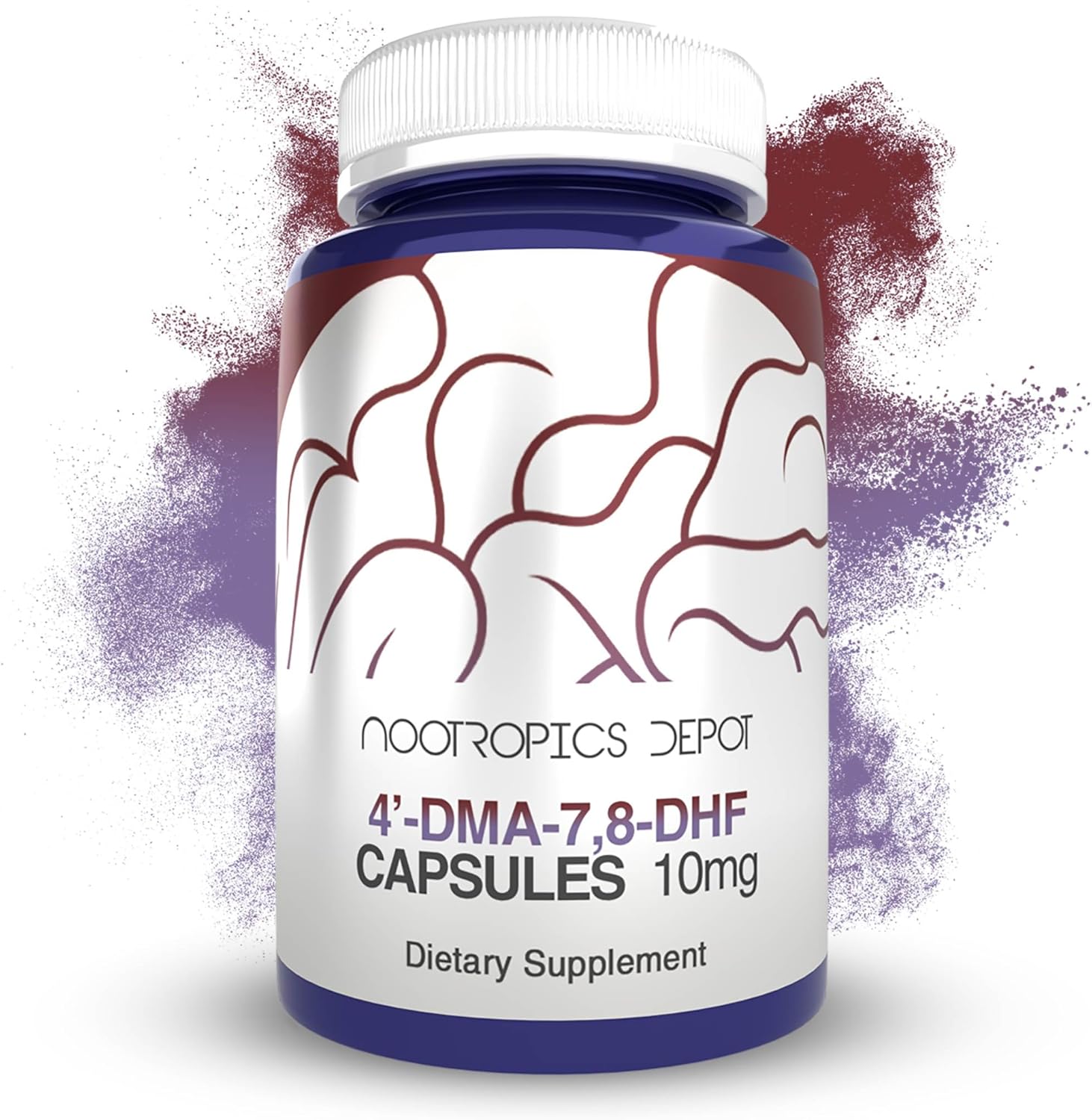
Eutropoflavin is a synthetic flavonoid studied as a selective agonist of TrkB, the receptor for brain-derived neurotrophic factor (BDNF). Chemically known as 4'-dimethylamino-7,8-dihydroxyflavone, it is a modified and more potent derivative of tropoflavin (7,8-dihydroxyflavone). In animal experiments it activates TrkB more strongly and for longer than its parent compound and shows neuroprotective, neurogenic, and antidepressant-like effects. It is not an approved medicine, although it has been sold online as a nootropic.
- a lab optimized TrkB agonist; the BDNF receptor itself
- roughly ten times more potent than 7,8-DHF in the dish
- longer acting at TrkB in mice than its parent flavonoid
- neuroprotective and antidepressant-like in rodent work
- real published pharmacology; human trials still to come
- a genuine frontier pick for the curious logbook
Overview
4'-DMA-7,8-DHF (4'-dimethylamino-7,8-dihydroxyflavone) is a synthetic flavone derivative developed as a more potent analog of 7,8-dihydroxyflavone (7,8-DHF), a small molecule identified as a selective agonist of the tropomyosin-related kinase B (TrkB) receptor, the primary receptor for brain-derived neurotrophic factor (BDNF) [2]. It was first described in a 2010 medicinal-chemistry optimization of the 7,8-DHF scaffold, where adding a dimethylamino substituent at the 4' position of the pendant phenyl ring produced a compound that displayed higher TrkB agonistic activity than the lead and a more robust, longer-lasting TrkB activation in animals [1]. Because it engages the same receptor as BDNF, it is often described as a "BDNF-mimetic," and it is sold by some supplement vendors under the marketing name Eutropoflavin.
In the founding study, 4'-DMA-7,8-DHF triggered TrkB phosphorylation at lower concentrations than 7,8-DHF (reported in the low-nanomolar range versus roughly ten-fold higher for the parent), and chronic oral administration in mice strongly promoted neurogenesis in the dentate gyrus of the hippocampus while producing marked antidepressant-like effects in the forced swim and tail suspension tests [1]. Both compounds were characterized as orally bioavailable TrkB agonists, which is much of the appeal relative to BDNF itself, a protein that does not cross the blood-brain barrier and is unusable as an oral drug [1][2]. The downstream signaling recruited by TrkB activation includes the Akt, ERK/MAPK, and CREB pathways associated with neuronal survival and synaptic plasticity [2].
The parent scaffold is a catechol, which brings pharmacokinetic liabilities: catechol-containing molecules are subject to rapid conjugation and O-methylation, giving them short systemic exposure. A follow-up optimization campaign explicitly set out to improve the poor pharmacokinetic profile intrinsic to these catechol-containing agonists while preserving TrkB activity, ultimately moving away from the labile dimethylamino group toward bioisosteric replacements [3]. Separately, work on 7,8-DHF metabolism showed that its O-methylated metabolites themselves activate TrkB and carry antidepressant activity, and that blocking methylation with COMT inhibitors reduces the TrkB response, complicating any simple reading of what the administered molecule does in the body [4]. A 2023 rodent pharmacokinetic comparison measured plasma and brain levels of both 7,8-DHF and 4'-DMA-7,8-DHF after intraperitoneal dosing in rats and found the parent to be the more metabolically stable of the two at systemic exposure, tempering the marketing framing of 4'-DMA-7,8-DHF as simply the "more bioavailable" option [5].
Overall, the evidence for 4'-DMA-7,8-DHF is entirely preclinical; the data come from cell assays and rodent models of depression and neurogenesis, and no controlled human trials have been reported for the compound itself. Human safety, effective oral dose, and long-term effects are uncharacterized. It is best understood as a research compound and an experimental TrkB tool rather than an established supplement or drug.
Mechanism
Eutropoflavin works by imitating brain-derived neurotrophic factor (), a growth factor that normally supports neurons by activating the receptor tyrosine kinase [2][3]. Like its parent tropoflavin, eutropoflavin binds directly to and prompts the receptor to pair up and phosphorylate itself, switching on the same downstream signaling cascades that activates, which promote neuronal survival, growth, and the formation of new neurons [2][3].
Compared with tropoflavin, the dimethylamino modification gives eutropoflavin higher agonistic potency and a longer-lasting activation of in the brain, which in animal studies translated into stronger antiapoptotic, neurogenic, and antidepressant-like effects [2]. Because signaling through is central to learning, memory, mood, and neuronal repair, compounds that can reproduce this signaling with a small, orally available molecule are of considerable research interest [3][4].
⚠️ THIS ANALOGUE WAS TESTED BY NAME IN THE REPLICATION FAILURE, so the doubt about it is not merely inherited from its parent. 4'-dimethylamino-7,8-dihydroxyflavone is listed among the compounds a Celon Pharma group screened when they set out to reproduce published small-molecule agonism, alongside LM22A-4, LM22B-10 and 7,8-DHF itself, and none of them produced receptor dimerisation or downstream signalling in their hands [8]. Two further independent groups reported the same failure for this compound class [10][11].
The tenfold potency advantage over 7,8-DHF that this compound is described by comes from the originating laboratory's own assay and has not been reproduced elsewhere. A standing review of the field notes that selectivity across this whole class was established almost entirely using a kinase inhibitor that blocks all three Trk receptors, which cannot distinguish TrkB from its relatives [9].
receptor fingerprint
downstream signaling (ERK/)activates
receptorPutative agonist (disputed)
receptor (NTRK2)Putative agonist (disputed)
/ downstream signaling (, ERK/MAPK, )Putative agonist (disputed)
Catechol antioxidant activityRadical scavenging attributable to the catechol/dihydroxy motif
Adult hippocampal (dentate gyrus)Promotes with chronic oral dosing in mice
Dosingtypical ranges, not medical advice
interested in protocols and clinical dosages? make an account to see them! ^_^
Safetyrisks and cautions, not medical advice
no human safety data exists for 4'-DMA-7,8-DHF; it has never been through a clinical trial. Everything known comes from cell and rodent studies, so its side-effect profile, safe dose, drug interactions, and long-term effects in people are all unknown. It is a research compound, not an approved drug or a well-characterized supplement, and any use is experimental. Chronic TrkB activation is not a fully benign target on paper; growth-factor signaling has theoretical proliferation concerns, and the compound's demethylation and catechol metabolism add uncertainty. People who are pregnant, nursing, on psychiatric or other medications, or who have any medical condition should not use it. Treat unverified vendor purity claims with skepticism.
History
Eutropoflavin, chemically 4'-dimethylamino-7,8-dihydroxyflavone (4'-DMA-7,8-DHF), is a synthetic flavone created through structural modification of tropoflavin (7,8-dihydroxyflavone), a small-molecule TrkB agonist reported by academic medicinal chemists in the late 2000s and 2010s. Investigators added a dimethylamino group at the 4' position to increase potency at the BDNF receptor TrkB and to lengthen the duration of action in rodents. The compound has no approved medical indication and reached the public largely through the research-chemical and nootropic supplement market rather than through formal pharmaceutical development.
Reputation
Eutropoflavin is regarded by enthusiasts as a promising next-generation BDNF mimetic, promoted for neurogenesis, mood, and cognitive resilience on the strength of its improved potency and half-life relative to 7,8-dihydroxyflavone, and vendor and community writeups are generally favorable. More cautious researchers and users emphasize that essentially all supporting data are preclinical, that no human trials or long-term safety studies exist, and that its status as an unregulated research-grade material means current enthusiasm outpaces the available evidence.
Where to buy
Suppliers
Vendors carrying Eutropoflavin, with live product details and codes. Links are affiliate links that support the wiki at no cost to you.
Amazon
4'-DMA-7,8-DHF
Research
- 2010first citedA synthetic 7,8-dihydroxyflavone derivative promotes neurogenesis and exhibits potent antidepre…
- 2024most recentAre TrkB receptor agonists the right tool to fulfill the promises for a therapeutic value of th…
- 1.Eutropoflavin (Wikipedia)
- 2.A synthetic 7,8-dihydroxyflavone derivative promotes neurogenesis and exhibits potent antidepressant effect
- 3.A selective TrkB agonist with potent neurotrophic activities by 7,8-dihydroxyflavone
- 4.7,8-dihydroxyflavone, a small molecular TrkB agonist, is useful for treating various BDNF-implicated human disorders
- 5.Optimization of a small tropomyosin-related kinase B (TrkB) agonist 7,8-dihydroxyflavone active in mouse models of depression.
- 6.O-methylated metabolite of 7,8-dihydroxyflavone activates TrkB receptor and displays antidepressant activity.
- 7.Investigation of the Pharmacokinetic Properties and Theoretical Chemical Activities of 7,8-Dihydroxyflavone and 4'-Dimethylamino-7,8-Dihydroxyflavone (Karakaya FM et al., Curr Pharm Anal, 2023)
- 8.Do small molecules activate the TrkB receptor in the same manner as BDNF? Limitations of published TrkB low molecular agonists and screening for novel TrkB orthosteric agonists
- 9.Are TrkB receptor agonists the right tool to fulfill the promises for a therapeutic value of the brain-derived neurotrophic factor?
- 10.A monoclonal antibody TrkB receptor agonist as a potential therapeutic for Huntington's disease
- 11.Multiplex quantitative assays indicate a need for reevaluating reported small-molecule TrkB agonists
11 listed here; entry last updated August 2026
Reviews
My notesprivate to this device
FAQ
What is eutropoflavin?
It is a synthetic flavone TrkB agonist derived from 7,8-DHF that mimics BDNF to support plasticity, memory, and neuroprotection.
How is it different from 7,8-DHF?
It is a structural upgrade with higher TrkB agonist activity and better stability, so it is more potent and longer-lasting than the parent.
What is TrkB?
TrkB is the main receptor for BDNF, the growth factor behind learning, synapse formation, and neuronal survival.
Notes and cautions
- An experimental research compound, not an approved medicine
- Safety and effectiveness in humans have not been established
- Studied so far only in cell and animal experiments
- Sometimes sold online as a nootropic without regulatory oversight