
spec sheet13 rows
7,8-Dihydroxyflavone (7,8-DHF), also called tropoflavin, is a naturally occurring flavone studied as a small-molecule mimic of brain-derived neurotrophic factor (BDNF). It is reported to act as an agonist of tropomyosin receptor kinase B (TrkB), the principal BDNF receptor, binding the receptor's extracellular domain to drive its dimerization and activation, and because it is orally active and crosses the blood-brain barrier it has become a widely used tool compound in neuroscience. Its direct activation of TrkB is not fully settled, however, since some quantitative assays have been unable to reproduce it, and it remains an experimental compound studied in models of depression, Alzheimer's, and other neurological conditions.
- A small molecule built to mimic BDNF
- Studied for deep learning and memory work
- Builds new synapses and dendritic growth
- Crosses into the brain; orally active
- Protects brain tissue across injury models
- Calmer, brighter mood in animal research
- Whether it directly activates TrkB in humans is scientifically disputed
- Use in pregnancy and drug interactions are unstudied
Overview
7,8-Dihydroxyflavone is a flavone, a class of plant-derived polyphenol, and has been identified in species such as Godmania aesculifolia, Tridax procumbens, and Primula vulgaris [1]. Interest in the molecule stems from its ability to engage the BDNF-TrkB signaling system without being a peptide, so unlike BDNF itself it can be given orally and penetrates the central nervous system [1]. It was first characterized as a selective TrkB agonist in 2010 [1].
In preclinical models 7,8-DHF has shown neurotrophic and neuroprotective effects and has been examined across a broad range of conditions, including depression, age-related cognitive decline, Alzheimer's disease, Parkinson's and Huntington's diseases, amyotrophic lateral sclerosis, traumatic brain injury and cerebral ischemia, and the developmental disorders Fragile X and Rett syndrome [1]. Biophysical studies have characterized how the compound binds and activates the TrkB receptor [2], and a prodrug named R13 was developed to improve its potency and pharmacokinetics and has been advanced as an Alzheimer's disease candidate [3]. The molecule also shows antioxidant activity that appears independent of TrkB [1].
The interpretation of 7,8-DHF as a direct TrkB agonist has been contested. A 2017 study using quantitative multiplexed assays failed to reproduce direct receptor activation by several reported small-molecule TrkB agonists, including this one, and argued that its effects may involve mechanisms other than straightforward agonism [4]. 7,8-DHF is not an approved drug; it exists as a research chemical and is sometimes sold as a supplement-grade powder, while formal clinical development has been pursued mainly through the R13 prodrug rather than the parent molecule [3][4].

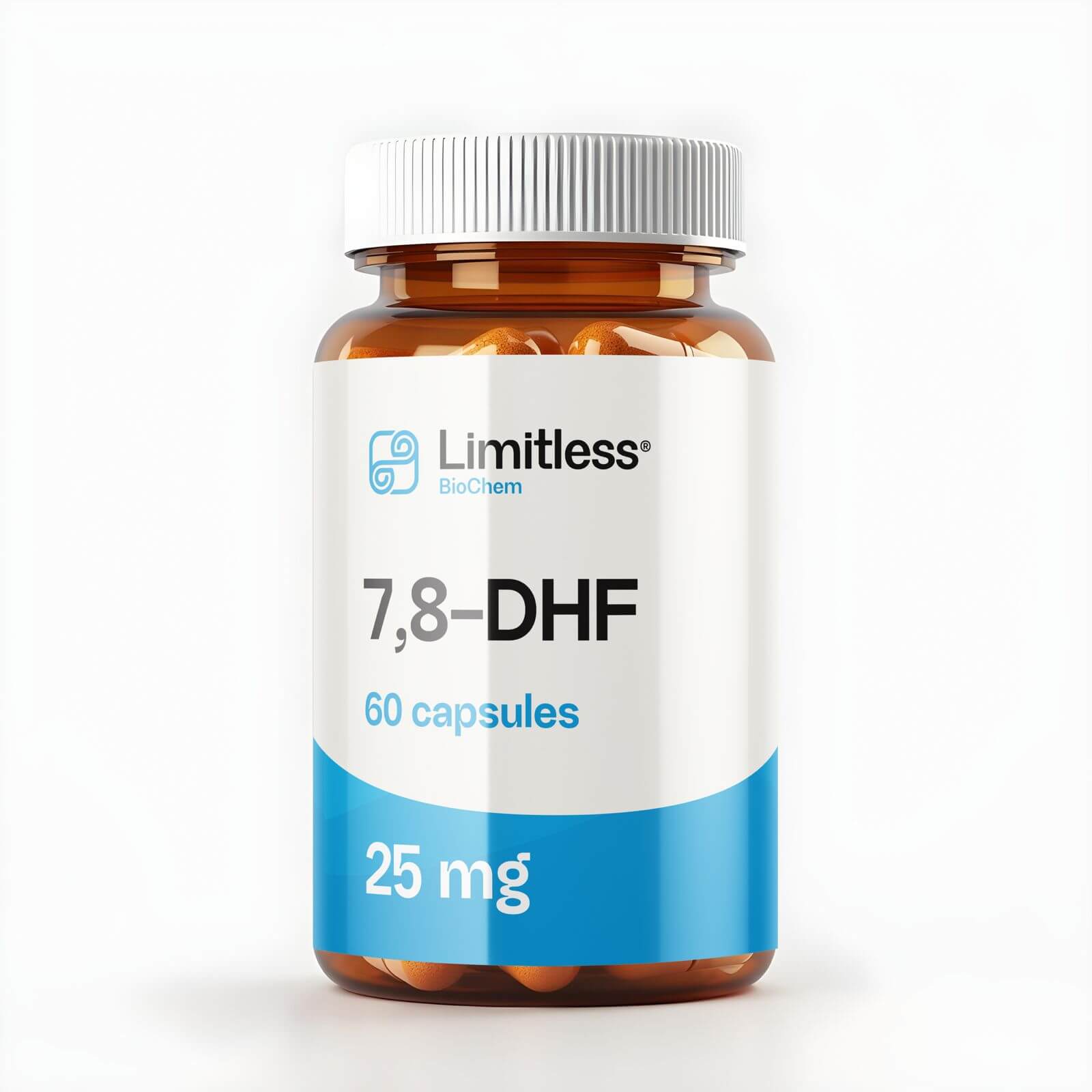
- 7,8-DHF was discovered by screening chemical libraries for a small molecule that could mimic BDNF, a neurotrophin protein too large to cross the blood-brain barrier; the flavone is small enough and orally active, so it can.
- It occurs naturally in certain plants and is also known as tropoflavin, giving it the unusual status of a plant flavone studied as a brain-growth-factor mimic.
Mechanism
7,8-DHF is described as a small-molecule of tropomyosin receptor kinase B (), the receptor through which brain-derived neurotrophic factor normally acts. By binding TrkB it is reported to promote receptor dimerization and autophosphorylation and to switch on downstream neurotrophic cascades, including the ERK and pathways that support neuronal survival, plasticity, and neurite outgrowth [1][2].
Because it is a small, orally bioavailable molecule that crosses the , it can reach central receptors that the protein cannot easily access from the periphery [1]. It additionally exerts direct antioxidant, free-radical-scavenging activity that does not depend on [1]. This mechanistic picture is not settled; quantitative reevaluation has questioned whether the molecule truly activates directly, suggesting that at least some of its effects arise through TrkB-independent routes [4].
⚠️ THE LABEL IS DISPUTED, AND THE DISPUTE IS LARGER THAN IT LOOKS. Three independent groups have tried to reproduce direct TrkB activation by this compound and failed. A BioFocus and CHDI team tested it in a TrkB reporter in both agonist and mode, in immunoblots for phosphorylated TrkB, ERK and , and in primary neuron rescue, and reported they were unable to detect agonist or positive allosteric activity in this class of small molecules, while antibody agonists worked in the same assays [21]. A Columbia and Broad Institute team reported the same failure across multiplexed quantitative assays [4]. A Celon Pharma group went furthest [22]: the compound did bind , but at a dissociation constant of 1.3 micromolar rather than the roughly 10 nanomolar reported by the originating laboratory, about 130-fold weaker, with no receptor dimerisation, no downstream signalling and no cytoprotection, and with no evidence of TrkB-dependent signalling in mouse brain after dosing.
⚠️ It is also far less selective than the label implies. In a 133-target panel the same group found it binds A1, A2A, A2B and A3 receptors, the benzodiazepine site of the -A receptor, 5-HT2B, COX-2, two matrix metalloproteinases and xanthine oxidase [22].
Several independent findings point at mechanisms that are not at all. It protects a cell line that expresses no TrkB receptor, through antioxidant activity, raising glutathione and lowering reactive oxygen species [24]. Its rapid potentiation of hippocampal mossy-fibre transmission is unaffected by two different blockers [12]. And its protection of retinal ganglion cells was reported in 2025 to be independent of activation, running instead through a gut- and aryl hydrocarbon receptor pathway [19].
⚠️ WHAT IS NOT IN DOUBT is that the compound does something. Hundreds of animal studies report real effects, and deleting does abolish some of them. What is in doubt is the mechanism, and the distinction that matters is between TrkB DEPENDENCE and TrkB AGONISM: an effect can require the receptor without the drug activating it directly, which is what the best-controlled independent work on this class concluded. A standing review puts the general problem plainly: selectivity for TrkB in this literature has been assessed almost entirely with a broad kinase inhibitor that hits all three Trk receptors [23].
⚠️ No paper in this area has been retracted, and nothing here rests on one. The monoamine-oxidase explanation that circulates for this compound has no published support and is not claimed.
receptor fingerprint
/ and MAPK/ERK signalingActivates downstream neurotrophic pathways
receptorPutative agonist (disputed)
Direct free-radical scavenging as a catechol flavone
Dosingtypical ranges, not medical advice
interested in protocols and clinical dosages? make an account to see them! ^_^
Safetyrisks and cautions, not medical advice
The honest headline is that there is essentially no human safety data; almost everything known comes from cells and rodents, so any human benefit is unproven and any risk profile is inferred. The main theoretical flag is that chronically and strongly activating TrkB might not be entirely benign, since TrkB signaling is implicated in some cancers, so open-ended heavy use is a reasonable thing to be cautious about. Studies also report a biphasic response, meaning more is not necessarily better and higher amounts can work less well. On top of that, supplement-grade material varies in purity, and interactions and use in pregnancy are simply unstudied. Treat it as an experimental compound rather than a proven supplement.
History
7,8-Dihydroxyflavone is a naturally occurring flavone found in a handful of plants that rose to prominence through neuroscience rather than folk use. It was identified by a research group screening large chemical libraries for small molecules that could imitate brain-derived neurotrophic factor (BDNF), a protein far too large to be given as a practical drug because it cannot readily cross the blood-brain barrier. First reported around 2010 as a small-molecule TrkB agonist, 7,8-DHF quickly became a popular tool compound because it is orally active and does reach the brain. In the years since, it has been studied across numerous animal models of depression, Alzheimer's disease, and other neurological conditions, even as later quantitative work has questioned exactly how directly it engages TrkB.
Reputation
7,8-DHF, also marketed as tropoflavin, carries a genuinely exciting reputation in nootropic and neuroscience-adjacent communities as a rare orally available way to nudge the BDNF/TrkB pathway that underpins learning, mood, and neuroprotection. Its extensive appearance in the research literature lends it credibility, and enthusiasts are drawn to the idea of a plant-derived molecule doing what a large neurotrophin cannot. The balanced view, which the better write-ups include, is that its mechanism is not fully settled; some careful assays have struggled to reproduce direct TrkB activation, and the compelling results so far come from animal studies rather than robust human trials. It remains a fascinating experimental compound.
Subjective profileweighing the evidence above
Genuinely interesting as a research tool, with real rodent results behind the BDNF story, but there is essentially no human safety data and whether it activates TrkB in people is disputed. Chronic strong TrkB signalling is not obviously benign either, so treat it as an experiment, not a daily.
Where to buy

1 other outlet
Suppliers
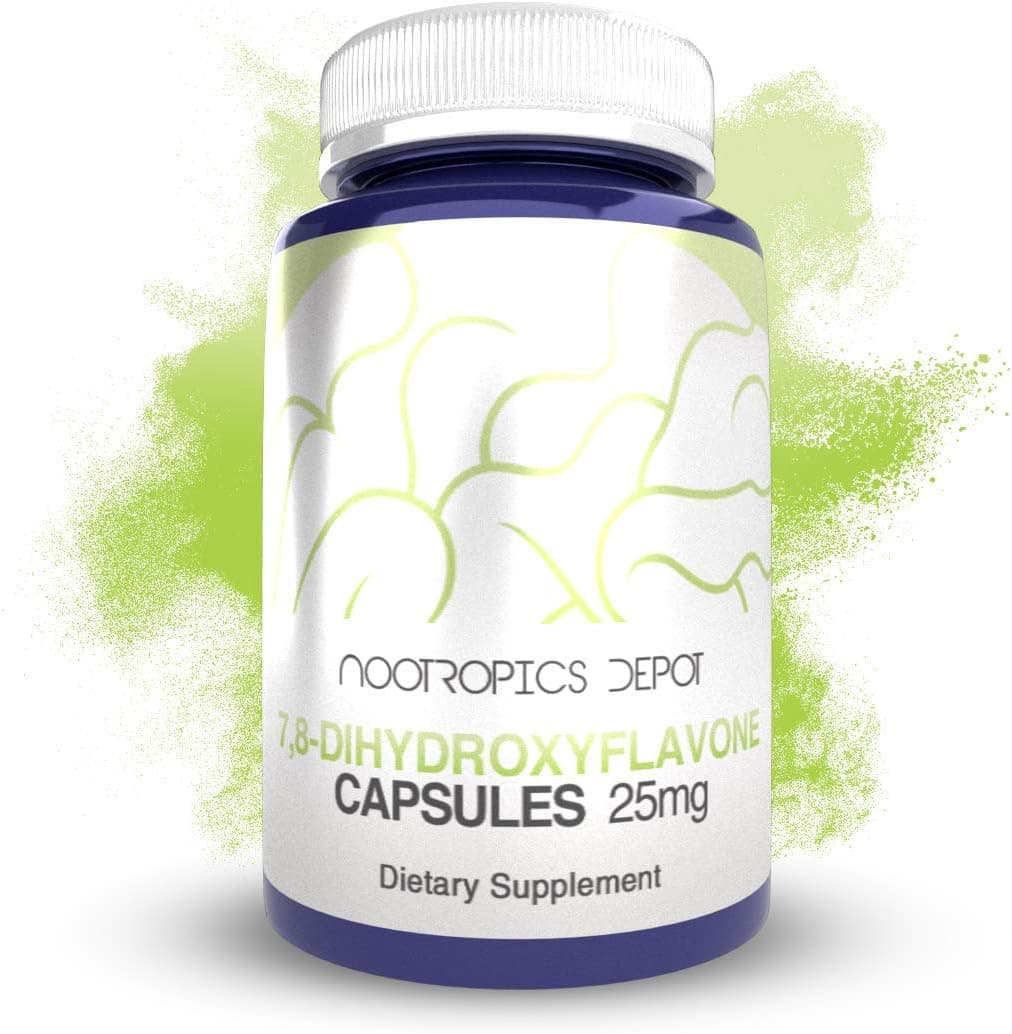
Vendors carrying 7,8-DHF, with live product details and codes. Links are affiliate links that support the wiki at no cost to you.
Amazon
7,8-DHF
Limitless Biochem🌐
7,8-DHF
Research
- 2010first citedA selective TrkB agonist with potent neurotrophic activities by 7,8-dihydroxyflavone
- 2012most active year3 papers
- 2025most recentOral 7,8-Dihydroxyflavone Protects Retinal Ganglion Cells by Modulating the Gut-Retina Axis and…
- 1.A selective TrkB agonist with potent neurotrophic activities by 7,8-dihydroxyflavone
- 2.Biochemical and biophysical investigation of the brain-derived neurotrophic factor mimetic 7,8-dihydroxyflavone in the binding and activation of the TrkB receptor
- 3.The prodrug of 7,8-dihydroxyflavone development and therapeutic efficacy for treating Alzheimer's disease
- 4.Multiplex quantitative assays indicate a need for reevaluating reported small-molecule TrkB agonists
- 5.Effect of 7,8-dihydroxyflavone, a small-molecule TrkB agonist, on emotional learning
- 6.Activation of TrkB by 7,8-dihydroxyflavone prevents fear memory defects and facilitates amygdalar synaptic plasticity in aging
- 7.7,8-dihydroxyflavone, a small-molecule TrkB agonist, reverses memory deficits and BACE1 elevation in a mouse model of Alzheimer's disease
- 8.7,8-dihydroxyflavone prevents synaptic loss and memory deficits in a mouse model of Alzheimer's disease
- 9.TrkB activation by 7,8-dihydroxyflavone increases synapse AMPA subunits and ameliorates spatial memory deficits in a mouse model of Alzheimer's disease
- 10.7,8-dihydroxyflavone rescues spatial memory and synaptic plasticity in cognitively impaired aged rats
- 11.Optimized TrkB Agonist Ameliorates Alzheimer's Disease Pathologies and Improves Cognitive Functions via Inhibiting Delta-Secretase
- 12.Synapse-selective rapid potentiation of hippocampal synaptic transmission by 7,8-dihydroxyflavone
24 listed here; entry last updated August 2026
Reviews
My notesprivate to this device
FAQ
Is 7,8-DHF the same as taking BDNF?
No, but it activates the same TrkB receptor that BDNF uses. BDNF itself does not cross the blood-brain barrier well, which is why a small-molecule mimetic is appealing.
Why is the half-life such a talking point?
It clears quickly and has low oral bioavailability because the catechol group is heavily metabolized, so blood levels drop fast. Prodrugs like R13 were made to improve this.
Does it work in humans?
The evidence is almost entirely from cells and rodents. There are essentially no controlled human trials, so human benefits are unproven.
Is more always better?
Not necessarily; some studies report a biphasic response where higher amounts can be less effective.
Limitations of the evidence
- No formal human safety or long-term toxicology data
- Oral bioavailability and half-life are limited, which has driven interest in prodrug forms
Adverse effects
- Whether it directly activates TrkB in humans is scientifically disputed
- Use in pregnancy and drug interactions are unstudied
Notes and cautions
- Purity of research-grade or supplement-grade material can vary