
spec sheet11 rows
AICAR is the original exercise mimetic, an AMPK-activating compound famous for enhancing endurance without a single workout. In a landmark study, four weeks of AICAR alone boosted running endurance in sedentary mice by 44 percent, switching on the same metabolic genes that exercise activates. Coveted for its ability to reprogram muscle toward fat-burning, endurance, and improved glucose handling, it remains one of the most sought-after metabolic and performance compounds in research.
- The original exercise mimetic
- Lifted running endurance 44 percent in sedentary mice
- Switches on the same genes exercise activates
- Direct AMPK activation, the master metabolic switch
- Pushes muscle toward fat burning and stamina
- One of the most sought after metabolic compounds
- May affect blood glucose and metabolism broadly
- Injectable use carries injection-site and sterility risks
- Potent metabolic effects mean uncertain interactions with other conditions or drugs
Overview
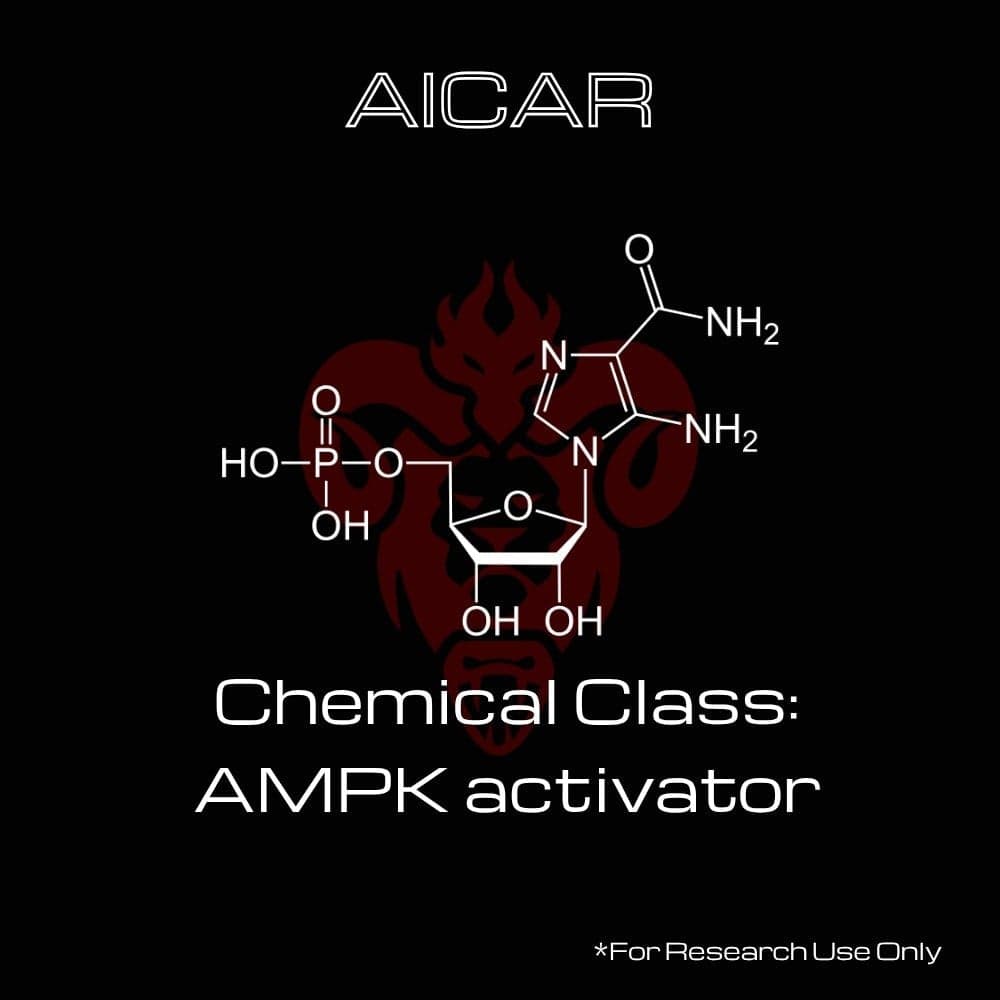
AICAR is the common name for 5-aminoimidazole-4-carboxamide-1-beta-D-ribofuranoside, a nucleoside also known pharmaceutically as acadesine. Chemically it is an analogue of adenosine; once inside a cell it is phosphorylated into ZMP, a molecule that mimics AMP, the signal the body produces when its energy stores are running low [2]. Because AMP is the natural trigger for the enzyme AMP-activated protein kinase (AMPK), AICAR is able to switch on AMPK artificially, in effect making a cell behave as though it has just exercised even at rest [2].
AICAR earned lasting fame in 2008 when researchers showed that four weeks of the drug given to sedentary mice, with no training at all, activated a program of metabolic genes and increased running endurance by 44 percent; this work popularized the idea of an exercise mimetic, or exercise in a pill [1]. Beyond endurance, AICAR reproduces many effects of physical training in muscle; it stimulates glucose uptake and raises levels of the glucose transporter GLUT4, which is why it has been investigated as a potential treatment for type 2 diabetes [2][3][4]. It has also been studied under the name acadesine in cardiology and in models of muscle-wasting diseases such as muscular dystrophy and spinal muscular atrophy [6].
Despite this promise, AICAR is not an approved everyday medicine; it has been explored in clinical research but is chiefly a laboratory and research compound, supplied as a powder or as an injectable. Its performance-enhancing potential has a regulatory consequence; because it can boost endurance, AICAR is classified as a prohibited substance in sport by the World Anti-Doping Agency, within the category of hormone and metabolic modulators, and doping-control laboratories screen for it [5]. Reviews of exercise mimetics note that such powerful metabolic drugs carry meaningful uncertainties and potential side effects that temper their use [5].
- In the study that made it famous, four weeks of AICAR alone, with no exercise at all, increased treadmill running endurance in mice by 44 percent.
- Inside the cell AICAR is converted to a molecule called ZMP that mimics AMP, effectively tricking muscle into behaving as though it had just finished a workout.
Mechanism
AICAR works by hijacking the cell's energy-sensing system. Structurally it is an analogue, and after it is taken up into cells it is phosphorylated to ZMP, a compound that closely mimics AMP (adenosine monophosphate) [2]. AMP normally accumulates when a cell burns through its energy during activity such as exercise, and it is the natural switch that turns on AMP-activated protein kinase (), the master regulator of cellular energy balance. By imitating AMP, AICAR activates AMPK directly, tricking the cell into responding as though it had just done physical work [2].
Once is switched on, it triggers the broad metabolic program of endurance training. In skeletal muscle this includes a rapid, -independent increase in glucose uptake and, over time, increased production of the glucose transporter GLUT4; mechanistic studies show AICAR drives GLUT4 gene transcription by activating the transcription factors MEF2 and GLUT4 enhancer factor, and it stimulates glucose transport through a signaling cascade running from AMPK through ERK and PDK1 to atypical protein kinase C [3][4]. activation also promotes fat oxidation and biogenesis via downstream partners such as PGC-1alpha, shifting muscle toward a more oxidative, fatigue-resistant character.
The headline functional consequence is enhanced endurance. In the defining experiment, four weeks of AICAR alone, without any exercise, increased treadmill running endurance in mice by 44 percent while inducing oxidative, exercise-associated genes [1]. The same -centered biology explains its investigation for type 2 diabetes, where improved glucose disposal is desirable [2], and for muscle-wasting conditions, where AICAR has preserved muscle structure in disease models [6]. The chief caveats are practical rather than mechanistic; as a potent metabolic modulator it is a banned performance-enhancing drug and its long-term safety in humans is not established [5].
receptor fingerprint
activates
biogenesisstimulates
Glucose uptakeraises
Dosingtypical ranges, not medical advice
interested in protocols and clinical dosages? make an account to see them! ^_^
Safetyrisks and cautions, not medical advice
AICAR is an AMPK-activating research compound studied for metabolic and endurance effects, with limited human safety data drawn mostly from short-term investigational use; it is prohibited in sport by the World Anti-Doping Agency as a metabolic modulator. Reported and plausible effects include changes in blood glucose and elevated uric acid, and its long-term safety is not established, including theoretical concerns that AMPK modulation could influence the growth of existing tumors.
History
AICAR, also known as acadesine, is an adenosine analogue that was studied for years in cardiovascular medicine, where it was investigated as a protective agent for the heart during and after surgery long before it became known in exercise science. Its modern fame dates to a landmark 2008 study in the journal Cell by Narkar, Evans, and colleagues, who showed that the compound could switch on the same metabolic program as endurance training by directly activating AMP-activated protein kinase (AMPK), the cell's master energy sensor. That work established AICAR as the prototypical exercise mimetic. Because of its potent metabolic effects, it was subsequently placed on the World Anti-Doping Agency's list of prohibited substances.
Reputation
AICAR holds an almost iconic status as the original exercise mimetic, celebrated for the headline finding that it boosted running endurance in sedentary mice without any training. Interest centers on its ability to activate AMPK and thereby reprogram muscle toward fat burning, mitochondrial biogenesis, and improved glucose handling, the hallmarks of aerobic conditioning. This same biology underlies its investigation for type 2 diabetes and muscle-wasting conditions. Honest discussion emphasizes important caveats: the most dramatic endurance results come from rodent studies, its long-term safety in humans is not established, and it is banned in competitive sport as a performance enhancer. It is best understood as a fascinating metabolic tool whose reputation rests largely on preclinical work.
Subjective profileweighing the evidence above
Not a practical buy. The mouse endurance result is real, but human use exists only as a long intravenous infusion in cardiac surgery, there is no validated oral protocol, it is banned in sport, and AMPK activation leaves an unresolved question about existing tumours.
Where to buy
Suppliers
Vendors carrying AICAR, with live product details and codes. Links are affiliate links that support the wiki at no cost to you.
RUPharma🌐
AICAR
RUO
AICAR
Peptira
Aicar
Kimera Chems
AICAR
Research
- 2000first citedAMP-activated protein kinase: possible target for treatment of type 2 diabetes
- 2018most recentPharmacological targeting of exercise adaptations in skeletal muscle: Benefits and pitfalls
- 1.AMPK and PPARdelta agonists are exercise mimetics
- 2.AMP-activated protein kinase: possible target for treatment of type 2 diabetes
- 3.Regulation of muscle GLUT4 enhancer factor and myocyte enhancer factor 2 by AMP-activated protein kinase
- 4.AICAR and metformin, but not exercise, increase muscle glucose transport through AMPK-, ERK-, and PDK1-dependent activation of atypical PKC
- 5.Pharmacological targeting of exercise adaptations in skeletal muscle: Benefits and pitfalls
- 6.Chronic Treatment with the AMPK Agonist AICAR Prevents Skeletal Muscle Pathology but Fails to Improve Clinical Outcome in a Mouse Model of Severe Spinal Muscular Atrophy
6 listed here; entry last updated August 2026
Reviews
My notesprivate to this device
FAQ
What is AICAR used for?
It is a research compound studied for endurance and metabolic effects.
How does AICAR work?
It activates AMPK, mimicking some of the cellular signals produced by exercise.
Is AICAR well-researched?
Most evidence comes from animal and lab studies; human data is limited and it is banned in sport.
What are the main side effects?
Possible concerns include raised uric acid and gastrointestinal upset.
Limitations of the evidence
- Human long-term safety is not established; mostly research use
Adverse effects
- May affect blood glucose and metabolism broadly
- Injectable use carries injection-site and sterility risks
- Potent metabolic effects mean uncertain interactions with other conditions or drugs
Notes and cautions
- Banned in sport as a metabolic modulator; use triggers doping tests