
spec sheet10 rows
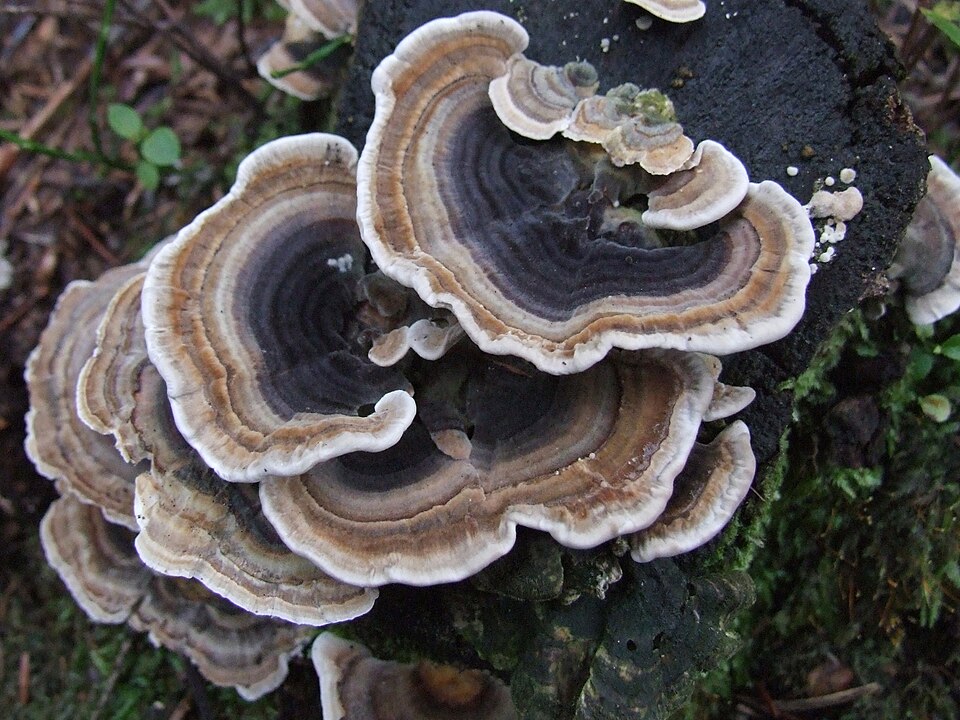
Turkey Tail Mushroom Turkey tail, Trametes versicolor (formerly Coriolus versicolor), is a common polypore bracket fungus found on dead wood worldwide, named for the fan of concentric, multicoloured bands that resemble a wild turkey's tail. It has a long history in East Asian herbal traditions, where it is known in China as yunzhi, and is the source of two well-studied polysaccharide preparations, PSK (Krestin) and PSP. In Japan PSK is approved as an adjunct to conventional cancer treatment, and the mushroom is widely sold elsewhere as an immune-oriented dietary supplement [1].
- Immune modulation
- Enhances NK and macrophage activity
- Prebiotic gut support
- Studied as cancer adjunct
- Mild digestive upset such as gas or nausea
- Darkening of stool or nails reported with PSK
Overview
Turkey tail is the common name for Trametes versicolor, a bracket or shelf fungus in the family Polyporaceae; older names include Coriolus versicolor and Polyporus versicolor. It grows as thin, tough, fan-shaped fruiting bodies without a stalk, and its upper surface shows concentric zones of contrasting colours and fine hairs, a banded pattern that gives it both its common name and the species epithet versicolor, meaning of several colours. On the underside are small pores rather than gills, marking it as a polypore.
The fungus is one of the most widespread in the world, growing in overlapping tiers on logs and stumps of dead broadleaf trees, where it acts as a white rot organism that breaks down lignin in wood. It is too thin and leathery to be eaten as food, so it is used in dried, powdered or extracted forms, typically as teas, powders and capsules.
Turkey tail has been used for centuries in East Asian herbal medicine; in China it is known as yunzhi and in Japan as kawaratake. Modern interest centres on two protein-bound polysaccharides isolated from the mushroom, polysaccharide-K, also called PSK or Krestin, and polysaccharopeptide, or PSP. PSK has been used in Japan for decades as an adjuvant given alongside surgery, chemotherapy or radiotherapy for certain cancers, and studies in animal models report that it can enhance tumour suppression and antitumour immune responses when combined with chemotherapy [1].
Much of the research on turkey tail focuses on its effects on the immune system. The polysaccharide fraction is rich in beta-glucans, which are recognised by immune receptors; work on PSK has shown that it activates dendritic cells and macrophages and stimulates the release of inflammatory cytokines, acting in part through pattern-recognition receptors such as Toll-like receptor 2 and Toll-like receptor 4 and the beta-glucan receptor Dectin-1, and that it can serve as an adjuvant that boosts T-cell responses [2][3][4]. These immunomodulatory properties are the proposed basis for its use in cancer care.
Neither the whole mushroom nor its extracts is approved as a drug in the United States, where turkey tail is sold as a dietary supplement, and product quality can vary with processing and labelling. Regulatory bodies note that evidence for many marketed health claims remains limited, so it is best regarded as a complementary preparation rather than an established treatment [1].
Mechanism
Turkey tail's biological activity is attributed chiefly to its protein-bound polysaccharides, above all the beta-glucan-rich extracts PSK (Krestin) and PSP. These large molecules are thought to act less on cancer cells directly than by engaging the innate immune system. Beta-glucans and associated components are recognised by pattern-recognition receptors on immune cells, including Toll-like receptor 2, Toll-like receptor 4 and the beta-glucan receptor Dectin-1; binding activates macrophages and dendritic cells, prompting them to mature and to release inflammatory cytokines such as tumour necrosis factor alpha, interleukin-6 and interleukin-12 [3][4].
Through activation of dendritic cells, PSK enhances the priming and proliferation of T cells and can act as a vaccine adjuvant, strengthening antigen-specific immune responses [2]. In tumour-bearing animals this immune stimulation translates into greater tumour suppression and increased infiltration of cytotoxic and helper T cells when PSK is combined with chemotherapy, alongside preserved natural killer cell activity [1].
Analytical work indicates that PSK carries at least two active elements, the well-known protein-bound beta-glucan acting via Dectin-1 and a distinct lipid component that stimulates Toll-like receptor 2, which appear to work together [3]. In short, the mushroom is understood to act as an immunomodulator rather than as a direct cytotoxic agent.
receptor fingerprint
Macrophagesactivates
Natural killer cellsenhances
T lymphocytesmodulates
Gut microbiotasupports
Dosingtypical ranges, not medical advice
interested in protocols and clinical dosages? make an account to see them! ^_^
Safetyrisks and cautions, not medical advice
Generally well tolerated. Mild digestive upset, gas, or darkened stool can occur. People on immunosuppressants or with autoimmune conditions should be cautious because of its immune-stimulating action. It is not a cancer treatment on its own.
Subjective profileweighing the evidence above
One of the more evidence-backed medicinal mushrooms for immune support; a reasonable choice, especially standardized PSK/PSP products.
Resources
This entry is here for reference.
Research
- 2010first citedRole for toll-like receptor 4 in TNF-alpha secretion by murine macrophages in response to polys…
- 2015most recentThe TLR2 agonist in polysaccharide-K is a structurally distinct lipid which acts synergisticall…
- 1.Polysaccharide-K augments docetaxel-induced tumor suppression and antitumor immune response in an immunocompetent murine model of human prostate cancer
- 2.Protein-bound polysaccharide activates dendritic cells and enhances OVA-specific T cell response as vaccine adjuvant
- 3.The TLR2 agonist in polysaccharide-K is a structurally distinct lipid which acts synergistically with the protein-bound β-glucan.
- 4.Role for toll-like receptor 4 in TNF-alpha secretion by murine macrophages in response to polysaccharide Krestin, a Trametes versicolor mushroom extract
4 listed here; entry last updated August 2026
Reviews
My notesprivate to this device
FAQ
What is PSK?
Polysaccharide-K, a protein-bound beta-glucan from turkey tail used as a cancer adjunct in Japan.
Is it a cancer cure?
No; it has been studied as an adjunct alongside conventional treatment, not a standalone therapy.
Does it help the gut?
Yes; its polysaccharides act as prebiotic fiber that supports beneficial gut bacteria.
Extract or whole mushroom?
Standardized extracts with defined PSK/PSP content are more reliable for immune effects.
Adverse effects
- Mild digestive upset such as gas or nausea
- Darkening of stool or nails reported with PSK
Notes and cautions
- Generally well tolerated
- Product quality varies between preparations
- Not an approved cancer treatment in the United States