
spec sheet9 rows
Sea moss is a red seaweed (Chondrus crispus, the true Irish moss, plus Gracilaria species often sold under the same name) that people soak into a jelly-like "gel" and stir into smoothies, or take as capsules and in blends with bladderwrack and burdock root. It is a genuine whole-food source of iodine and trace minerals, and it sets into that pudding texture thanks to a gel-forming seaweed fiber; in true Irish moss (Chondrus crispus) that fiber is carrageenan, while in the golden Gracilaria type most commonly sold today it is agar (a different gelling polysaccharide from the same red-algae family). Social media sells it hard for thyroid, immunity, gut, and skin, usually with a "92 minerals" hook; the honest read is that it is a decent mineral-and-iodine food with real but modest support, and most of the specific disease claims are traditional or anecdotal rather than proven. Its iodine is the double-edged part; helpful if you are low, but a problem in excess.
- A genuine whole-food source of iodine and trace minerals
- Potassium, magnesium, calcium, iron, zinc and selenium in one food
- Iodine supports normal thyroid hormone production when levels are low
- Gel-forming soluble fiber that soothes the gut and feeds bacteria
- Centuries of culinary use, familiar rather than exotic
- Stirs straight into smoothies as an easy gel
- Excess iodine can trigger or worsen thyroid problems (both under- and overactive), especially with existing thyroid disease, thyroid meds, or in pregnancy
- Carrageenan is only in the true Irish moss (Chondrus) type, where it is the native food form (less concerning than degraded carrageenan); the golden Gracilaria type gels with agar and has no carrageenan; either way sensitive guts may bloat
Overview
The right frame for sea moss is this: it is food first, supplement second. It is a real red algae that has been eaten and used as a thickener for centuries (the gel-forming fiber in it is literally why it sets; carrageenan in the true Irish moss / Chondrus crispus type, agar in the golden Gracilaria type most people buy now), so it is not some exotic compound; it is closer to eating a mineral-rich sea vegetable than to taking an isolated "active." What it genuinely brings to the table is iodine (a trace element your thyroid needs to build hormone) plus a spread of minerals like potassium, magnesium, calcium, iron, zinc, and selenium in small, food-level amounts. That is the grain of truth under the hype.
The "92 minerals" line is where skepticism is warranted; it is a marketing number, not a nutrition-label fact. The human body is often quoted as containing around that many elements, so the slogan quietly implies sea moss "replaces" all of them, which is not how nutrition works; most of those would be present in trace or negligible amounts, and some elements you would never want more of. That phrase reads as a sign a product is being oversold, not as evidence.
The thyroid story is the part most worth actually understanding, because it cuts both ways. If you are genuinely iodine-deficient, an iodine source can help your thyroid work properly. But iodine is a classic case where more is not better; too much can trigger or worsen thyroid problems (both an underactive and an overactive thyroid), and it is riskier if you already have a thyroid condition like Hashimoto's or Graves', or you are pregnant. Sea moss does not come with a dose on the label, and its iodine content swings widely batch to batch depending on the species and where it was harvested, so you are essentially dosing iodine blind. That is the single biggest caution here.
Two more honest caveats. Carrageenan (really a caveat only for the true Irish moss / Chondrus type, since the golden Gracilaria type gels with agar and contains no carrageenan at all): whole Chondrus sea moss contains the native, food-form carrageenan, which is different from "degraded carrageenan" (also called poligeenan) that shows up in some animal-gut inflammation studies; the food-grade form is debated but far less alarming, so panic is not warranted, though it would be wrong to pretend it is fully settled. Heavy metals: seaweeds soak up whatever is in their water, so arsenic, cadmium, lead, and mercury can concentrate, which means buying tested product from a reputable source matters more here than with a lot of supplements.
Bottom line: it is a pleasant, food-derived way to get some iodine and minerals with a soothing gut-friendly fiber, and it is fine as an occasional smoothie add-in for most people; it is not a thyroid cure, an immune shield, or a 92-mineral miracle, and the iodine load is a real reason to be moderate and to skip it (or check with a doctor) if you have thyroid issues.

- Carrageenan, the fiber that makes true Irish moss (Chondrus crispus) gel, is named after Carragheen on the Irish coast and has been used for generations to set puddings, thicken ice cream, and clarify beer; the golden Gracilaria 'sea moss' common today gels with agar instead, a different seaweed fiber.
- 'Sea moss' is not one species; true Irish moss is Chondrus crispus from the cold North Atlantic, while much of the golden 'sea moss' sold today is a Gracilaria species farmed in warmer Caribbean waters.
- Sea moss is often sold in a trio with bladderwrack (another seaweed, Fucus vesiculosus) and burdock root, a blend popularized in alternative-health circles by the herbalist Alfredo Bowman (Dr. Sebi).
- Because seaweeds concentrate iodine from seawater, a single serving of some seaweeds can exceed a week's worth of iodine, which is exactly why 'more is better' is the wrong instinct here.
Mechanism
Sea moss works mostly as a nutrient-delivery food rather than through a single receptor or pathway. Its headline component is iodine, a trace mineral your thyroid gland uses as the raw material to make thyroid hormones (thyroxine, or T4, and triiodothyronine, or T3) that set your metabolic rate; in someone who is iodine-deficient, supplying iodine lets the thyroid build hormone normally, while in someone who already has enough, extra iodine offers no benefit and can disrupt the gland.
The thyroid even has a built-in brake called the Wolff-Chaikoff effect (a transient shutdown of hormone production after an iodine surge), and repeated overload can tip susceptible people into an underactive or overactive state. Alongside iodine it supplies small, food-level amounts of minerals such as potassium, magnesium, calcium, iron, zinc, and selenium that act as cofactors across normal physiology.
The gel texture comes from a gel-forming polysaccharide (a large sugar-chain molecule) that differs by species: carrageenan, a sulfated (sulfur-tagged) polysaccharide, in true Irish moss (Chondrus crispus), or agar, a related but largely non-sulfated galactan (a galactose-sugar-based polysaccharide), in the golden Gracilaria type; either way it behaves as a soluble, gel-forming fiber, and in the gut it can act as a demulcent (a coating, soothing agent) and as fermentable fiber that gut bacteria feed on, which is the plausible basis for the "gut" and mild prebiotic claims. Proposed immune, antioxidant, and skin effects are largely extrapolated from its polysaccharides and mineral content in lab and animal work, not demonstrated in strong human trials.
receptor fingerprint
Thyroid axis (iodine substrate)provides iodine to build T4/T3
Trace minerals (potassium, magnesium, calcium, iron, zinc, selenium)whole-food dietary source
Gut (gel-forming seaweed fiber)carrageenan (Chondrus) or agar (Gracilaria) as gel-forming demulcent + fermentable fiber
Immune / antioxidant signalingpolysaccharide-driven (proposed)
Skin / mucous membraneshydrating, film-forming polysaccharides
Evidencehow good the literature is
Weak-to-modest and mostly indirect. The strongest, most defensible claim is nutritional: sea moss is a genuine whole-food source of iodine and trace minerals, and those nutrients have well-established roles, so a benefit in someone who is actually deficient is plausible. Beyond that, most of the popular claims (immune support, gut healing, thyroid "boosting," skin, energy) rest on traditional use, the behavior of its polysaccharides in test-tube and animal studies, and anecdote, rather than on controlled human trials of sea moss itself. There is no good evidence that it treats disease, and the "92 minerals" framing is marketing, not data. It is best filed as a reasonable mineral-rich food with an interesting fiber, not as a clinically proven remedy.
Dosingtypical ranges, not medical advice
interested in protocols and clinical dosages? make an account to see them! ^_^
Safetyrisks and cautions, not medical advice
For most healthy people, sea moss eaten in modest food amounts is generally well tolerated; the real safety issues are about dose and source rather than acute toxicity. The biggest one is iodine: the content is unlabeled and varies a lot between batches and species, so it is easy to overshoot the amount your thyroid is comfortable with. Excess iodine can cause or worsen thyroid dysfunction in both directions (underactive and overactive), and the risk is higher if you have an existing thyroid condition (such as Hashimoto's thyroiditis or Graves' disease), take thyroid medication, or are pregnant or breastfeeding; if any of those apply to you, freelancing with sea moss without a doctor's input is a bad idea.
Second, seaweeds bioaccumulate heavy metals (arsenic, cadmium, lead, and mercury) from seawater, so third-party-tested product from a reputable seller genuinely matters. Third, carrageenan is only a consideration for the true Irish moss (Chondrus) type; there it is the native food form, far less concerning than the "degraded" form used in some inflammation research, while the common golden Gracilaria type actually gels with agar and contains no carrageenan at all. Either way, people with sensitive guts sometimes report bloating or GI upset. It could also, in theory, add to the effect of thyroid or blood-thinning medications, so care is sensible alongside those. This is general educational information, not medical advice.
History
True Irish moss is Chondrus crispus, a red seaweed that grows on the rocky Atlantic coasts of Ireland, Britain, and North America, where it has been harvested for centuries as food and as a thickener; the Irish leaned on it during hard times and made a traditional convalescent dish of the moss simmered in milk. Its carrageenan (the gelling fiber specific to Chondrus, not to the golden Gracilaria type widely sold as "sea moss" today, which gels with agar) was prized commercially long before the wellness era, going into puddings, ice cream, beer clarification, and folk remedies for coughs and chest complaints.
In the 20th century the same seaweed-and-root idea carried into alternative-health circles, most visibly through the herbalist Alfredo Bowman (known as Dr. Sebi), whose "alkaline" regimen paired sea moss with bladderwrack and burdock root; that combination is still the template for many products sold today. The current explosion in popularity, though, is a social-media phenomenon; sea moss gel became a viral wellness staple across the late 2010s and 2020s, promoted by influencers and celebrities well ahead of any serious clinical evidence.
Reputation
In the wellness world sea moss has a glowing, almost cure-all reputation, sold as a thyroid tonic, immune booster, gut healer, skin fix, and "92-mineral" superfood. Among people who actually look at the evidence, the reputation is much cooler; it is respected as a legitimate mineral-and-iodine-rich sea vegetable but widely regarded as oversold, with the specific health claims running far ahead of the data. An honest read sits in the middle: it is a fine food-derived source of iodine and trace minerals with a soothing fiber, popular for good reason as an ingredient, but the miracle framing and especially the "92 minerals" slogan are marketing, and the unpredictable iodine load means it deserves respect and moderation rather than blind daily megadosing.
Subjective profileweighing the evidence above
Fine as a mineral-rich food, worthless as the cure-all it is sold as; the 92 minerals line is marketing, and the immune, gut and energy claims rest on tradition and test tubes, not trials of sea moss itself. The iodine is the part to take seriously, since content is unlabelled and swings by batch, and too much can push a thyroid either way. Skip it with thyroid disease or thyroid medication.
Where to buy
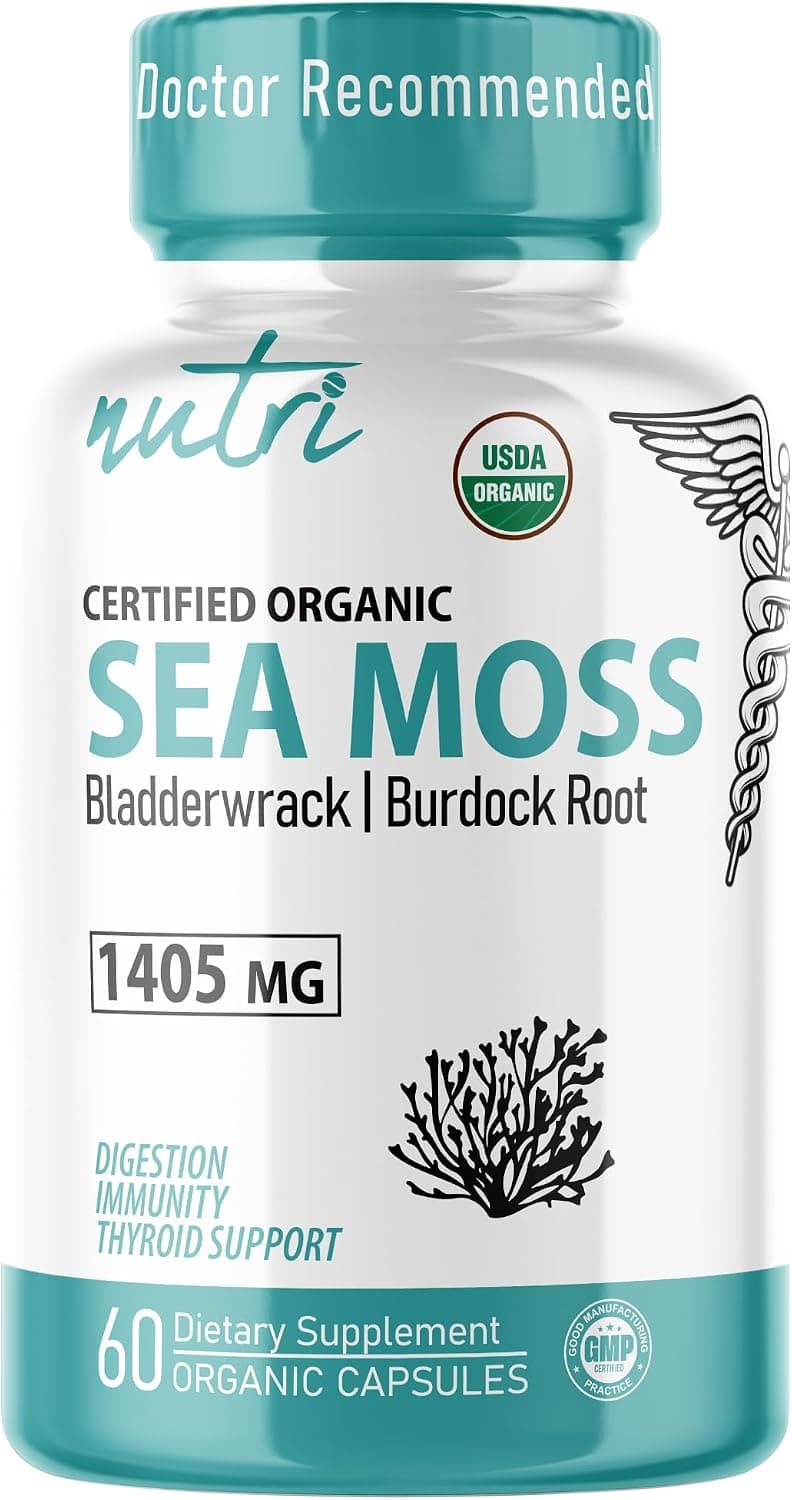
Suppliers
Vendors carrying Sea Moss, with live product details and codes. Links are affiliate links that support the wiki at no cost to you.
Amazon
Sea Moss
Research
- 2013first citedTotal and inorganic arsenic in dietary supplement supplies in northern Mexico
- 2026most recentImpact of habitual seaweed consumption on iodine nutrition and thyroid function: a non-randomiz…
- 1.Seaweed Nutritional Value and Bioactive Properties: Insights from Ascophyllum nodosum, Palmaria palmata, and Chondrus crispus.
- 2.Impact of habitual seaweed consumption on iodine nutrition and thyroid function: a non-randomized pre-post clinical study
- 3.Evidence and hypotheses on adverse effects of the food additives carrageenan (E 407)/processed Eucheuma seaweed (E 407a) and carboxymethylcellulose (E 466) on the intestines: a scoping review
- 4.Total and inorganic arsenic in dietary supplement supplies in northern Mexico
- 5.Degraded polysaccharides from Porphyra haitanensis: purification, physico-chemical properties, antioxidant and immunomodulatory activities
5 listed here; entry last updated August 2026
Reviews
My notesprivate to this device
FAQ
Is the '92 minerals' claim true?
It is marketing, not a nutrition fact. The number echoes how many elements the human body is said to contain, which quietly implies sea moss supplies them all; in reality most would be present in trace or negligible amounts, and some elements you would not want more of. Treat it as a hype flag, not evidence.
Will sea moss fix or boost my thyroid?
Mainly only if you are iodine-deficient, in which case the iodine helps your thyroid work normally. If you already get enough iodine, extra does not 'boost' anything and can actually disrupt the gland; iodine is a nutrient where more is not better, so it is not a risk-free thyroid tonic.
Is sea moss safe if I have a thyroid condition?
Be cautious. If you have Hashimoto's, Graves', take thyroid medication, or are pregnant or breastfeeding, the variable iodine load is a real concern and can push your thyroid the wrong way; check with a clinician before using it regularly.
What about the carrageenan I have heard is bad?
First, carrageenan is only in the true Irish moss (Chondrus crispus) type; the golden Gracilaria 'sea moss' most people buy now gels with agar and has no carrageenan at all. Where it is present, the alarming studies mostly used 'degraded carrageenan' (poligeenan), a chemically broken-down form, not the native carrageenan in whole Chondrus moss. The food form is far less concerning, though it is still debated and sensitive guts can react; no reason to panic, but no reason to call it fully settled either.
Is sea moss gel better than capsules?
Neither is clearly superior; the gel is closer to eating the whole food and easy to add to smoothies, while capsules are convenient but carry the same unlabeled-iodine and source-quality issues. What matters more is buying tested product and not megadosing.
How much should I take?
There is no proven dose. People commonly use about 1 to 2 tablespoons of gel a day or 500 to 1,000 mg capsules; because the iodine is unpredictable, start low, keep it occasional rather than a daily megadose, and remember the adult iodine upper limit is around 1,100 micrograms per day.
Limitations of the evidence
- Most specific health claims are traditional or anecdotal, not clinically proven; the '92 minerals' line is marketing
Adverse effects
- Excess iodine can trigger or worsen thyroid problems (both under- and overactive), especially with existing thyroid disease, thyroid meds, or in pregnancy
- Carrageenan is only in the true Irish moss (Chondrus) type, where it is the native food form (less concerning than degraded carrageenan); the golden Gracilaria type gels with agar and has no carrageenan; either way sensitive guts may bloat
Notes and cautions
- Iodine content is unlabeled and swings batch to batch, so it is easy to overdo iodine
- Seaweed bioaccumulates heavy metals (arsenic, cadmium, lead, mercury); source and testing matter