
spec sheet10 rows
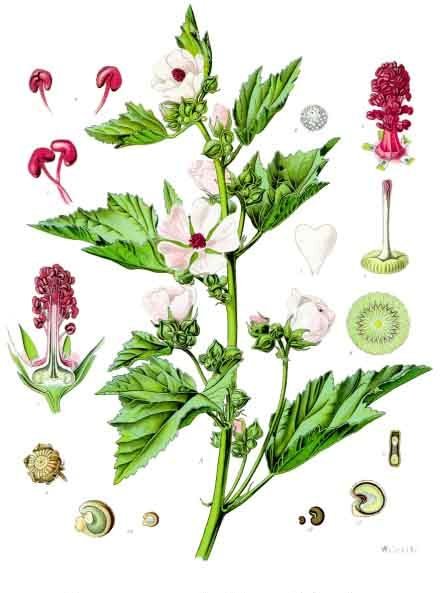
Marshmallow root is the root of Althaea officinalis, a perennial herb in the mallow family (Malvaceae) native to Europe, western Asia, and North Africa, used in traditional herbal medicine as a soothing, or demulcent, remedy. Its roots are especially rich in mucilage, a gel-forming mixture of polysaccharides that coats and soothes irritated mucous membranes, which is the basis for its long use for cough, sore throat, and digestive irritation [1]. The same mucilage historically gave its name to the marshmallow confection, though modern marshmallows no longer contain the plant.
- Soothes sore throat
- Eases dry cough
- Calms gut irritation
- Gentle and safe
- Rare allergic reactions in sensitive individuals
Overview
Althaea officinalis, commonly called marsh mallow or marshmallow, is a herbaceous perennial reaching up to about two meters, with soft, downy leaves and pale flowers, growing in damp and marshy ground. Its genus name comes from a Greek word meaning to heal, reflecting a very long history of medicinal use dating back to antiquity [1]. The leaves, flowers, and especially the roots have all been used, with the peeled root valued as the richest source of the plant's soothing mucilage [1]. The root's mucilage was once boiled with sugar to make a soft sweet, the original marshmallow, although today's marshmallow candy is made from gelatin and sugar and contains none of the plant.
The characteristic constituents of marshmallow root are its polysaccharide mucilages, which can make up a substantial fraction of the dried root and swell into a viscous gel in water [1]. A well-studied component is a branched pectic polysaccharide called rhamnogalacturonan, along with other complex sugars; the root also contains starch, pectin, flavonoids, and small amounts of other compounds [1][2]. It is these gel-forming polysaccharides, rather than any single potent molecule, that are thought to account for most of the herb's traditional effects [1].
Marshmallow root is used chiefly as a demulcent, a substance that forms a soothing film over mucous membranes. It is a common ingredient in herbal teas, syrups, and lozenges for dry, irritating cough and for sore throat, and it has also been taken for irritation of the stomach and gut lining [1]. Experimental work supports a cough-suppressing action: an isolated Althaea rhamnogalacturonan reduced the cough reflex in animal tests, with an effect that was, at the higher dose, comparable to the drug codeine in that model [2]. Human evidence is more limited and often involves multi-herb products; for example, a controlled trial of a cough preparation combining ivy leaf, marshmallow, and other botanicals reported benefit for cough and cold symptoms with good tolerability [3]. Reviews conclude that marshmallow, alone or combined with other herbs, is a reasonable option for dry cough and throat irritation, while noting that rigorous single-herb trials remain few [1].
Marshmallow root is sold as a herbal medicine and dietary supplement in forms such as dried root, teas, tinctures, syrups, and capsules, and it is a component of many traditional cough remedies. In Europe it is recognized within traditional herbal medicine frameworks for the symptomatic relief of dry cough and accompanying throat irritation and for mild gastric discomfort, uses based on long tradition rather than on large modern trials [1]. It is generally regarded as safe and gentle, one reason it is often chosen for children and for people seeking a mild, non-drug demulcent [1].
Mechanism
Marshmallow root acts primarily through a physical, coating mechanism rather than a specific drug-receptor interaction. Its high mucilage content, made up of large gel-forming polysaccharides, absorbs water and swells into a viscous layer that adheres to and coats the lining of the mouth, throat, and digestive tract [1]. This soothing film is thought to shield irritated or inflamed mucous membranes from further irritation, blunt the sensation that provokes coughing, and create a protective barrier over the tissue, which underlies the herb's demulcent and cough-easing reputation [1].
Beyond simple coating, some of the root's polysaccharides appear to have more specific activity. In animal experiments, the isolated pectic polysaccharide rhamnogalacturonan suppressed the cough reflex in a dose-dependent way, indicating an antitussive effect that may involve calming the sensory pathways that trigger coughing rather than only a mechanical barrier [2]. Laboratory and traditional-use reports also credit marshmallow polysaccharides with mild anti-inflammatory and tissue-protective actions on mucosal surfaces and skin [1]. Because the active constituents are large, poorly absorbed sugars that act locally, systemic effects are minimal, which is consistent with the herb's long record of gentle, well-tolerated use [1].
receptor fingerprint
Mucous membranescoats/soothes
Cough reflexreduces
Mucosal inflammationreduces
Blood sugarmodestly lowers
Dosingtypical ranges, not medical advice
interested in protocols and clinical dosages? make an account to see them! ^_^
Safetyrisks and cautions, not medical advice
Very safe and gentle; the main caution is that its mucilage can slow or reduce absorption of medications taken at the same time, so separate dosing by a couple hours. It may modestly lower blood sugar. Occasional mild GI effects are possible.
Subjective profileweighing the evidence above
A safe, soothing demulcent that genuinely helps with throat and gut irritation; not a heavy hitter, but a nice gentle option.
Resources
This entry is here for reference.
Research
- 2011first citedAntitussive activity of Althaea officinalis L. polysaccharide rhamnogalacturonan and its change…
- 2018controlled trialThe evaluation of efficacy and safety of Cough (EMA) granules used for upper respiratory disord…
- 2020most recentMarsh Mallow (Althaea officinalis L.) and Its Potency in the Treatment of Cough
- 1.Marsh Mallow (Althaea officinalis L.) and Its Potency in the Treatment of Cough
- 2.Antitussive activity of Althaea officinalis L. polysaccharide rhamnogalacturonan and its changes in guinea pigs with ovalbumine-induced airways inflammation
- 3.The evaluation of efficacy and safety of Cough (EMA) granules used for upper respiratory disorders
3 listed here; entry last updated August 2026
Reviews
My notesprivate to this device
FAQ
How does marshmallow root work?
Its mucilage forms a soothing gel that coats irritated throat and gut tissue.
Is it related to the candy?
The candy was originally made from the plant, but modern marshmallows contain none of it.
Can I take it with medications?
Separate it by a couple hours since the mucilage can slow drug absorption.
Is it good for cough?
Yes, it is a classic demulcent for dry, irritated coughs.
How should I prepare it?
A cold-water infusion preserves the mucilage well, or use capsules with plenty of water.
Limitations of the evidence
- Limited high-quality human trial data for single-herb use
Adverse effects
- Rare allergic reactions in sensitive individuals
Notes and cautions
- Generally well tolerated and considered gentle
- Mucilage may delay the absorption of medicines taken at the same time