
spec sheet13 rows
Celecoxib is a nonsteroidal anti-inflammatory drug (NSAID) that selectively targets the cyclooxygenase-2 enzyme, used mainly to relieve pain and inflammation in arthritis and related conditions [1][2]. By focusing on COX-2 while largely sparing COX-1, it aims to ease inflammation with a lower risk of stomach ulcers than older, nonselective NSAIDs [2]. Discovered at Searle and approved in the United States in 1998, it is sold under the brand name Celebrex and is now widely available as a generic [1]. Like other NSAIDs it carries cardiovascular and other risks that shape how it is prescribed [1][3].
- arthritis relief that goes easy on the stomach
- targets COX-2 and largely leaves COX-1 alone
- far lower ulcer risk than the older NSAIDs
- does not thin the blood the way aspirin does
- works on acute pain and period pain too
- once or twice a day covers it
- Indigestion or abdominal discomfort
- Raised blood pressure and fluid retention
- Cardiovascular risk, including heart attack and stroke, especially with high doses or long use
Overview
Celecoxib belongs to the class of selective cyclooxygenase-2 inhibitors, often called coxibs, a subgroup of the nonsteroidal anti-inflammatory drugs [1][2]. Its molecular formula is C17H14F3N3O2S, corresponding to a molar mass of about 381 grams per mole, and its structure contains a sulfonamide group; that feature matters clinically because people with an allergy to sulfonamide drugs may react to it as well [1]. It is taken by mouth, usually in capsule form [1].
The drug was discovered by chemists at the Searle division of Monsanto, in work led by John Talley, and it was patented in 1993 [1]. The United States Food and Drug Administration approved celecoxib at the end of 1998, and Pfizer went on to market it under the brand name Celebrex [1]. It was among the first selective COX-2 inhibitors to reach wide clinical use, and after its patent lapsed around 2014 it became broadly available as a low-cost generic; it remains one of the more commonly prescribed medicines in the United States [1].
Celecoxib is approved to treat osteoarthritis, rheumatoid arthritis, psoriatic arthritis, ankylosing spondylitis, and juvenile rheumatoid arthritis, and it is also used for acute pain and for painful menstruation [1]. Randomized trials and systematic reviews have found NSAIDs, including selective COX-2 inhibitors, effective for menstrual pain, though the evidence has not clearly singled out any one agent as best [4]. The drug additionally has a niche role in reducing the number of colorectal polyps in people with familial adenomatous polyposis, although its ability to prevent cancer itself is not established [1].
A central theme in celecoxib's history is cardiovascular safety [1][3]. The selective COX-2 inhibitors as a group came under scrutiny after some were linked to raised risks of heart attack and stroke, and a pooled analysis reported that coxibs increased major cardiovascular events relative to placebo [1]. A large randomized trial published in 2016, comparing moderate-dose celecoxib with ibuprofen and naproxen in patients at increased cardiovascular risk, found celecoxib to be no worse than those older drugs for cardiovascular outcomes while causing fewer gastrointestinal and kidney problems [3]. On the strength of such data a United States advisory panel later revisited and softened earlier warnings about the drug [1].
Celecoxib is a prescription medicine available in most countries as capsules, both branded and generic [1]. It is not recommended in the later part of pregnancy or during breastfeeding, and it is avoided in people with a known sulfonamide allergy [1]. As with all NSAIDs, prescribers weigh its benefits against the risk of heart, stomach, and kidney effects and generally use the lowest effective dose for the shortest necessary time [1][3].
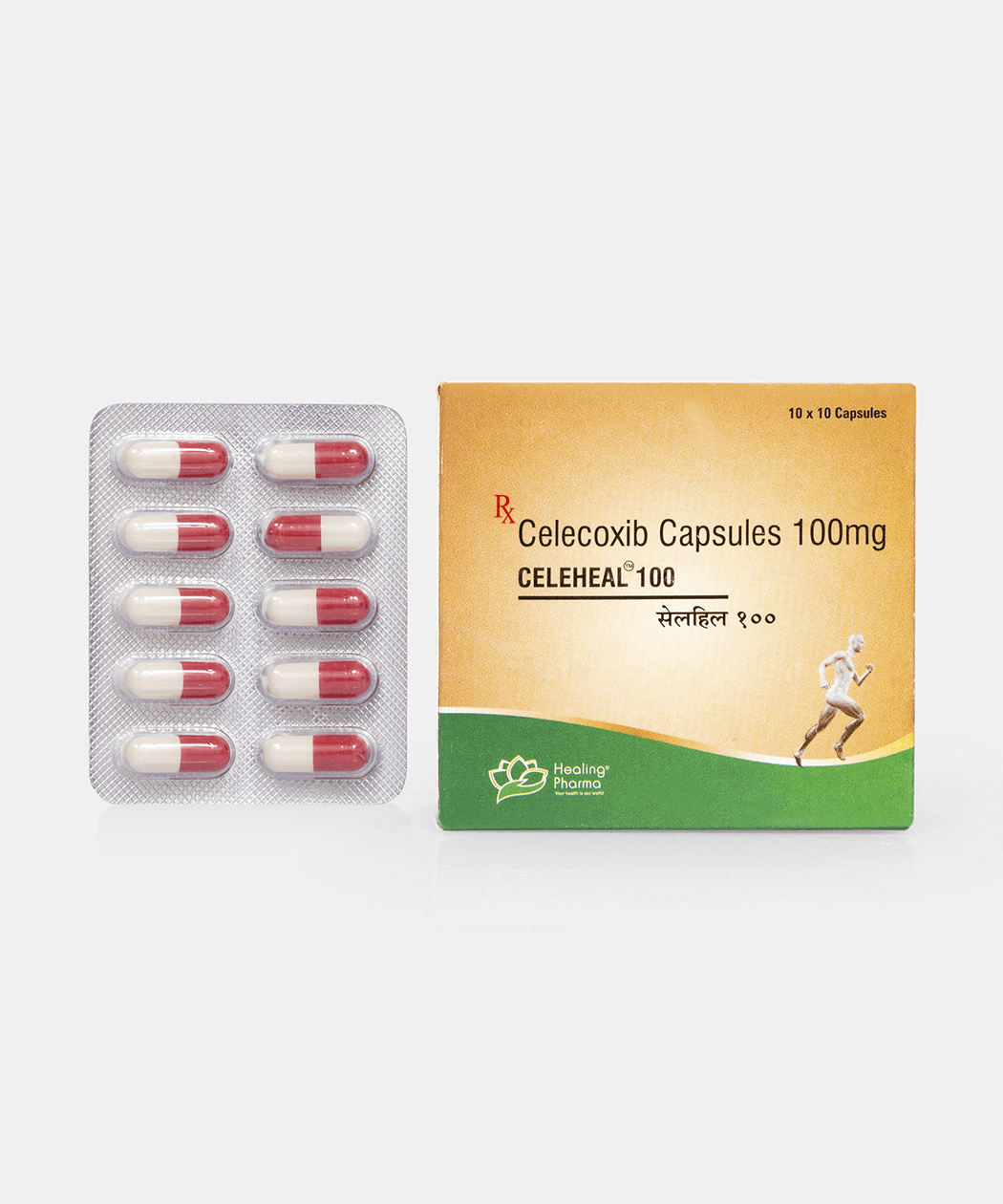
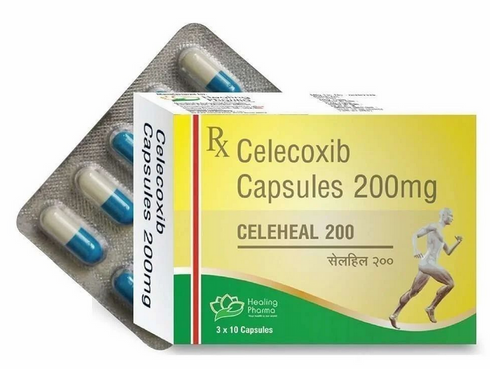
- Celecoxib carries a sulfonamide group and, as a byproduct of its chemistry, weakly inhibits carbonic anhydrase, an enzyme unrelated to its anti-inflammatory purpose.
- In laboratory assays it inhibits COX-2 at roughly hundreds of times lower concentrations than COX-1, the molecular basis for its stomach-sparing design.
Mechanism
Celecoxib produces its effects by inhibiting cyclooxygenase, the enzyme that converts arachidonic acid into prostaglandins, the local signaling molecules that drive pain, swelling, and fever [1][2]. Two forms of the enzyme exist: COX-1, which is present constantly in tissues such as the stomach lining where its prostaglandins are protective, and COX-2, which is switched on at sites of inflammation [2]. Celecoxib binds preferentially to a pocket in the COX-2 enzyme, giving it roughly ten to twenty times greater activity against COX-2 than against COX-1 at usual doses [1]. By suppressing COX-2 while largely leaving COX-1 intact, it lowers inflammatory prostaglandins with less disruption of the protective ones in the gut, which underlies its comparatively lower rate of ulcers [2]. Because it does not appreciably block COX-1 in platelets, it lacks the blood-thinning action of aspirin [1].
receptor fingerprint
Cyclooxygenase-2 (COX-2)inhibits
Prostaglandin E2 synthesisblocks
Endothelial prostacyclin (PGI2)blocks
Cyclooxygenase-1 (COX-1)inhibits
Carbonic anhydraseinhibits
Dosingtypical ranges, not medical advice
interested in protocols and clinical dosages? make an account to see them! ^_^
Safetyrisks and cautions, not medical advice
Celecoxib is prescription only and carries boxed warnings shared by NSAIDs. It can raise the risk of heart attack and stroke, especially at higher doses or with long term use, and it can worsen high blood pressure, cause fluid retention, and strain the kidneys. Although it is easier on the stomach than older NSAIDs, serious gastrointestinal bleeding and ulcers are still possible. Because it is a sulfonamide, people with a sulfa allergy should be cautious. It should be avoided in late pregnancy and used carefully in those with heart, kidney, or liver disease.
Interactionsdocumented pairs only, not exhaustive
Celecoxib is a substrate of CYP2C9 and can be subject to pharmacokinetic interactions with CYP2C9 inhibitors. Fluconazole, a moderate inhibitor of CYP2C9, increases celecoxib plasma area-under-the-curve by 2.2 to 2.6-fold depending on CYP2C9 genotype, with the effect most pronounced in patients with the *1/*1 genotype [6]. This is a pharmacokinetic interaction where the inhibitor reduces celecoxib clearance and prolongs its half-life.
Celecoxib combined with warfarin shows a mild but non-statistically significant increase in bleeding complications; the mechanism is thought to be pharmacodynamic (additive effects on platelet function and the gastrointestinal tract), though the clinical risk appears lower than with non-selective NSAIDs [7]. Other CYP2C9 inhibitors (ketoconazole, voriconazole, amiodarone) have not been specifically tested with celecoxib but would be expected to produce similar increases in exposure. Most OTC medications and many antihistamines have not been studied with celecoxib; these pairings are poorly characterized.
Checking a whole stack? Run it through interactions + stacks.
History
Celecoxib emerged from research at G. D. Searle and Company in the 1990s, following the discovery that cyclooxygenase exists as two isoforms and the hypothesis that selectively blocking the inflammation-associated COX-2 form could relieve pain while sparing the COX-1 that protects the stomach lining. It became the first selective COX-2 inhibitor, or coxib, approved by the United States Food and Drug Administration in 1998, reaching the market under the brand name Celebrex and rapidly becoming one of the best-selling drugs of its era.
Its commercial life was shaped by the wider coxib story, including the 2004 withdrawal of the related drug rofecoxib over cardiovascular concerns, which intensified scrutiny of the entire class. Large safety studies followed, and the drug survived where some competitors did not; it is now widely available as a generic. Celecoxib remains approved for osteoarthritis, rheumatoid arthritis, and other painful inflammatory conditions.
Reputation
Celecoxib is regarded as the enduring success of the COX-2 inhibitor class, valued for delivering meaningful relief of arthritic pain and inflammation with a notably lower rate of stomach ulcers and gastrointestinal bleeding than older nonselective NSAIDs. Because it does not appreciably block COX-1 in platelets, it lacks the blood-thinning effect of aspirin, which can be an advantage in patients at risk of bleeding.
Its cardiovascular safety was the central question of its history, and later large comparative trials helped reassure prescribers that, at commonly used doses, its cardiovascular risk was not clearly worse than that of traditional NSAIDs. Rheumatologists and pain specialists continue to view it as a useful option, particularly for patients vulnerable to gastric injury. Honest discussion still emphasizes that, like all NSAIDs, it carries cardiovascular, renal, and other risks that guide careful use.
Subjective profileweighing the evidence above
A reasonable choice when arthritis pain needs an NSAID and the older ones tear up your stomach. The boxed cardiovascular warning is not decoration though; heart attack and stroke risk climbs with dose and duration, so use the lowest dose that works for the shortest time you can.
Where to buy
1 other outlet
Suppliers
Vendors carrying Celecoxib, with live product details and codes. Links are affiliate links that support the wiki at no cost to you.
PCT.Zone
Celecoxib
RUPharma🌐
Celecoxib
Research
- 1999first citedImmunologic tolerability profile of celecoxib.
- 2025most recentEffects of fluconazole on the pharmacokinetics of celecoxib and its carboxylic acid metabolite…
- 1.Immunologic tolerability profile of celecoxib.
- 2.COX-1 and COX-2 inhibitors.
- 3.Cardiovascular Safety of Celecoxib, Naproxen, or Ibuprofen for Arthritis.
- 4.Nonsteroidal anti-inflammatory drugs for dysmenorrhoea.
- 5.Effects of the selective COX-2 inhibitors celecoxib and rofecoxib on human vascular cells
- 6.Effects of fluconazole on the pharmacokinetics of celecoxib and its carboxylic acid metabolite in different CYP2C9 genotypes.
- 7.Bleeding complications in patients on celecoxib and warfarin.
7 listed here; entry last updated August 2026
Reviews
My notesprivate to this device
FAQ
Why is celecoxib easier on the stomach?
It mainly blocks COX-2, the inflammation enzyme, while sparing COX-1 that protects the stomach lining, so ulcers and bleeding are less likely.
Is it safe for my heart?
Like other NSAIDs it can raise the risk of heart attack and stroke, particularly at higher doses or over long periods, so use the lowest dose that works.
Can I take it if I am allergic to sulfa drugs?
Celecoxib is a sulfonamide, so caution is advised if you have a sulfa allergy; check with your doctor first.
Does it thin the blood like aspirin?
No, it does not meaningfully reduce platelet function, so it will not protect against clots the way low dose aspirin does.
Should I take it with food?
Taking it with food can ease stomach upset, and higher doses in particular are better tolerated that way.
Adverse effects
- Indigestion or abdominal discomfort
- Raised blood pressure and fluid retention
- Cardiovascular risk, including heart attack and stroke, especially with high doses or long use
- Kidney strain
- Allergic reactions, particularly in people with sulfonamide allergy