
spec sheet13 rows
Ketorolac is a nonsteroidal anti-inflammatory drug (NSAID) noted for unusually strong analgesic activity, used for the short-term management of moderate to severe pain. Chemically a pyrrolizine carboxylic acid derivative, it is often given by injection after surgery, where it can relieve pain comparably to opioids such as morphine while sparing opioid use [1]. Because of a heightened risk of gastrointestinal, kidney, and bleeding complications, its use is deliberately limited to short courses [1].
- Opioid strength pain relief from a nonsteroidal drug
- Matches morphine for acute pain in trials
- No sedation, no dependence, no opioid haze
- Reduces inflammation while it kills the pain
- Injection, tablet, nasal and eye routes available
- Earns its place in short courses after surgery
- It can cause stomach ulceration and gastrointestinal bleeding
- It can impair kidney function, usually reversibly after stopping
- By affecting platelets it can increase the tendency to bleed
Overview
Ketorolac is a nonsteroidal anti-inflammatory drug, or NSAID, of the acetic acid group, chemically a pyrrolizine carboxylic acid derivative usually formulated as ketorolac tromethamine [1]. It is a racemic compound and is distinguished within its class by potent analgesic activity, which is the main reason it is used [1]. Rather than being taken for long-term inflammatory conditions like many NSAIDs, it is reserved for the short-term relief of acute pain [1].
The drug was patented in 1976 and approved in the United States in 1989, where it is best known under the brand name Toradol [1]. An ophthalmic form followed under the name Acular in 1992, and an intranasal spray, Sprix, was approved in 2010 [1]. Concerns about gastrointestinal and kidney complications led to its withdrawal from the German market in 1993 and shaped tighter dosing guidance elsewhere [1].
Ketorolac is used chiefly for moderate to severe pain, particularly after surgery and injury, and it is frequently given by intramuscular or intravenous injection [1]. In hospital and emergency settings it has been shown to relieve pain from conditions such as renal colic, migraine, and musculoskeletal injury about as effectively as commonly used opioids, and it serves as a valuable opioid-sparing agent within multimodal, opioid-reducing pain regimens [1][2]. It is also used in infants and children in the perioperative period as a non-opioid analgesic, and ophthalmic drops are used for eye pain and inflammation and for ocular itching [2][3].
Mechanistically the drug blocks cyclooxygenase and thereby the synthesis of prostaglandins, which underlies both its strong analgesia and its characteristic risks [1]. Its unusually powerful pain relief has made it a useful alternative or adjunct to opioids [1][2].
The defining caution with ketorolac is that its use should be brief, generally not beyond a few days, because the risk of serious adverse effects rises steeply with prolonged or high-dose treatment, especially in older adults [1]. These effects include gastrointestinal ulceration and bleeding, acute kidney injury that is usually reversible on stopping the drug, and an increased tendency to bleed; like other NSAIDs it also carries cardiovascular and allergic risks and is avoided in people with active ulcers, significant kidney impairment, or bleeding tendencies and in late pregnancy [1]. Used within its guidelines it offers effective, opioid-comparable pain relief [1].

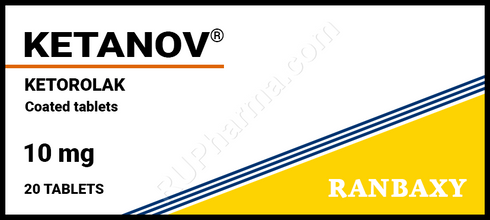
- By injection, ketorolac can relieve postoperative pain about as effectively as morphine, a rare distinction for a non-opioid drug.
- A meta-analysis of 27 randomized trials found no significant increase in postoperative bleeding with ketorolac compared with control, easing a long-standing concern.
- Its use is capped at roughly five days precisely because the risks of gastrointestinal, kidney, and bleeding complications climb sharply with longer treatment.
Mechanism
Ketorolac works like other traditional NSAIDs by inhibiting cyclooxygenase, the enzyme that converts arachidonic acid into prostaglandins, which are signaling molecules central to inflammation, pain, and fever [1]. It is a nonselective inhibitor, blocking both the COX-1 and COX-2 forms of the enzyme, and by lowering prostaglandin production it produces analgesic, anti-inflammatory, and fever-reducing effects [1]. What sets ketorolac apart from most NSAIDs is the strength of its pain-relieving action; in the postoperative and acute pain setting its analgesic efficacy approaches that of opioids, and when combined with an opioid it can cut opioid requirements substantially, with an accompanying reduction in opioid-related side effects [1][2].
Its analgesic effect may begin slightly more slowly than that of an opioid but often lasts longer [1]. The same blockade of prostaglandins that relieves pain also accounts for its main hazards: prostaglandins normally protect the stomach lining and help maintain kidney blood flow, so inhibiting them can lead to gastrointestinal irritation and bleeding and to impaired kidney function, while interference with platelet activity can promote bleeding [1]. These risks rise sharply when the drug is used at high doses or for more than a few days, which is why treatment is restricted to short-term use [1].
receptor fingerprint
Cyclooxygenase-1 (COX-1)inhibits
Cyclooxygenase-2 (COX-2)inhibits
Prostaglandin synthesisblocks
Platelet thromboxane A2modulates
Renal prostaglandinsmodulates
Dosingtypical ranges, not medical advice
interested in protocols and clinical dosages? make an account to see them! ^_^
Safetyrisks and cautions, not medical advice
Ketorolac is a prescription NSAID intended only for short courses of five days or less. It carries boxed warnings for gastrointestinal bleeding and ulcers, kidney injury, bleeding risk and cardiovascular events, and it is contraindicated in advanced kidney disease, active bleeding, before major surgery and during labor. It should not be combined with other NSAIDs or aspirin, and it increases bleeding risk with anticoagulants. Older adults and those with dehydration or kidney problems need extra caution.
Interactionsdocumented pairs only, not exhaustive
Ketorolac increases bleeding time independently of its effects on warfarin pharmacokinetics; in controlled studies, ketorolac prolonged template bleeding time by approximately 35% compared with placebo despite causing no significant change in warfarin pharmacokinetics or prothrombin time [5]. This is a pharmacodynamic interaction at the level of platelet function and bleeding risk. Clinical caution is warranted with concurrent warfarin use despite the lack of pharmacokinetic displacement, as the additive antiplatelet effect increases bleeding risk.
Ketorolac, like all NSAIDs, is known to reduce renal function and interact with renal-dependent drugs, particularly relevant with lithium and ACE inhibitors, though specific ketorolac studies at therapeutic doses are limited. NSAIDs have been documented broadly to reduce the renal clearance of lithium and to blunt the antihypertensive effect of ACE inhibitors through renal hemodynamic changes. Concurrent use with other NSAIDs, aspirin at therapeutic doses, and corticosteroids remains understudied for ketorolac specifically.
Checking a whole stack? Run it through interactions + stacks.
History
Ketorolac, chemically a pyrrolizine carboxylic acid derivative, was developed by the pharmaceutical company Syntex and introduced for clinical use around 1989 to 1990, initially in an injectable form for the treatment of moderate to severe acute pain. It distinguished itself among nonsteroidal anti-inflammatory drugs by the unusual strength of its analgesic action, which in the postoperative setting approaches that of opioids such as morphine. This property made it valuable as a means of relieving surgical pain while sparing opioid use and the side effects that accompany it.
Over time, additional formulations broadened its reach, including an ophthalmic solution (Acular) for ocular inflammation and pain and a nasal spray (Sprix) for short-term systemic analgesia. Recognition that its risks of gastrointestinal bleeding, kidney injury, and impaired platelet function rise sharply with prolonged use led regulators to restrict treatment to short courses, typically no more than five days. Within that boundary it has become a widely used component of modern multimodal, opioid-sparing pain management.
Reputation
Ketorolac is well regarded as one of the most powerful non-opioid analgesics available, occupying an important place in postoperative and acute-pain care. Its central appeal is the ability to deliver opioid-level relief without the sedation, respiratory depression, and dependence risk that accompany narcotics, and studies show it can substantially reduce opioid requirements when used alongside them. This makes it a valued pillar of the multimodal, opioid-sparing analgesic strategies that have become standard in enhanced-recovery surgical pathways.
Its onset may lag slightly behind an opioid, but its effect often lasts longer. The honest limitation is that the same prostaglandin blockade responsible for its analgesia also raises the risks of gastrointestinal irritation and bleeding, kidney stress, and impaired platelet function, which is precisely why its use is deliberately confined to short courses. Used briefly and appropriately, it is a highly effective tool for controlling significant pain.
Subjective profileweighing the evidence above
Genuinely impressive short-term pain relief, close to opioid strength without the sedation or dependence, which is why it earns its place after surgery. The boxed warnings for gastrointestinal bleeding, kidney injury and bleeding risk are real, and the five-day limit is not a formality.
Where to buy
1 other outlet

Suppliers
Vendors carrying Ketorolac, with live product details and codes. Links are affiliate links that support the wiki at no cost to you.
PCT.Zone
Ketorolac
RUPharma🌐
Ketorolac
Research
- 1990first citedInvestigations into the potential effects of multiple dose ketorolac on the pharmacokinetics an…
- 2024most recentThe efficacy and safety of ketorolac for postoperative pain management in lumbar spine surgery:…
- 1.Ketorolac: A reappraisal of its pharmacodynamic and pharmacokinetic properties and therapeutic use in pain management
- 2.Postoperative Multimodal Analgesia Pain Management With Nonopioid Analgesics and Techniques: A Review
- 3.A review of perioperative anesthesia and analgesia for infants: updates and trends to watch
- 4.The efficacy and safety of ketorolac for postoperative pain management in lumbar spine surgery: a meta-analysis of randomized controlled trials
- 5.Investigations into the potential effects of multiple dose ketorolac on the pharmacokinetics and pharmacodynamics of racemic warfarin.
5 listed here; entry last updated August 2026
Reviews
My notesprivate to this device
FAQ
How strong is ketorolac?
For short term acute pain it can rival opioids, which is unusual for a non steroidal anti-inflammatory drug.
Why can I only use it for five days?
Longer use sharply raises the risk of stomach bleeding, kidney injury and other harms, so total treatment is capped at five days.
Can I take it with ibuprofen or aspirin?
No. Combining it with other non steroidal anti-inflammatory drugs or aspirin greatly increases bleeding and ulcer risk.
Does it increase bleeding?
Yes. It reduces platelet function, so it is avoided before surgery and in people with bleeding risk.
Is there a pill form?
Yes, oral tablets exist, but they are meant only to continue a course that started with an injection, within the five day limit.
Adverse effects
- It can cause stomach ulceration and gastrointestinal bleeding
- It can impair kidney function, usually reversibly after stopping
- By affecting platelets it can increase the tendency to bleed
Notes and cautions
- It is intended only for short-term use, generally not beyond a few days