
spec sheet12 rows
Ranitidine is a histamine H2 receptor antagonist that reduces stomach acid production and was long sold under the brand name Zantac. Introduced in the early 1980s, it became one of the world's best-selling medicines for heartburn, ulcers, and reflux. Most products were withdrawn from markets around 2020 after the discovery of the probable carcinogen NDMA as a contaminant.
- Cuts stomach acid at the histamine H2 receptor
- Eases heartburn and reflux, often within the hour
- Faster onset than a proton pump inhibitor
- Helps peptic ulcers heal over a course
- One of the world's best selling medicines for decades
- Gentle, familiar acid control under the Zantac name
- Headache
- Constipation or diarrhea
- Dizziness
Overview
Ranitidine is a competitive, reversible histamine H2 receptor antagonist, a class of drugs that lower the secretion of gastric acid [1]. It was first synthesized in England in 1977 by the chemist John Bradshaw at Glaxo's laboratories and grew out of a deliberate effort to design an improved successor to the earlier H2 blocker cimetidine, replacing that molecule's imidazole ring with a furan-based structure [1]. Entering use in the early 1980s under the brand name Zantac, it had become the world's best-selling prescription drug by the late 1980s.
Medically, ranitidine has been used for heartburn, gastric and duodenal ulcers, gastroesophageal reflux disease, erosive esophagitis, and the acid oversecretion of Zollinger-Ellison syndrome, as well as for preventing stress ulcers in seriously ill patients [1]. Studies have compared its speed of acid suppression with that of other agents such as famotidine [1]. As with other acid-suppressing drugs, research has associated its use with a higher risk of certain infections, including gastrointestinal infections and pneumonia in children and Clostridioides difficile infection in adults [2][3].
Beginning in 2019, testing detected N-nitrosodimethylamine (NDMA), classified as a probable human carcinogen, in ranitidine products, and the impurity was found to increase as the drug degraded over time [4]. In 2020 the United States Food and Drug Administration requested that all ranitidine products be withdrawn from the market, and European regulators suspended them as well [4]. Later laboratory work traced much of the NDMA formation to defects in the drug's crystal structure and showed that improved crystallization could suppress it, informing reformulated versions [4]. The drug had previously been available both by prescription and over the counter, in oral tablets, syrups, and injectable forms.
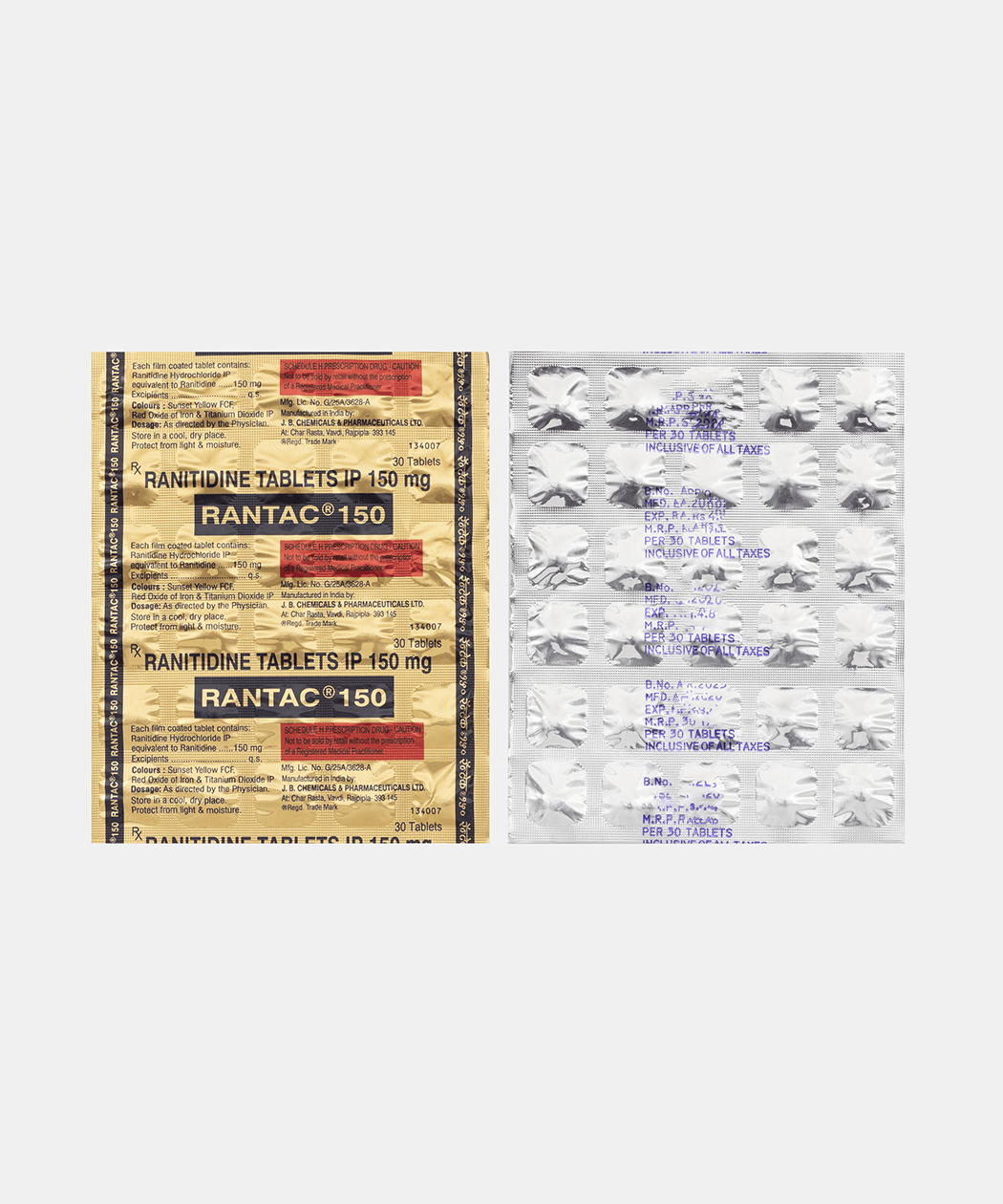
- By the late 1980s Zantac had become one of the best-selling prescription drugs in the world.
- Ranitidine was withdrawn from most markets not because its acid-blocking action was unsafe, but because the molecule itself can form the probable carcinogen NDMA under certain conditions.
- It works one step upstream of the proton pump inhibitors, blocking the histamine signal that tells stomach cells to make acid rather than disabling the acid pump directly.
Mechanism
Ranitidine competitively and reversibly blocks H2 receptors on the acid-producing parietal cells of the stomach lining [1]. normally binds these receptors to stimulate acid secretion, so blocking them reduces both the volume and the acidity of gastric juice, allowing irritated or ulcerated tissue to heal [1]. Unlike the proton pump inhibitors, which disable the acid pump itself, ranitidine acts one step upstream at the receptor [1]. A separate and unintended chemistry problem, the gradual formation of NDMA from the molecule under certain conditions, was the reason for the drug's market withdrawal rather than any consequence of its acid-blocking action [4].
receptor fingerprint
H2 receptorantagonist
Gastric acid secretionblocks
Parietal cell cyclic AMP signalinginhibits
Pepsin outputblocks
Nocturnal basal acidblocks
Dosingtypical ranges, not medical advice
interested in protocols and clinical dosages? make an account to see them! ^_^
Safetyrisks and cautions, not medical advice
Ranitidine is a prescription and formerly over the counter medicine that has been withdrawn in many countries because of NDMA contamination, a probable human carcinogen that increases with storage and temperature. As an H2 blocker its own side effects were usually mild; headache, constipation or diarrhea and dizziness, with rare reports of low platelet counts, liver irritation, breast enlargement and confusion in older adults or those with poor kidney function. The main modern concern is the impurity rather than the drug action, and current advice generally favors safer alternatives such as famotidine. Anyone still holding old ranitidine should not use it and should dispose of it properly.
Interactionsdocumented pairs only, not exhaustive
Ranitidine's interactions come from raising gastric pH, not from enzyme inhibition, which is what separates it from cimetidine. It binds cytochrome P450 with roughly a tenth of cimetidine's affinity, so the theophylline, warfarin and phenytoin interactions that made cimetidine troublesome largely do not appear here.
The pH effect is substantial. Ketoconazole exposure fell by as much as 95 percent when ranitidine was given in a regimen holding gastric pH at 6 or above, and atazanavir and other acid-dependent drugs are impaired the same way. It runs in the other direction too: triazolam, midazolam and glipizide are absorbed more completely at higher pH, so sedation from a benzodiazepine or a glucose-lowering response can be larger than expected.
At high doses ranitidine also competes for renal tubular secretion and raises plasma procainamide and its N-acetyl metabolite, which is unlikely to matter at ordinary doses. Worth noting for context: ranitidine was withdrawn from most markets after NDMA contamination was found in the drug substance, so these interaction questions are now largely historical or belong to the agents that replaced it.
Checking a whole stack? Run it through interactions + stacks.
History
Ranitidine was discovered by scientists at Glaxo, in a research effort led by John Bradshaw, as the company sought a histamine H2 receptor antagonist that would improve upon the pioneering acid-reducer cimetidine. Introduced in 1981 under the brand name Zantac, it offered longer action and fewer drug interactions than its predecessor, and through aggressive development and marketing it became, by the late 1980s, one of the best-selling prescription medicines in the world.
For decades it was a mainstay treatment for heartburn, peptic ulcers, and gastroesophageal reflux, available both by prescription and over the counter. Its long run came to an abrupt end beginning in 2019, when testing revealed that the ranitidine molecule could form N-nitrosodimethylamine (NDMA), a probable human carcinogen, under certain storage and physiological conditions. Regulators including the United States Food and Drug Administration requested broad market withdrawals in 2020, ending the availability of most ranitidine products.
Reputation
For most of its life ranitidine enjoyed an outstanding reputation as a safe, effective, and convenient remedy for acid-related complaints, so trusted that it became a household name through the Zantac brand and one of the first blockbuster drugs in pharmaceutical history. Clinicians relied on it for healing ulcers and controlling reflux, and patients valued its fast, dependable relief with a low burden of side effects during ordinary use.
Its enduring legacy is twofold: it demonstrated the commercial and therapeutic power of the H2-blocker concept, and its later downfall became a landmark case study in pharmaceutical quality and the chemistry of nitrosamine impurities. It is important to be clear that the NDMA problem was a contamination and stability issue intrinsic to the molecule, not a consequence of its acid-blocking action, and that closely related H2 blockers such as famotidine remain widely used. Ranitidine is remembered as a genuinely effective medicine undone by an unexpected chemistry flaw.
Subjective profileweighing the evidence above
It worked well for decades, and that is now beside the point; most products were pulled around 2020 over NDMA contamination, a probable carcinogen that accumulates with storage and heat. Famotidine does the same job without the question mark.
Where to buy

Suppliers
Vendors carrying Ranitidine, with live product details and codes. Links are affiliate links that support the wiki at no cost to you.
PCT.Zone
Ranitidine
Research
- 2002first citedDetermination of the time of onset of action of ranitidine and famotidine on intra-gastric acid…
- 2013meta-analysisThe association between histamine 2 receptor antagonist use and Clostridium difficile infection…
- 2025most recentCrystal defects cause nitrosamine formation in ranitidine under accelerated storage conditions
- 1.Determination of the time of onset of action of ranitidine and famotidine on intra-gastric acidity
- 2.Therapy with gastric acidity inhibitors increases the risk of acute gastroenteritis and community-acquired pneumonia in children
- 3.The association between histamine 2 receptor antagonist use and Clostridium difficile infection: a systematic review and meta-analysis
- 4.Crystal defects cause nitrosamine formation in ranitidine under accelerated storage conditions
- 5.Understanding and Preventing (N-Nitrosodimethylamine) NDMA Contamination of Medications
5 listed here; entry last updated August 2026
Reviews
My notesprivate to this device
FAQ
Why was ranitidine taken off the market?
Testing found it can form NDMA, a probable human carcinogen, and that the level rises with time and heat, so many regulators pulled it.
Is it safe to take ranitidine I still have at home?
No; because of the contamination concern you should not use old ranitidine and should dispose of it safely.
What can I use instead?
Famotidine is another H2 blocker without the same impurity problem, and proton pump inhibitors are options; ask your pharmacist.
How was it different from omeprazole?
Ranitidine blocks the histamine signal for acid and works fast but modestly, while proton pump inhibitors shut the acid pump itself for stronger, longer control.
Did the drug itself cause cancer?
The concern is the NDMA impurity that can form in the product, not the acid blocking action, but that impurity was enough to justify withdrawal.
Adverse effects
- Headache
- Constipation or diarrhea
- Dizziness
- Rarely, confusion in older or seriously ill patients
Notes and cautions
- The NDMA contamination concern that led to its withdrawal