
spec sheet11 rows
Mosapride is a gastroprokinetic drug that acts as a selective agonist of the serotonin 5-HT4 receptor, used to improve the movement of the upper digestive tract. It is prescribed for conditions such as chronic gastritis, gastroesophageal reflux disease and functional dyspepsia, where sluggish stomach emptying contributes to symptoms. Marketed largely in Japan and other parts of Asia, it is noted for a favorable cardiac safety profile compared with the older prokinetic cisapride.
- Sluggish stomach emptying speeds up again
- Fullness, bloating and reflux all ease
- Selective 5-HT4 agonist built for the upper gut
- Low cardiac risk compared with older prokinetics like cisapride
- Generally well tolerated day to day
- A mainstay across Japan and much of Asia
- Diarrhea or loose stools
- Dry mouth
- Abdominal pain or discomfort
Overview
Mosapride is a prokinetic medication, meaning a drug that stimulates movement of the gastrointestinal tract, and it belongs to the class of selective 5-HT4 (serotonin) receptor agonists. It is often given as the citrate salt, and one of its metabolites, referred to as M1, additionally blocks the 5-HT3 receptor, a property that contributes to speeding transit through the gut [1][3].
Clinically, mosapride is used to relieve the symptoms of several upper-digestive disorders in which the stomach empties too slowly or the gut is oversensitive, including chronic gastritis, gastroesophageal reflux disease and functional dyspepsia, and it has also been studied in irritable bowel syndrome [1]. Reviews report that it improves overall symptoms and gastric emptying and performs comparably to several other agents, although at least one controlled trial did not find it clearly better than placebo for functional dyspepsia [1]. It has been examined as an add-on to acid-suppressing proton pump inhibitors, where combining it with esomeprazole improved esophageal contraction in patients with reflux disease [4].
A defining feature of mosapride is its cardiac safety. An earlier 5-HT4 prokinetic, cisapride, was withdrawn in many markets after it was linked to dangerous heart-rhythm disturbances caused by blockade of a cardiac potassium channel (the hERG channel). Mosapride, by contrast, has little effect on this channel and has not shown the same cardiovascular risk in testing, which is a major reason it remains in use [2].
Mosapride is taken by mouth, usually on an empty stomach, and is marketed mainly in Japan and other parts of Asia rather than in the United States or Europe [1]. It is generally well tolerated [1].
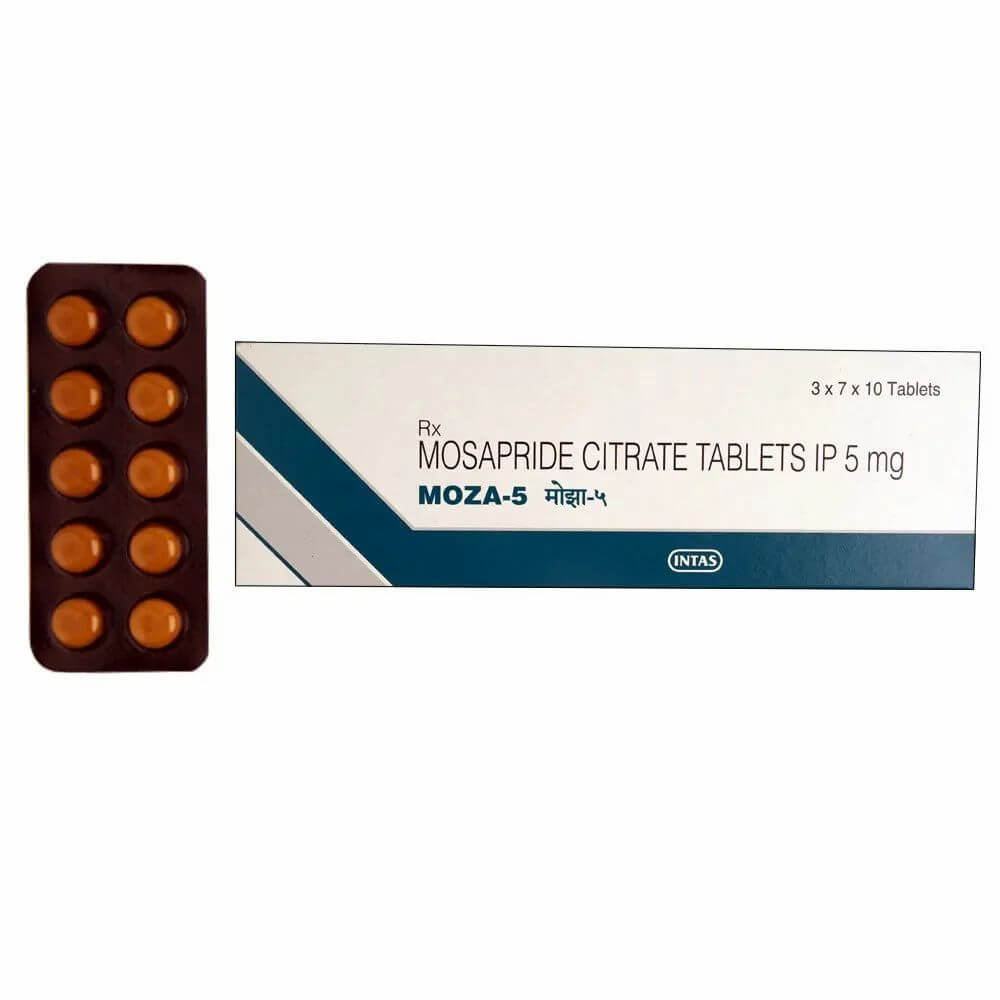
- Mosapride was purpose-built to keep the gut-stimulating action of cisapride while shedding its heart-rhythm risk; it and its M1 metabolite show little affinity for the cardiac hERG channel.
- Its principal active metabolite, M1, adds a second mechanism by antagonizing the 5-HT3 receptor, complementing the 5-HT4 agonism of the parent drug.
- Despite being a mainstay in Japan and much of Asia for over two decades, mosapride has never been approved in the United States or Europe.
Mechanism
Mosapride promotes gastrointestinal movement by activating 5-HT4 receptors on the nerve cells of the enteric nervous system, the network of neurons embedded in the wall of the gut. Stimulating these receptors triggers the release of from the myenteric nerve plexus, and this extra acetylcholine strengthens the muscular contractions that propel contents forward, accelerating gastric emptying and transit through the digestive tract [1][3].
Its principal active , M1, adds a second action by antagonizing the 5-HT3 receptor, which further supports faster gut transit and may raise the threshold for visceral pain, helping to ease dyspeptic discomfort [3]. Importantly, mosapride is relatively selective for the 5-HT4 receptor and interacts only weakly with the cardiac hERG potassium channel; this selectivity is thought to explain why it lacks the heart-rhythm effects that led to the withdrawal of the less selective agent cisapride [2].
receptor fingerprint
5-HT4 receptor on enteric neuronsagonist
Myenteric cholinergic neuronsactivates
Gastric emptying rateactivates
5-HT3 receptorantagonist
Dosingtypical ranges, not medical advice
interested in protocols and clinical dosages? make an account to see them! ^_^
Safetyrisks and cautions, not medical advice
Mosapride is prescription only in the countries where it is sold. It is generally well tolerated, with the most common complaints being diarrhea or loose stools, abdominal pain, dry mouth and headache. Less often it can raise liver enzymes or trigger a rise in eosinophils, so occasional monitoring is reasonable with long use. Its low cardiac risk is a key advantage over older prokinetics, but it should still be used thoughtfully in people with serious liver disease. If symptoms do not improve, an underlying cause should be looked for rather than simply continuing the drug.
History
Mosapride was developed in Japan by Dainippon Pharmaceutical (now Sumitomo Pharma) as part of a deliberate search for a gastroprokinetic that could accelerate sluggish digestion without the cardiac liabilities of the earlier agent cisapride. Introduced to the Japanese market in the late 1990s under the brand name Gasmotin, it was designed to act with high selectivity at the serotonin 5-HT4 receptor while interacting only weakly with the cardiac hERG potassium channel.
This design goal proved central to its identity, since cisapride was later withdrawn in several markets over arrhythmia concerns that mosapride was engineered to avoid. Over the following decades it became a widely prescribed treatment for functional dyspepsia, chronic gastritis and reflux across Japan, South Korea, China, India and other parts of Asia. It has never gained approval in the United States or the European Union, so most of its clinical evidence base and prescribing tradition remains centered in Asian gastroenterology.
Reputation
Mosapride enjoys a solid reputation in the regions where it is licensed as a dependable, well-tolerated prokinetic that gently speeds gastric emptying and eases the fullness, bloating and early satiety of functional dyspepsia. Clinicians particularly value its favorable cardiac profile; unlike cisapride, it is not associated with the QT-interval problems that ended its predecessor's career, and gastrointestinal side effects such as loose stools are usually mild.
Researchers have also explored it beyond dyspepsia, including its use to improve bowel recovery and transit in various settings. It is worth noting honestly that comparative meta-analyses place its efficacy in the middle of the prokinetic field rather than at the very top, and that its evidence is concentrated in Asian populations. Even so, its combination of a clear mechanism, decades of real-world use and a reassuring safety record has earned it lasting trust among gastroenterologists.
Subjective profileweighing the evidence above
A sensible prokinetic where it is available: it eases the fullness, bloating and reflux that come with sluggish stomach emptying, and its low cardiac risk is a real advantage over the older drugs in its class. Loose stools and dry mouth are the usual complaints, and occasional liver enzyme checks make sense with long use.
Where to buy

Suppliers
Vendors carrying Mosapride, with live product details and codes. Links are affiliate links that support the wiki at no cost to you.
PCT.Zone
Mosapride
Research
- 2008first citedMosapride in gastrointestinal disorders.
- 2023most recentProkinetics for the treatment of functional dyspepsia: an updated systematic review and network…
- 1.Mosapride in gastrointestinal disorders.
- 2.Systematic review: cardiovascular safety profile of 5-HT(4) agonists developed for gastrointestinal disorders.
- 3.Effects of mosapride citrate, a 5-HT4-receptor agonist, on gastric distension-induced visceromotor response in conscious rats.
- 4.Effect of mosapride combined with esomeprazole improves esophageal peristaltic function in patients with gastroesophageal reflux disease: a study using high resolution manometry.
- 5.Prokinetics for the treatment of functional dyspepsia: an updated systematic review and network meta-analysis
5 listed here; entry last updated August 2026
Reviews
My notesprivate to this device
FAQ
What does mosapride treat?
It is used for functional dyspepsia and related upper gut symptoms like fullness, bloating and reflux by helping the stomach empty faster.
Is it safer than cisapride?
Yes; unlike cisapride it barely affects the heart's hERG channel, so it lacks that drug's dangerous QT and arrhythmia risk.
When should I take it?
Usually three times a day before meals, since its job is to get the stomach moving as food comes in.
How soon will it help?
Many people notice steadier digestion within a week of regular use; if nothing improves, the cause should be reassessed.
Can I use it long term?
It can be used for extended periods under medical care, with occasional checks of liver enzymes for long courses.
Adverse effects
- Diarrhea or loose stools
- Dry mouth
- Abdominal pain or discomfort
- Headache
- Dizziness or malaise
- Uncommonly, nausea or, rarely, constipation