
spec sheet13 rows
Letrozole is a nonsteroidal aromatase inhibitor used chiefly to treat hormone receptor-positive breast cancer in postmenopausal women, working by suppressing the enzyme that manufactures estrogen and thereby slowing tumors that depend on it. In a notable paradox, the same estrogen suppression makes it an effective ovulation inducer, and because of its short half-life and monofollicular response it has become first-line for ovulation induction in polycystic ovary syndrome, where trials showed higher live-birth rates than clomiphene. It is also used off-label for endometriosis and is sold under the brand name Femara.
- Standard of care against hormone receptor positive breast cancer
- First line for ovulation induction in polycystic ovary syndrome
- Trials showed higher live birth rates than clomiphene
- Usually one follicle and a better uterine lining than older drugs
- Cuts estrogen feedback, so testosterone rises
- One simple tablet a day, short half life
- Joint and muscle pain
- Fatigue
- Dizziness
Overview
Letrozole is a synthetic, nonsteroidal aromatase inhibitor with the molecular formula C17H11N5. Its structure centers on a triazole ring joined to two benzonitrile groups, an arrangement that lets it bind selectively to the aromatase enzyme; because it lowers estrogen throughout the body, it belongs to the broad family of antiestrogen or endocrine therapies. The compound was developed by Novartis and reached the market under the brand name Femara [1].
The molecule was patented in 1986 and cleared by United States regulators in 1996. It went on to become one of the more commonly dispensed hormonal medicines and is included on the World Health Organization's Model List of Essential Medicines. In postmenopausal women, the large BIG 1-98 trial found that five years of letrozole reduced breast-cancer recurrence and improved survival when compared with tamoxifen, which helped establish it as a standard adjuvant treatment for early, hormone-sensitive disease [1].
Beyond oncology, letrozole has become a leading option for ovulation induction. A landmark multicenter trial reported that women with polycystic ovary syndrome who took letrozole reached higher rates of ovulation and live birth than those given clomiphene, and many fertility guidelines now list it as a first-line choice [2]. It has also been examined for male infertility, where reducing estrogen can lift testosterone and support sperm production.
Several further uses are backed by research or clinical practice, though not always by formal approval. Because endometriotic tissue overproduces aromatase, the drug has been trialed to shrink implants and ease the pain of endometriosis [3]. It is likewise used to manage gynecomastia, and, when paired with a prostaglandin such as misoprostol, it can improve the effectiveness of medical abortion regimens [4]. In pediatric endocrinology it has been studied as a way to delay closure of the growth plates and extend adult height in selected boys.
Letrozole is a prescription-only medicine in the United States, United Kingdom, European Union, and Canada, and it is taken orally as a film-coated tablet. It is contraindicated in premenopausal women outside of supervised fertility care and is avoided during pregnancy. In competitive sport it is banned by the World Anti-Doping Agency, since athletes have misused aromatase inhibitors to blunt the estrogenic side effects of anabolic steroids.
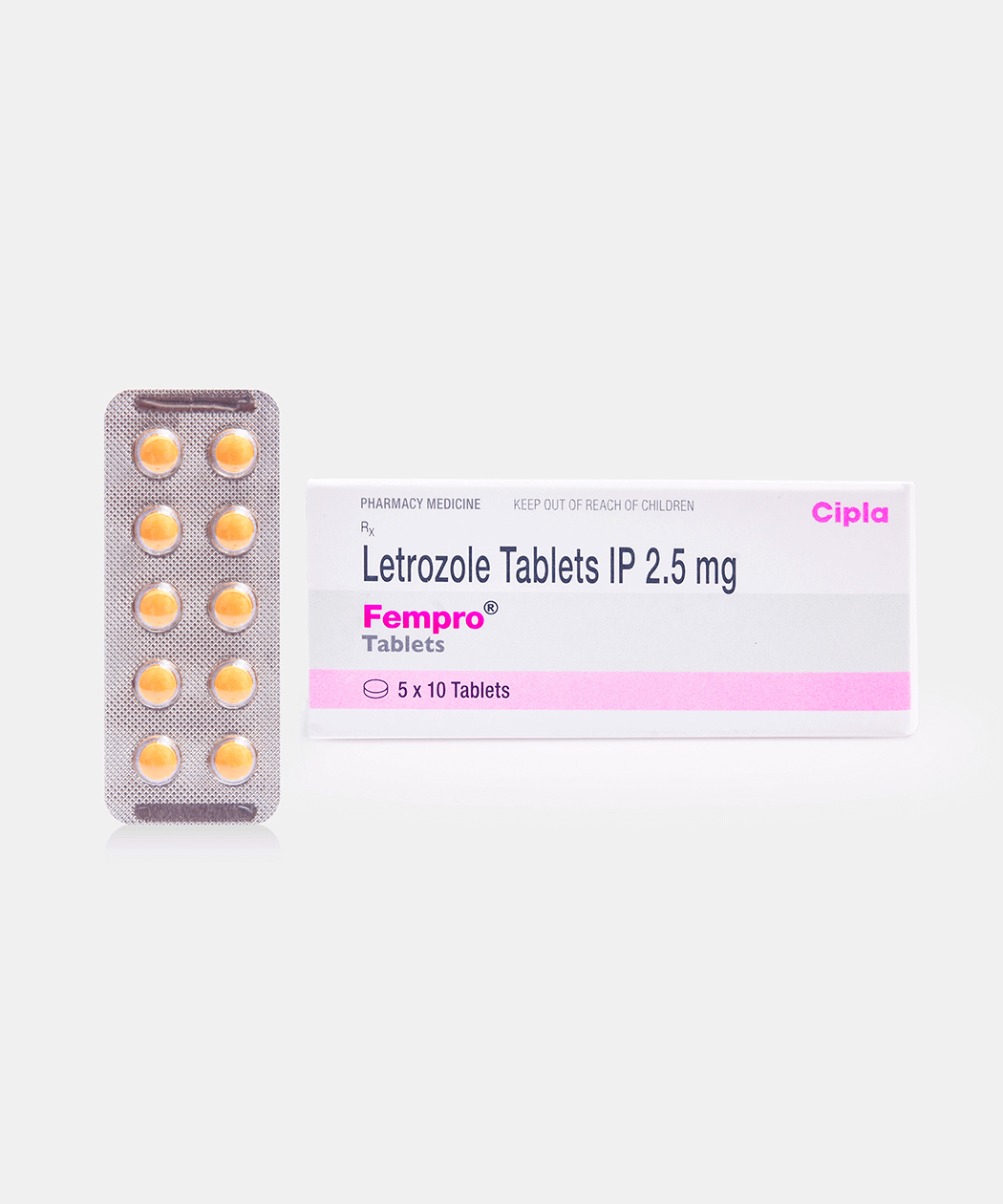

- The same estrogen-lowering action that fights breast cancer also makes letrozole an effective fertility drug that triggers ovulation.
- In women with polycystic ovary syndrome, randomized trials found letrozole produced higher live-birth rates than the long-standard clomiphene.
- Because it does not disturb the body's production of cortisol or aldosterone, its hormonal action stays narrowly focused on estrogen.
Mechanism
In postmenopausal women, is produced mainly in peripheral tissues such as fat, muscle, and skin, where the aromatase enzyme converts androgens into estrogens. Letrozole binds competitively and reversibly to the heme group of aromatase's cytochrome P450 unit, blocking this conversion and driving circulating estrogen levels sharply down [1]. In hormone-sensitive breast tumors, the resulting deprivation removes a key growth signal and slows or halts the proliferation of cancer cells [1].
In the ovaries, the temporary fall in releases the and pituitary from negative feedback, which raises follicle-stimulating hormone and encourages a follicle to mature and ovulate; this is the basis for its use in fertility treatment [2]. Because the enzyme is inhibited rather than permanently destroyed, the effect fades as the drug is cleared, and letrozole does not interfere with the production of corticosteroids or aldosterone.
receptor fingerprint
Aromatase (CYP19A1)inhibits
Circulating estradiol and estroneblocks
-driven breast tumor cellsblocks
Hypothalamic-pituitary feedbackmodulates
Ovarian follicle (FSH driven)activates
Dosingtypical ranges, not medical advice
interested in protocols and clinical dosages? make an account to see them! ^_^
Safetyrisks and cautions, not medical advice
This is a prescription drug. Because it strips out estrogen, common effects mirror menopause: hot flashes, joint and muscle aches, fatigue, headaches, and vaginal dryness. Long-term use in breast cancer speeds bone thinning and raises fracture risk, so bone density is watched and calcium, vitamin D, or bone medicines are often added, and cholesterol can rise. In fertility cycles side effects are usually milder and short lived, though there is a small chance of multiple pregnancy. It must not be used in pregnancy because it can harm a developing baby, and it is not used in women who are still fully premenopausal for cancer treatment without also shutting down ovarian function.
Interactionsdocumented pairs only, not exhaustive
Letrozole is a nonsteroidal aromatase inhibitor metabolized partly through CYP3A4 and undergoes glucuronidation. Letrozole itself acts as a CYP3A4 inhibitor of moderate strength; when combined with abemaciclib, a CDK4/6 inhibitor also metabolized by CYP3A4, both drugs exert combined inhibitory effects on CYP3A4, leading to reduced metabolism of abemaciclib and increased systemic exposure [23]. This is a bidirectional pharmacokinetic interaction. Conversely, potent CYP3A4 inducers such as rifampicin and carbamazepine would be expected to reduce letrozole levels, though published clinical studies quantifying this interaction are scarce. The interaction profile of letrozole with most CYP3A4 inhibitors and inducers remains largely undocumented, leaving substantial uncertainty about dose adjustments needed when letrozole is combined with other metabolized agents.
Checking a whole stack? Run it through interactions + stacks.
History
Letrozole was developed by the pharmaceutical company Ciba-Geigy, later Novatis, as a third-generation nonsteroidal aromatase inhibitor designed to suppress estrogen synthesis with high selectivity. It received US Food and Drug Administration approval in 1997 under the brand name Femara, initially for advanced breast cancer in postmenopausal women whose disease had progressed on antiestrogen therapy, and its indications later expanded to early-stage and extended adjuvant treatment.
In a notable turn, reproductive medicine researchers recognized that the same estrogen suppression could paradoxically stimulate ovulation, and in the early 2000s letrozole began to be studied as an ovulation-inducing agent. A landmark randomized trial later showed higher live-birth rates with letrozole than with clomiphene in women with polycystic ovary syndrome, establishing it as a first-line choice for that indication. It is also used off-label for endometriosis and remains a widely prescribed medicine in oncology and fertility care.
Reputation
Letrozole holds an excellent reputation across two very different fields, a rare distinction for a single drug. In hormone receptor-positive breast cancer it is a cornerstone endocrine therapy, valued for potently lowering estrogen and slowing tumors that depend on it. In reproductive medicine it has become a preferred agent for ovulation induction in polycystic ovary syndrome, where meta-analyses of randomized trials report higher ovulation, pregnancy, and live-birth rates than the older standard clomiphene, along with a favorable tendency toward single-follicle ovulation.
Its short half-life is an asset for fertility use, clearing quickly and reducing lingering antiestrogenic effects on the uterine lining. As with any aromatase inhibitor, estrogen deprivation can bring side effects such as hot flashes and joint aches. Overall, letrozole is a highly regarded, evidence-rich medicine in both oncology and fertility.
Subjective profileweighing the evidence above
Excellent at what it is for, which is hormone-positive breast cancer and first-line ovulation induction in PCOS, both under a doctor. The estrogen it strips out was doing other jobs; joint and muscle pain are common and long-term use thins bone, which is why it is monitored rather than self-prescribed.
Where to buy

1 other outlet

Suppliers
Vendors carrying Letrozole, with live product details and codes. Links are affiliate links that support the wiki at no cost to you.
PCT.Zone
Letrozole
RUPharma🌐
Letrozole
Research
- 1974first citedUtilization of oxygen and reduced nicotinamide adenine dinucleotide phosphate by human placenta…
- 2011most active year3 papers
- 2019meta-analysisLetrozole Compared With Clomiphene Citrate for Unexplained Infertility: A Systematic Review and…
- 2026most recentCYP3A4-Mediated Metabolism and Drug-Drug Interaction Potential of Abemaciclib and Letrozole In…
- 1.Assessment of letrozole and tamoxifen alone and in sequence for postmenopausal women with steroid hormone receptor-positive breast cancer: the BIG 1-98 randomised clinical trial at 8.1 years median follow-up.
- 2.Letrozole versus clomiphene for infertility in the polycystic ovary syndrome.
- 3.The emerging use of aromatase inhibitors for endometriosis treatment.
- 4.Medical methods for first trimester abortion.
- 5.Letrozole, Gonadotropin, or Clomiphene for Unexplained Infertility
- 6.Letrozole Compared With Clomiphene Citrate for Unexplained Infertility: A Systematic Review and Meta-analysis
- 7.A Review on the Use of Letrozole in Female and Male Infertility
- 8.Letrozole, berberine, or their combination for anovulatory infertility in women with polycystic ovary syndrome: study design of a double-blind randomised controlled trial
- 9.Controversial association between polycystic ovary syndrome and breast cancer
- 10.Potential role of aromatase inhibitors in the treatment of endometriosis
- 11.Treatment of endometriosis and chronic pelvic pain with letrozole and norethindrone acetate: a pilot study
- 12.Nonsurgical mouse model of endometriosis-associated pain that responds to clinically active drugs
25 listed here; entry last updated August 2026
Reviews
My notesprivate to this device
FAQ
How is letrozole different from clomiphene for fertility?
Letrozole lowers estrogen without blocking its receptors, so it often gives a single follicle and a thicker uterine lining, with good live birth rates in PCOS.
Will it thin my bones?
Long-term use in cancer care can, so doctors monitor bone density and may add calcium, vitamin D, or bone-protecting medicine.
Why do my joints ache on it?
Low estrogen commonly causes joint and muscle stiffness; gentle exercise and talking to your doctor can help manage it.
Can men use letrozole?
It is used off label to raise testosterone by reducing estrogen feedback, but only under supervision because crashing estrogen has its own downsides.
Is it safe in pregnancy?
No, it must be stopped before pregnancy and is only used to help conception in the days before ovulation, not once pregnant.
Adverse effects
- Joint and muscle pain
- Fatigue
- Dizziness
Notes and cautions
- Hot flushes
- Night sweats
- Reduced bone density over time