
spec sheet9 rows
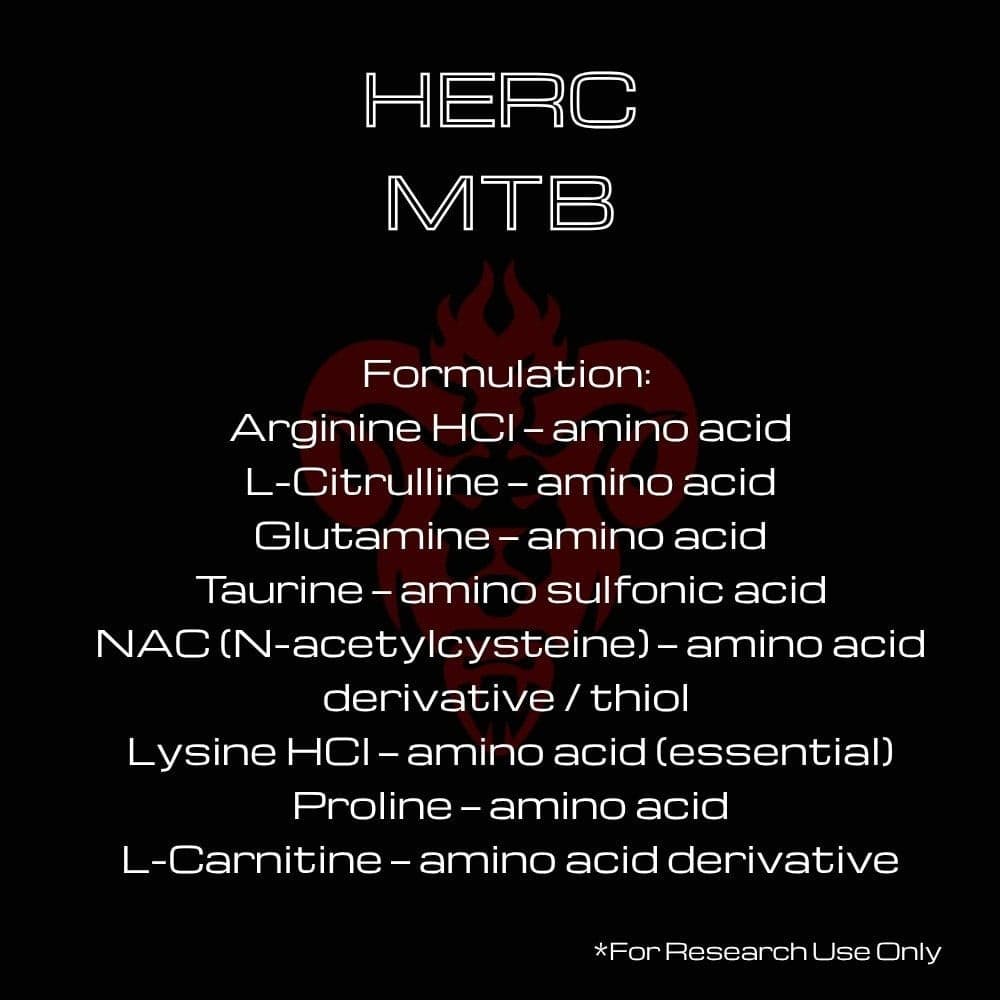
HERC (MTB) is a compounded amino acid blend engineered around the two levers endurance athletes care about most: blood flow and cellular energy. It pairs L-arginine and L-citrulline, which raise nitric oxide to widen vessels and improve muscle oxygenation, with L-carnitine, the carrier that ferries fatty acids into mitochondria for fuel, and L-glutamine for recovery and ammonia handling [1][2][6]. Each component rests on its own peer-reviewed evidence base, giving the blend a mechanistically grounded rationale [1][5][6]. It is supplied for laboratory research.
- Blood flow and cell energy in one blend
- Bigger, fuller pumps from nitric oxide
- Carnitine ferries fat into mitochondria for fuel
- Built for endurance that does not fade
- Glutamine handles recovery and ammonia clearance
- Every ingredient carries its own evidence base
- Amino acid blends can cause mild stomach upset or bloating in some people
- L-arginine may lead to loose stools or gastrointestinal discomfort
Overview
HERC (MTB) is a compounded, multi-ingredient amino acid formulation built around four constituents with complementary roles in exercise physiology: L-arginine, L-citrulline, L-carnitine, and L-glutamine. Rather than a single molecule, it is a blend whose logic is to combine a nitric oxide (vasodilation) axis with a fatty-acid energy axis and a recovery axis. It is supplied as a research-use preparation and is not an approved drug.
The vasodilation axis is driven by L-citrulline and L-arginine. L-arginine is the direct substrate for endothelial nitric oxide synthase, while L-citrulline is efficiently converted to arginine in the kidney and is, somewhat counterintuitively, a more reliable way to raise circulating arginine than arginine itself, because oral arginine is heavily degraded by intestinal and hepatic arginase before it reaches the bloodstream [1]. Human pharmacokinetic work confirms that oral citrulline is highly bioavailable, escapes first-pass metabolism, and increases both plasma citrulline and arginine [1]. Citrulline sources such as citrulline malate and watermelon concentrate have been shown to raise nitric oxide markers and improve skeletal-muscle oxygenation during exercise, though effects on actual endurance and strength outcomes have been mixed across trials [2][3][4].
The energy axis is L-carnitine, a compound the body synthesizes from lysine and methionine and one that is central to fat metabolism. Carnitine is required for the carnitine-palmitoyltransferase system that transports long-chain fatty acids across the mitochondrial membrane so they can be oxidized for ATP [7]. Supplemental L-carnitine has moderate-certainty evidence for reducing markers of exercise-induced muscle damage and soreness, supporting its inclusion for recovery as well as fuel handling [6]. The recovery axis, L-glutamine, is the most abundant free amino acid in the body and a fuel for gut and immune cells; controlled trials show oral glutamine can speed the recovery of muscle strength and reduce soreness after damaging eccentric exercise [5]. Together these constituents give HERC (MTB) an evidence-anchored, if individually modest, rationale for endurance and recovery support.
- Oral L-citrulline raises blood arginine, the precursor for nitric oxide, more effectively than taking arginine itself, because citrulline sidesteps the gut and liver breakdown that destroys most swallowed arginine.
- The nitric-oxide signaling pathway the blend targets was the subject of the 1998 Nobel Prize in Physiology or Medicine.
- Well-controlled trials show citrulline reliably shifts biochemical markers such as plasma nitric oxide, yet acute performance gains in trained athletes have often been absent, a candid gap between mechanism and measured output.
Mechanism
HERC (MTB) is designed to act through three parallel mechanisms that together support endurance performance and recovery. The first is enhanced blood flow via the pathway. L-arginine is the substrate that endothelial nitric oxide synthase converts into nitric oxide, the signaling gas that relaxes vascular smooth muscle and widens blood vessels, increasing oxygen and nutrient delivery to working muscle. Because oral arginine is largely broken down before it reaches the circulation, the blend leans on L-citrulline, which bypasses that loss; in controlled human studies oral L-citrulline was highly bioavailable and produced roughly a doubling of plasma arginine, the rate-limiting precursor for nitric oxide [1]. Citrulline supplementation likewise raises circulating nitrite and improves muscle oxygenation during exercise [2], and citrulline malate can elevate plasma citrulline nearly 9-fold after acute intake [3].
The second mechanism is fatty-acid energy provision through L-carnitine. Carnitine is the obligatory carrier of the carnitine-palmitoyltransferase shuttle, the system that moves long-chain fatty acids across the inner membrane so they can enter beta-oxidation and generate ATP [7]. By supporting this transport step, carnitine helps muscle draw on fat as fuel and spare glycogen, and pooled clinical evidence gives it moderate-certainty benefit for lowering post-exercise creatine kinase and muscle soreness [6]. The third mechanism is recovery and nitrogen handling via L-glutamine, the body's most abundant free amino acid, which fuels enterocytes and immune cells and participates in ammonia clearance; randomized trials show oral glutamine accelerates the return of muscle strength and reduces soreness ratings across a 72-hour recovery window after eccentric exercise [5].
The honest picture is that the mechanistic rationale is strong while the ergogenic evidence is mixed. Several rigorous trials of citrulline malate found no acute performance benefit in trained individuals despite clear biochemical changes, though some reported reduced muscle soreness [3][4]. The strength of HERC (MTB) is therefore its convergent, well-characterized biochemistry rather than any single dramatic performance effect, with the most consistent signals appearing in blood-flow markers, fat oxidation capacity, and recovery [1][5][6].
receptor fingerprint
(arginine, citrulline)raises
fatty acid oxidation (carnitine)supports
Glutamine / nitrogen and gutsupplies
Ammonia clearance (urea cycle)aids
Dosingtypical ranges, not medical advice
interested in protocols and clinical dosages? make an account to see them! ^_^
Safetyrisks and cautions, not medical advice
These are common amino acids with a friendly safety profile, so problems are usually mild and dose related; GI upset, loose stools, or bloating at higher amounts. Arginine and citrulline can lower blood pressure, which matters if you are on antihypertensives or nitrates, and high dose arginine can reactivate cold sores in susceptible people. Glutamine is generally gentle but is worth caution in significant liver disease. The main caveat is that this is a research chemical blend for lab use, so the exact ratios, purity, and sterility are on the buyer to confirm. It is not approved for human or veterinary use.
History
HERC (MTB) is a compounded amino acid blend assembled around ingredients whose individual physiology is well established rather than a single discovered molecule, and it is supplied for laboratory research. Its design draws on the nitric oxide pathway first illuminated in the 1980s and 1990s, work recognized by the 1998 Nobel Prize in Physiology or Medicine for identifying nitric oxide as a signaling molecule that relaxes blood vessels, and on the recognition that L-arginine is the substrate endothelial nitric oxide synthase converts into that gas.
Because oral arginine is largely degraded before reaching the circulation, the formulation leans on L-citrulline, which bypasses first-pass metabolism and reliably raises plasma arginine, a property documented in controlled human pharmacokinetic studies. To these it adds L-carnitine, the obligatory carrier that shuttles fatty acids into mitochondria, and L-glutamine, the body's most abundant free amino acid, chosen for recovery and nitrogen handling. The blend therefore reflects an engineering choice to combine several separately validated components rather than a discrete invention with a dated origin.
Reputation
HERC (MTB) is built on an appealing and mechanistically coherent premise: pull the two levers endurance athletes care about most, blood flow and cellular energy, using ingredients that each carry their own peer-reviewed evidence base. The citrulline component is genuinely well supported at the biochemical level, reliably raising plasma arginine and nitric oxide markers and improving muscle oxygenation, while carnitine has moderate-certainty evidence for lowering post-exercise muscle damage and soreness, and glutamine has randomized data for speeding recovery of strength.
The honest picture is that its mechanistic rationale is stronger than its proven ergogenic punch: several rigorous trials of citrulline malate found no acute performance benefit in trained individuals despite clear biochemical changes, though some reported reduced soreness or improved muscular endurance. Its real strength is convergent, well-characterized biochemistry across blood flow, fat oxidation, and recovery rather than any single dramatic effect, and it is candidly positioned as a research-grade blend.
Subjective profileweighing the evidence above
The ingredients are real and reasonably evidenced individually, and citrulline with carnitine is a sensible endurance pairing. The catch is that this is a fixed research blend, so the ratios are set for you; buying the separate aminos at the doses studies actually used is the better value.
Where to buy
Suppliers
Vendors carrying Herc (mtb), with live product details and codes. Links are affiliate links that support the wiki at no cost to you.
Kimera Chems
HERC (MTB)
Research
- 2007first citedManipulation of citrulline availability in humans.
- 2025most recentAcute effects of combined supplementation of L-arginine and citrulline malate on aerobic, anaer…
- 1.Manipulation of citrulline availability in humans.
- 2.Two weeks of watermelon juice supplementation improves nitric oxide bioavailability but not endurance exercise performance in humans.
- 3.Acute Citrulline-Malate Supplementation and High-Intensity Cycling Performance.
- 4.Citrulline Malate Fails to Improve German Volume Training Performance in Healthy Young Men and Women.
- 5.The Influence of Oral L-Glutamine Supplementation on Muscle Strength Recovery and Soreness Following Unilateral Knee Extension Eccentric Exercise.
- 6.Nutritional interventions for exercise-induced muscle damage: an umbrella review of systematic reviews and meta-analyses of randomized trials.
- 7.Carnitine palmitoyltransferase 1A P479L and infant death: policy implications of emerging data.
- 8.Acute effects of combined supplementation of L-arginine and citrulline malate on aerobic, anaerobic, and CrossFit exercise performance
- 9.Changes in resistance training performance, rating of perceived exertion, and blood biomarkers after six weeks of supplementation with L-citrulline vs. L-citrulline DL-malate in resistance-trained men: a double-blind placebo-controlled trial
9 listed here; entry last updated August 2026
Reviews
My notesprivate to this device
FAQ
What is HERC (MTB)?
A research amino acid blend combining arginine and citrulline for nitric oxide with L-carnitine and glutamine for mitochondrial energy and recovery.
What is it used for?
It targets blood flow and cellular energy, the classic levers for endurance and pump. As a blend it is lightly studied, but the individual aminos are well researched.
Is citrulline better than arginine?
For raising nitric oxide, yes; citrulline dodges first pass breakdown and lifts plasma arginine more reliably than arginine itself, so the two together cover both bases.
Is it approved for people?
No. It is supplied for laboratory research only, not for human or veterinary use.
Adverse effects
- Amino acid blends can cause mild stomach upset or bloating in some people
- L-arginine may lead to loose stools or gastrointestinal discomfort
Notes and cautions
- L-citrulline is generally well tolerated
- L-carnitine can produce a fishy body odor in a minority of individuals
- Effects on athletic performance are inconsistent across studies