
spec sheet13 rows
Triamcinolone acetonide is a synthetic corticosteroid, the acetonide ester of triamcinolone, valued for strong anti-inflammatory and immunosuppressive action. Forming a cyclic ketal across the 16- and 17-positions makes it markedly more potent and longer-lasting than the parent compound, on the order of eight times as strong as prednisone. It is one of the most widely used steroids in dermatology and is also injected into joints, skin lesions and the eye, and delivered as a nasal spray for allergies.
- Roughly eight times the potency of prednisone
- One depot shot can quiet an inflamed joint for weeks
- A dermatology workhorse for stubborn skin flare ups
- Flattens and softens keloids and thick raised lesions
- Also delivered as a nasal spray for allergies
- Calms inflammation fast wherever it is placed
- Raised eye pressure with intraocular use
- Cataract with intraocular use
- Menstrual changes or flushing
Overview
Triamcinolone acetonide is a synthetic glucocorticoid corticosteroid formed by joining an acetonide group across the 16-alpha and 17-alpha hydroxyls of triamcinolone. Chemically it is a halogenated, cyclic-ketal pregnane steroid; the acetonide bridge increases lipophilicity and receptor affinity, so the derivative is considerably more potent and longer-acting than triamcinolone itself, roughly eight times the strength of prednisone [1]. It binds the glucocorticoid receptor with high selectivity, showing little interaction with androgen or estrogen receptors but retaining modest affinity for the progesterone receptor, which underlies some of its endocrine effects [5].
The molecule emerged from mid-twentieth-century efforts to refine cortisol-derived steroids into more effective topical and depot agents, and it became one of the most commercially important corticosteroids. It is sold under many brand names, among them Kenalog for injection and topical use, Nasacort for intranasal allergy relief, and Xipere for suprachoroidal ophthalmic delivery.
Clinically the acetonide is a mainstay of dermatology, applied as creams, ointments and lotions for eczema, psoriasis and contact reactions including poison ivy, and it is combined with the antifungal nystatin for inflamed, infected skin. Injectable suspensions are placed into joints for arthritis, into hypertrophic and keloid scars, and into the vitreous or suprachoroidal space for macular edema linked to diabetic retinopathy and uveitis [3][1]. Dental pastes treat mouth ulcers, and metered nasal sprays relieve allergic rhinitis. It also has veterinary applications for itching in animals.
Regulatory status varies by formulation; injectable and most topical products are prescription-only in the United States, the United Kingdom, Australia and the European Union, while the intranasal spray is sold over the counter in the United States following its 2014 switch. The drug is available generically in numerous dosage forms. Its metabolism is hepatic, carried out largely by CYP3A enzymes, with elimination split between urine and feces [2].
Adverse effects mirror those of other potent glucocorticoids. Intraocular use raises the risk of increased eye pressure and cataract [3], repeated or excessive local injection can lead to iatrogenic Cushing's syndrome and adrenal suppression [6], and corticosteroid injections have been associated with sex-related effects including menstrual irregularity and flushing [4]. Because of its progesterone-receptor activity, the acetonide can also inhibit ovulation through suppression of the hypothalamic-pituitary-ovarian axis [5].

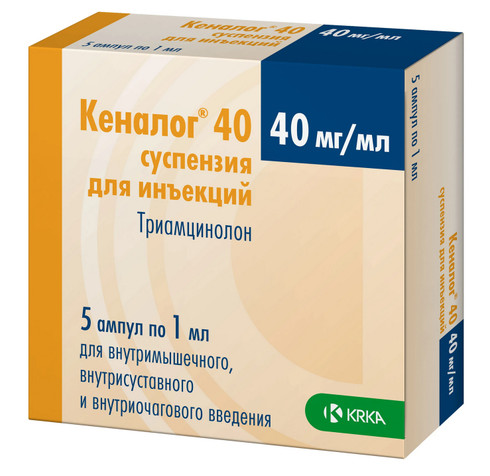
- A single chemical bridge across the steroid, the acetonide ketal, is what lets injected triamcinolone acetonide keep working in a joint or lesion for weeks rather than days.
- It is roughly eight times as potent as prednisone, weight for weight.
- In 2017 an engineered extended-release version delivering the drug from tiny biodegradable microspheres was approved specifically for knee osteoarthritis, modernizing a medicine first used in the 1950s.
Mechanism
Triamcinolone acetonide acts as a glucocorticoid-receptor . Being highly , it diffuses across cell membranes and binds the cytoplasmic glucocorticoid receptor; the resulting complex translocates to the nucleus and regulates transcription at glucocorticoid response elements, raising anti-inflammatory gene products while repressing pro-inflammatory cytokines, chemokines and enzymes and their prostaglandin and leukotriene products [1]. The acetonide bridge across the 16,17 positions, together with the 9-alpha-fluorine of the parent steroid, increases receptor binding and prolongs tissue residence, making the drug more potent and slower to clear than triamcinolone and allowing depot formulations to act over weeks [1].
Receptor profiling shows strong glucocorticoid selectivity with negligible androgen or binding but roughly fifteen percent progesterone-receptor affinity, which can translate into endocrine effects including disruption of ovulation by way of the hypothalamic-pituitary-ovarian axis [5]. Systemically it is metabolized chiefly by hepatic CYP3A enzymes to weaker products [2]. When injected as a poorly soluble suspension it forms a local depot, giving a sustained regional anti-inflammatory effect while limiting, though not eliminating, systemic absorption [6].
receptor fingerprint
Glucocorticoid receptor (NR3C1)agonist
Nuclear factor kappa B signalinginhibits
Phospholipase A2 (via annexin A1)inhibits
Pro-inflammatory cytokinesinhibits
Leukocyte migration and immune responsemodulates
Dosingtypical ranges, not medical advice
interested in protocols and clinical dosages? make an account to see them! ^_^
Safetyrisks and cautions, not medical advice
This is a prescription medicine. A local injection can bring pain at the site, thinning of the skin or fat where it goes in, loss of pigment, and, rarely, a joint infection. Higher doses or prolonged use unlock the classic steroid problems: suppression of the adrenal (HPA) axis, higher blood sugar, weight gain, fluid retention, osteoporosis, cataracts, mood swings, and a greater chance of infection. It should not be injected into a joint that is already infected, and it is avoided in untreated systemic fungal infection; use caution in diabetes and any active infection. After prolonged systemic use it has to be tapered rather than stopped abruptly, since the adrenal glands need time to recover.
Interactionsdocumented pairs only, not exhaustive
Triamcinolone acetonide, a glucocorticoid, demonstrates a pharmacodynamic interaction with vitamin D3; corticosteroids inhibit intestinal calcium absorption, and concurrent vitamin D3 administration can partially counteract this adverse effect and improve calcium transport [8]. The interaction occurs at the intestinal level where both hormones influence calbindin-D28K expression and calcium-binding protein synthesis; low-dose glucocorticoids may enhance vitamin D3 effects while high doses oppose them [9].
As a CYP3A4-metabolized drug, triamcinolone acetonide is subject to pharmacokinetic interactions with CYP3A4 inhibitors (which would increase systemic exposure) and inducers (which would decrease it), though specific clinical studies documenting these interactions in humans are scarce. Common combinations with anti-infectives, antidepressants, and other agents lack published interaction data.
Checking a whole stack? Run it through interactions + stacks.
History
Triamcinolone acetonide is the acetonide ester of triamcinolone, created by bridging the 16 and 17 positions of the parent steroid with a cyclic ketal, a modification that markedly increases potency and prolongs its residence in tissue. Like its parent it entered medical use around 1958, and it quickly overshadowed plain triamcinolone in everyday practice because the ester's longer action suited both topical preparations and injectable depot formulations.
Marketed under names such as Kenalog and Nasacort, it became one of the most widely used steroids in dermatology and a mainstay for injection into joints, skin lesions, and the eye. Its depot behavior, in which a poorly soluble suspension forms a local reservoir that releases drug over weeks, made it especially useful for sustained regional treatment. That principle was extended in 2017 with the approval of an extended-release microsphere formulation, Zilretta, developed for osteoarthritis of the knee, giving the long-established molecule a modern, engineered delivery system.
Reputation
Triamcinolone acetonide is one of the most trusted and heavily used corticosteroids in clinical practice, prized for delivering strong, durable anti-inflammatory relief right where it is needed. Dermatologists rely on it as a workhorse topical and intralesional agent for inflammatory skin disease and stubborn scars, while orthopedists and rheumatologists value its depot injections for calming painful joints over weeks from a single administration.
Its long tissue residence, on the order of eight times the potency of prednisone, is central to its usefulness, and newer extended-release forms have refined that staying power further for knee osteoarthritis. Candor requires noting the trade-offs of any potent steroid, including local skin thinning or pigment change at injection sites and the possibility of systemic effects when doses are large or repeated. For targeted, sustained control of inflammation, however, it remains a highly regarded and remarkably practical option.
Subjective profileweighing the evidence above
Very effective at what it does, and one depot injection can quiet an inflamed joint or a stubborn skin lesion for weeks. The cost shows up with repetition: skin and fat atrophy at the site, adrenal suppression, higher blood sugar, and cataract or raised eye pressure with intraocular use. A prescribed tool, deliberately spaced out.
Where to buy
1 other outlet

Suppliers
Vendors carrying Triamcinolone Acetonide, with live product details and codes. Links are affiliate links that support the wiki at no cost to you.
PCT.Zone
Triamcinolone Acetonide
RUPharma🌐
Triamcinolone Acetonide
Research
- 1978first citedThe mechanism of ovulation inhibition by triamcinolone acetonide
- 2020meta-analysisIntravitreal steroids for macular edema in diabetes
- 2025most recentImproved Pain and Function With Triamcinolone Acetonide Extended-Release and Cryoneurolysis for…
- 1.Corticosteroids in ophthalmology: drug delivery innovations, pharmacology, clinical applications, and future perspectives
- 2.Metabolic pathways of inhaled glucocorticoids by the CYP3A enzymes
- 3.Intravitreal steroids for macular edema in diabetes
- 4.Corticosteroid Injections: A Review of Sex-Related Side Effects
- 5.The mechanism of ovulation inhibition by triamcinolone acetonide
- 6.Local Injection of Triamcinolone Acetonide: A Forgotten Aetiology of Cushing's Syndrome
- 7.Improved Pain and Function With Triamcinolone Acetonide Extended-Release and Cryoneurolysis for Knee Osteoarthritis: Use of a New Real-World Registry
- 8.25-Hydroxycholecalciferol as an antagonist of adverse corticosteroid effects on phosphate and calcium metabolism in man.
- 9.Positive cotranscriptional regulation of intestinal calbindin-D28K gene expression by 1,25-dihydroxyvitamin D3 and glucocorticoids.
9 listed here; entry last updated August 2026
Reviews
My notesprivate to this device
FAQ
How long does one injection last?
Because the crystals dissolve slowly, a single depot injection can keep working locally for several weeks, sometimes longer in a large joint.
Is it the same as the steroids bodybuilders use?
No; it is a corticosteroid that calms inflammation, not an anabolic steroid that builds muscle. They are completely different families.
Can it be injected into any joint?
Not if the joint might be infected; injecting a steroid into an infected joint can make things much worse, so infection has to be ruled out first.
Why can't I just keep using it?
Repeated or high-dose use brings steroid side effects like adrenal suppression, bone thinning, and cataracts, so it is given in measured courses rather than continuously.
Will a single shot cause the classic steroid side effects?
A single local injection rarely does; the whole-body problems like weight gain and high blood sugar mostly come with higher doses or long-term use.
Adverse effects
- Raised eye pressure with intraocular use
- Cataract with intraocular use
- Menstrual changes or flushing
Notes and cautions
- Skin thinning at application sites
- Iatrogenic Cushing's with repeated injection
- Adrenal suppression