
spec sheet6 rows
Komfoderm is a Russian ointment of methylprednisolone aceponate, a non-halogenated potent corticosteroid for eczema and dermatitis.
- Activated by esterases inside inflamed skin, exactly where needed
- Potent control of eczema and dermatitis
- Cleared fast by the liver once it gets there
- Less systemic exposure than an older halogenated steroid
- A sensible step up for stubborn body plaques
- Non halogenated potency in a simple Russian ointment
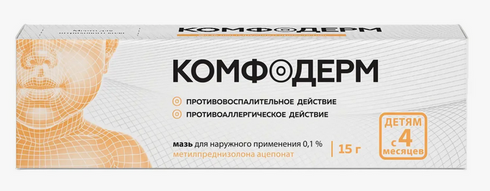
- Methylprednisolone aceponate is a fourth-generation non-halogenated topical corticosteroid; the C6 methyl group confers higher intrinsic activity and it sits in the potent class III/IV band [1].
- Head to head against mometasone furoate, the other agent with the highest therapeutic index, MPA showed higher nuclear receptor binding specificity and induced markedly less skin atrophy and fewer telangiectasias in a rodent model [5].
- It is licensed once daily rather than twice, improving compliance and lowering total steroid exposure without compromising efficacy [2].
- It gives fast itch relief in children and infants as young as 2 months with atopic dermatitis [4].
- Contact sensitisation to the molecule occurs and cross-reacts: a girl already sensitised to hydrocortisone-17-butyrate went on to react to 6-alpha-methylprednisolone aceponate [6].
Mechanism
The diester is applied inactive and is hydrolysed by esterases in inflamed skin to the active 17-propionate, which binds the glucocorticoid receptor there. Whatever reaches the circulation is inactivated quickly in the liver, and that split between local activation and rapid systemic clearance is the design goal: high potency in the plaque with less systemic exposure than a halogenated steroid of similar strength.
receptor fingerprint
Glucocorticoid receptor (NR3C1)Agonist; the non-halogenated C17/C21 diester is hydrolysed in inflamed skin to the more active 17-propionate, so activation is greatest where esterase activity is highest
Nuclear receptor selectivity (androgen, mineralocorticoid and progesterone receptors)Higher specificity in nuclear receptor binding than mometasone furoate, meaning less cross-binding to off-target steroid receptors
Dermal collagen synthesis and cutaneous microvasculatureInduces markedly less skin atrophy and fewer telangiectasias than mometasone furoate in a rodent model at comparable anti-inflammatory effect
Pruritus signalling in atopic skinRapid antipruritic effect demonstrated in children and infants as young as 2 months
Safetyrisks and cautions, not medical advice
A potent topical corticosteroid; continuous use thins skin and it should not be used on the face or in flexures without instruction.
Subjective profileweighing the evidence above
Applied inactive and switched on by esterases inside inflamed skin, then cleared fast by the liver once it gets that far, this is a better bargain than an older halogenated steroid of similar strength. None of that changes the local arithmetic: it is a potent steroid, continuous use thins skin, and the face and the flexures are where people get into trouble. For a stubborn body plaque that a mild steroid failed to clear, used in short courses, it is a sensible step up.
Where to buy
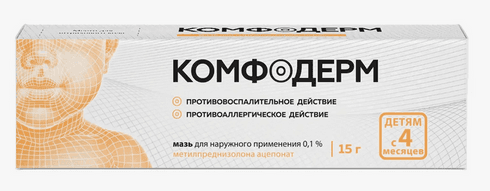
Suppliers
Vendors carrying Methylprednisolone aceponate, with live product details and codes. Links are affiliate links that support the wiki at no cost to you.
RUPharma🌐
Methylprednisolone aceponate
Research
- 1997first citedContact sensitization to 6 alpha-methylprednisolone aceponate.
- 2017most recentMethylprednisolone aceponate for atopic dermatitis.
- 1.Methylprednisolone aceponate for atopic dermatitis.
- 2.Methylprednisolone aceponate in eczema and other inflammatory skin disorders -- a clinical update.
- 3.Balancing efficacy and safety in the management of atopic dermatitis: the role of methylprednisolone aceponate.
- 4.Frontiers of rapid itch relief: a review of methylprednisolone aceponate.
- 5.Superior nuclear receptor selectivity and therapeutic index of methylprednisolone aceponate versus mometasone furoate.
- 6.Contact sensitization to 6 alpha-methylprednisolone aceponate.
6 listed here; entry last updated August 2026
Reviews
My notesprivate to this device
Notes and cautions
- MPA has no boxed warning and its defining property is a wide therapeutic index, with minimal local or systemic adverse effects reported even in infants and children (PMID 28258632, PMID 21294777).
- Class risks still apply where use is prolonged, occluded or on thin skin: atrophy, striae, telangiectasia, perioral dermatitis and HPA-axis suppression, and children absorb proportionally more per unit body surface area.
- Allergic contact dermatitis to the steroid itself is real and cross-reacts with hydrocortisone-17-butyrate, so a patient whose eczema paradoxically worsens should be patch-tested rather than escalated [6].