
spec sheet12 rows
Selank is a synthetic peptide anxiolytic and nootropic derived from the immune peptide tuftsin, developed in Russia as a non-sedating, non-addictive alternative to conventional anti-anxiety drugs. It eases anxiety while supporting memory and attention, and animal research links these effects to modulation of GABA, serotonin, and brain-derived neurotrophic factor. Typically given as a nasal spray, it offers calm and cognitive support without the dependence or withdrawal associated with benzodiazepines.
- Calm, clear headed focus
- Eases anxiety without sedation
- Non addictive, no withdrawal
- Supports memory and attention
- Easy nasal spray delivery
- Nice mood lift on top
- Mild nasal irritation
- Some tiredness in a few people
- Occasional headache
Overview
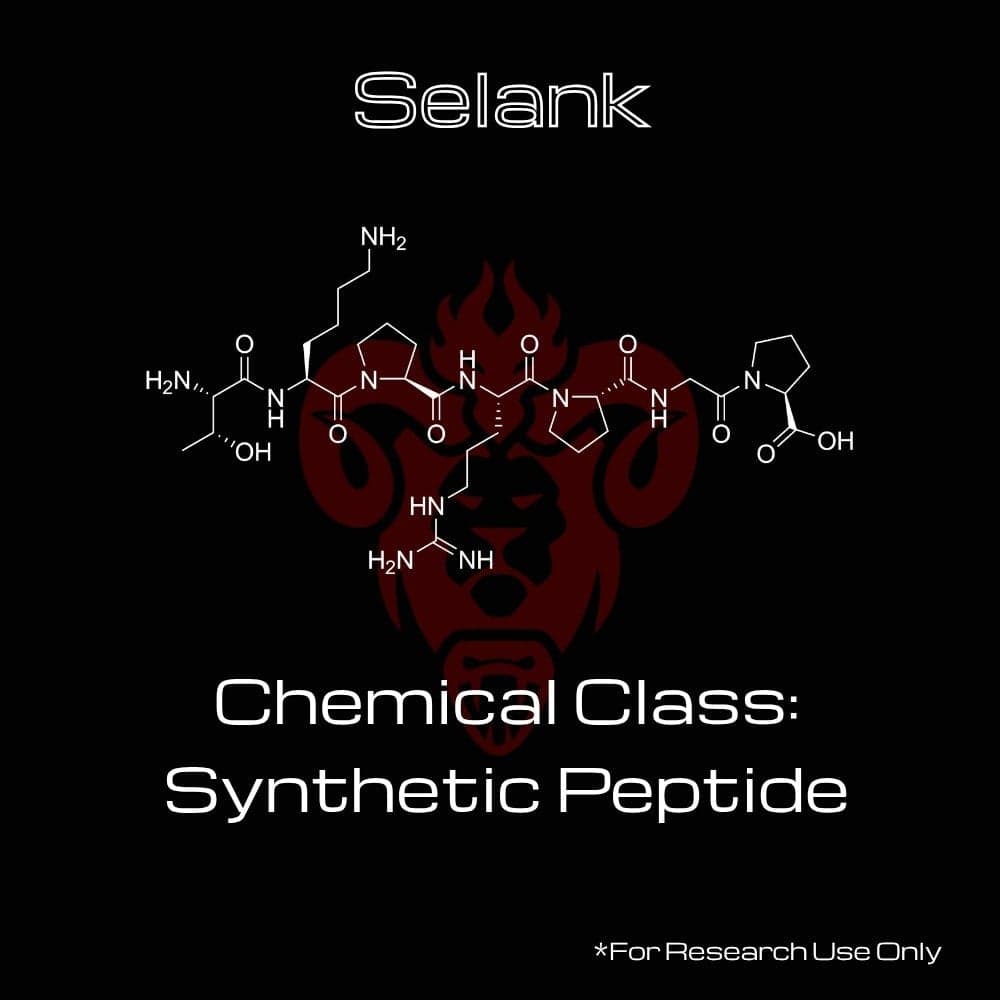
Selank is a synthetic heptapeptide, chemically the tuftsin fragment Thr-Lys-Pro-Arg extended with the tripeptide Pro-Gly-Pro, and it is also referenced in the literature under the code TP-7 [3][4]. It was created at the Zakusov Research Institute of Pharmacology in Russia as a stable, longer-acting analogue of the endogenous immunomodulatory peptide tuftsin, and it is classified pharmacologically as an anxiolytic with nootropic and antiviral properties [3].
Its research profile centers on anxiety, memory, and stress. Long-term dosing studies in emotionally reactive rats showed that the heptapeptide reduced anxiety-phobic states within days and sustained that effect over weeks without altering body weight [3], while related work demonstrated anxiolytic action tied to normalization of brain serotonin metabolism [4]. More recent studies connect Selank to neurotrophin biology, reporting that it protects against ethanol-induced memory impairment and regulates brain-derived neurotrophic factor in the hippocampus and prefrontal cortex [1]. It has also been shown to change the expression of genes for chemokines, cytokines, and their receptors, consistent with its tuftsin-derived immunomodulatory heritage [2].
In Russia and neighboring countries Selank has been used clinically as an anxiolytic, but it is not approved by the United States Food and Drug Administration or the European Medicines Agency, so in most of the world it is an unapproved research peptide [1][3]. It is most commonly formulated as an intranasal solution, a route that suits its peptide chemistry and supports delivery toward the central nervous system. Interest in Selank rests on the idea of a peptide that calms anxiety and supports cognition through endogenous regulatory systems, described in the literature as fast-acting and largely free of the side effects associated with classic sedatives [3].
- Selank is built from tuftsin, a peptide the immune system naturally produces to activate white blood cells.
- In early Russian studies the peptide carried the laboratory code TP-7 before it became known as Selank.
Mechanism
Selank produces its calming and cognitive effects through several interacting systems rather than a single receptor. A central thread in the research is modulation of the inhibitory neurotransmitter systems and monoamines; early studies showed that the tuftsin analogue normalized levels in the brains of animals with disrupted serotonergic activity, linking its anxiolytic action to restoration of serotonin balance and investigatory behavior [4]. This monoamine modulation, together with effects attributed to the system, underlies its reputation as an anxiolytic that calms without heavy sedation [3][4].
A second and increasingly emphasized mechanism is neurotrophic support. In rats exposed to chronic ethanol, Selank prevented memory and attention disturbances during withdrawal and produced a cognition-stimulating effect, and these behavioral benefits were accompanied by regulation of brain-derived neurotrophic factor content in the and frontal [1]. Because brain-derived neurotrophic factor is a key driver of plasticity, this action provides a plausible molecular route for the memory and learning benefits reported with the [1].
Selank also carries the immunomodulatory signature of its parent tuftsin. Gene-expression studies found that a single dose significantly changed the messenger RNA levels of numerous chemokines, cytokines, and their receptors in the spleen, effects shared with its minimal active fragment Gly-Pro, which has been identified as a pharmacophore with antiviral activity [2]. Quantitative human effect sizes are limited in the peer-reviewed literature, so the strongest defensible evidence is the reproducible anxiolytic effect seen across rodent models, sustained over four weeks of treatment without tolerance or weight change in controlled experiments [3]. Together these strands describe a that reduces anxiety, supports memory, and engages immune signaling through the body's own regulatory peptides [1][2][3].
receptor fingerprint
Tuftsin / immune pathwaymimics
/ modulates
Enkephalinaseinhibits
Dosingtypical ranges, not medical advice
interested in protocols and clinical dosages? make an account to see them! ^_^
Safetyrisks and cautions, not medical advice
Selank has a clean short-term profile in Russian clinical and community use, with mild nasal irritation the most common gripe, plus the occasional bit of tiredness, headache, or mild dizziness. Because it works through GABA, the one real caution is stacking it with other strong GABAergic agents (benzos, phenibut, alcohol), where additive calming could tip into sedation. It is non-addictive and does not cause withdrawal. It is used clinically in Russia but is not an approved medicine in most of the West, where it is sold as a research peptide, so long-term human data is limited; if you reconstitute peptide yourself, sterile handling matters. Not medical advice.
Reconstitutionarithmetic only, not dosing advice
arithmetic only; not medical or dosing advice.
History
Selank is a synthetic heptapeptide developed in Russia at the V.V. Zakusov Research Institute of Pharmacology, working with the Institute of Molecular Genetics of the Russian Academy of Sciences. It was designed as an analogue of the endogenous immune peptide tuftsin, extending the tuftsin sequence with a Pro-Gly-Pro tail to improve metabolic stability; in the early literature the molecule was designated TP-7. Foundational pharmacological work in the 1990s by Seredenin, Semenova and colleagues characterized its anxiolytic and mild psychostimulant profile and its normalization of brain serotonin metabolism. Selank was subsequently studied as a non-sedating, non-addictive anxiolytic and has been used in Russia as a nasal formulation, though it has not received regulatory approval in Western markets.
Reputation
Selank is well regarded among peptide enthusiasts as a gentle, non-sedating way to ease anxiety while supporting focus and memory, a profile that sets it apart from benzodiazepines and their dependence and withdrawal problems. Reviewers frequently highlight its favorable tolerability, the absence of tolerance across weeks of dosing in animal studies, and its intriguing dual identity as both an anxiolytic and an immunomodulator inherited from tuftsin. The convenience of intranasal delivery adds to its practical appeal. Honesty requires noting that most controlled evidence remains preclinical or from smaller Russian clinical studies, and large Western trials with quantified human effect sizes are lacking. Even so, its reproducible calming effect and clean safety record keep it a favorite in the nootropic community.
Subjective profileweighing the evidence above
Selank is alright, but it doesn't earn much enthusiasm here; for calm, anxiolytic, mood-focused goals Picamilon or GB-115 are the better direction, they tend to deliver more of what people actually want from it.
Where to buy


Suppliers
Vendors carrying Selank, with live product details and codes. Links are affiliate links that support the wiki at no cost to you.
| supplier | size | price | $/mg |
|---|---|---|---|
| Limitless Biochemlowest | 10mg | $32.00 | $3.20/mg |
| Moglabs | 5mg | $26.00 | $5.20/mg |
| RUO | 5mg | $26.00 | $5.20/mg |
| Moglabs | 5mg | $36.00 | $7.20/mg |
RUPharma🌐
Selank
Exceed Enhancement
Selank
RUO
Selank
Moglabs
Selank
Kimera Chems
Selank
Limitless Biochem🌐
Selank

Moglabs
Selank
Peptira
Selank
Research
- 1995first citedThe characteristics of the anxiolytic action of taftsin and its analog TP-7 on behavior and ser…
- 2017most active year4 papers
- 2022most recentSelank, a Peptide Analog of Tuftsin, Attenuates Aversive Signs of Morphine Withdrawal in Rats.
- 1.Selank, Peptide Analogue of Tuftsin, Protects Against Ethanol-Induced Memory Impairment by Regulating of BDNF Content in the Hippocampus and Prefrontal Cortex in Rats.
- 2.Changes in expression of the genes for chemokines, cytokines, and their receptors in response to selank and its fragments.
- 3.Influence of long-term treatment with tuftsin analogue TP-7 on the anxiety-phobic states and body weight.
- 4.The characteristics of the anxiolytic action of taftsin and its analog TP-7 on behavior and serotonin metabolism in the brain of rats with chronic deprivation of serotoninergic system activity.
- 5.Selank, a Peptide Analog of Tuftsin, Attenuates Aversive Signs of Morphine Withdrawal in Rats.
- 6.The temporary dynamics of inflammation-related genes expression under tuftsin analog Selank action.
- 7.Expression of inflammation-related genes in mouse spleen under tuftsin analog Selank.
- 8.Selank Administration Affects the Expression of Some Genes Involved in GABAergic Neurotransmission.
- 9.[Transcriptome alteration in hippocampus under the treatment of tuftsin analog Selank].
- 10.GABA, Selank, and Olanzapine Affect the Expression of Genes Involved in GABAergic Neurotransmission in IMR-32 Cells.
- 11.Effect of Selank on Spontaneous Synaptic Activity of Rat Hippocampal CA1 Neurons.
- 12.Functional Connectomic Approach to Studying Selank and Semax Effects.
25 listed here; entry last updated August 2026
Reviews
- Sleep improvement
Selank boosted my sleep quality, but it was not the only thing responsible. Putting my phone down 30 minutes before bed and using Selank nightly improved my sleep quality. It calms my anxiety at night
0
My notesprivate to this device
FAQ
What is Selank?
It is a peptide developed in Russia related to a fragment of the immune molecule tuftsin, used for anti-anxiety effects. It is often taken as a nasal spray.
Does it cause sedation?
It is generally described as calming without strong sedation. Many use it aiming for relaxed focus during the day.
Why is it given intranasally?
Peptides break down quickly if swallowed, so nasal delivery is used to improve absorption. Effects from a dose are relatively short-lived.
Is it widely approved?
It is used in Russia but is not an approved medicine in most Western countries. Research outside Russia is limited.
Adverse effects
- Mild nasal irritation
- Some tiredness in a few people
- Occasional headache
- Mild dizziness
Notes and cautions
- Selank is given as nasal drops, and the route is documented in the primary literature rather than only in product labelling. A tritium labelling study measured Selank pharmacokinetics in brain tissue after intranasal dosing and identified its main breakdown fragments [23]. A direct comparison of intraperitoneal, intranasal, intragastric and intravenous delivery concluded that the intranasal route was the best of the four for getting these glyproline peptides into the central nervous system [24]. Intranasal Selank raised BDNF expression in the rat hippocampus [25], and a five day intranasal course in mice shifted NMDA receptor binding in a way that intraperitoneal dosing did not, which the authors read as a route dependent difference in pharmacokinetics [21]. What is missing is human route data: the published clinical trials of Selank in anxiety disorders do not state the administration route in their abstracts, and no study measures Selank in human blood or cerebrospinal fluid after a nasal dose.