
spec sheet11 rows
Orexin-A, also known as hypocretin-1, is a 33-amino-acid neuropeptide produced by a small population of neurons in the lateral hypothalamus that is central to promoting wakefulness and arousal. It is one of two orexin peptides cut from a single precursor and signals through two G-protein-coupled receptors. Narcolepsy type 1 is essentially an orexin-deficiency disease, in which the roughly 70,000 orexin-producing neurons are selectively destroyed and cerebrospinal-fluid orexin becomes undetectable; this is the rationale for orexin-2 receptor agonists now in clinical trials as the first mechanism-based, replacement-style treatment rather than a symptomatic stimulant. Since its discovery in 1998 the orexin system has become a major target in sleep medicine.
- The brain's own wakefulness switch
- Drives clean, natural alertness
- Sharpens attention when sleep runs short
- Linked to better memory under fatigue
- Holds the wake and sleep switch steady
- Nasal spray capable; no needles
- As an arousal-promoting signal, increased orexin activity is broadly associated with wakefulness and appetite
- Most human data come from research settings, including experimental intranasal delivery to study alertness
- Drugs that block orexin receptors, used for insomnia, can cause next-day drowsiness, which illustrates the system's role in wakefulness
Overview
Orexin-A is one of a pair of excitatory neuropeptides, the orexins, which are also called hypocretins [1][3]. Both orexin-A and its partner orexin-B are produced from the same larger precursor protein, prepro-orexin, which is cut by enzymes into the two finished peptides [1]. Orexin-A is a chain of 33 amino acids held in a compact shape by two disulfide bonds between cysteine residues, a structure that distinguishes it from the shorter, linear orexin-B [1][3]. The two names reflect research teams that described the system at nearly the same time: one called the peptides orexins for their appetite-stimulating effect, the other called them hypocretins for their hypothalamic origin [3].
The peptide is made by a relatively small group of neurons clustered in the lateral and posterior hypothalamus, a deep brain region involved in basic drives [1]. Despite their small number, these neurons send projections throughout the brain and spinal cord, reaching and exciting the arousal systems that use dopamine, noradrenaline, histamine, and acetylcholine [2]. Through these wide connections orexin-A helps knit together signals about metabolism, time of day, and the accumulated need for sleep [2].
Orexin-A is best known for stabilizing wakefulness and preventing unwanted transitions between waking and sleep [2][3]. It also stimulates appetite and feeding, influences energy expenditure, and takes part in circuits tied to motivation and reward [1]. The system's importance became clear through narcolepsy type 1, a disorder marked by irresistible daytime sleepiness and sudden loss of muscle tone, which is caused by the destruction of orexin-producing neurons, most likely through an autoimmune process [4]. Measuring orexin-A in the cerebrospinal fluid, where it is very low or absent in this form of narcolepsy, is used in diagnosis [4]. These findings have driven interest in drugs that either block or mimic orexin signaling [3].
Understanding of orexin-A has reshaped the treatment of sleep disorders. Medicines that block orexin receptors, known as orexin receptor antagonists, promote sleep and are approved for insomnia, beginning with suvorexant in 2014 and followed by lemborexant and daridorexant [3]. Conversely, compounds that activate orexin receptors are being developed to treat narcolepsy and other conditions of excessive sleepiness [3]. Orexin-A itself is chiefly a research substance and an endogenous signaling molecule rather than a marketed drug, though experimental delivery, including through the nose, has been explored as a way to boost alertness [3].
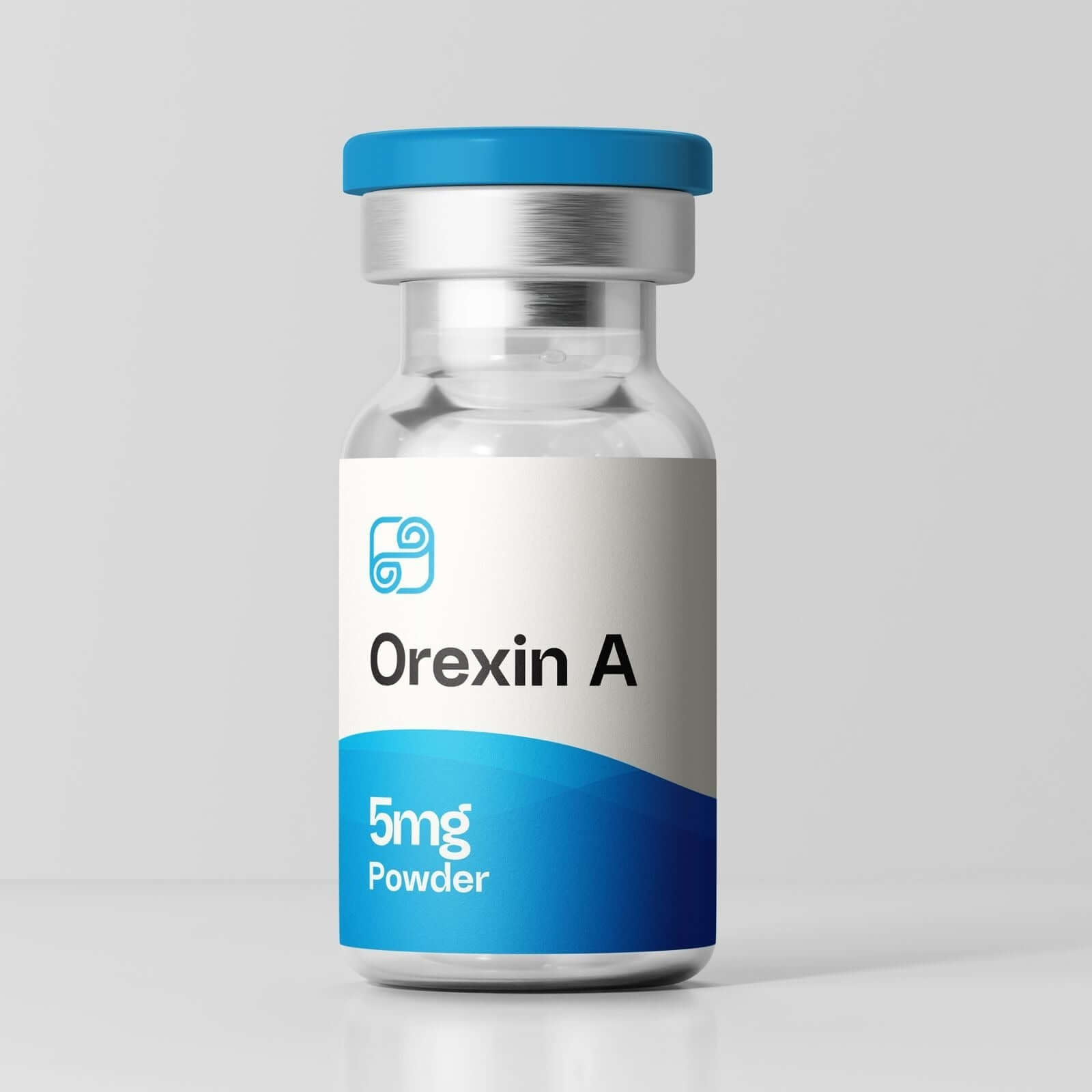
- Orexin-A carries two names because two labs discovered it independently in 1998; one called the peptides 'orexins' for appetite, the other 'hypocretins' for their hypothalamic origin.
- Narcolepsy type 1 involves the selective destruction of the roughly 70,000 orexin-producing neurons, after which cerebrospinal-fluid orexin becomes almost undetectable.
- Orexin-A binds the orexin-1 and orexin-2 receptors with roughly equal strength, whereas its sibling orexin-B strongly prefers the orexin-2 receptor.
Mechanism
-A exerts its effects by activating two closely related receptors on the surface of nerve cells, the orexin type 1 receptor (OX1R) and the orexin type 2 receptor (OX2R), both of which are G-protein-coupled receptors [1][3]. A distinguishing feature is that -A binds both receptors with roughly equal strength, whereas orexin-B prefers the type 2 receptor; the two receptor types are also distributed differently in the brain, with the type 1 receptor linked more to motivation, reward, and autonomic control and the type 2 receptor more strongly tied to the control of sleep and wakefulness [3].
When -A binds, the receptors trigger intracellular signaling, largely through rises in calcium, that excites the target neurons [1]. By exciting the brain's arousal centers, -A keeps the wake-promoting systems switched on and stabilizes the boundary between waking and sleeping, which is why the loss of orexin signaling produces the state instability seen in narcolepsy [2][4].
receptor fingerprint
OX2R (-2 receptor)Agonist
OX1R (-1 receptor)Agonist
Monoaminergic/cholinergic arousal circuitsActivation
Dosingtypical ranges, not medical advice
interested in protocols and clinical dosages? make an account to see them! ^_^
Safetyrisks and cautions, not medical advice
Human safety data is thin and mostly from small intranasal studies in narcolepsy, where no clear harmful effects were reported in the short term. Being an arousal peptide, the obvious cautions are overstimulation, jitteriness, and wrecked sleep if used late, plus possible bumps in blood pressure or heart rate since orexin signaling touches sympathetic tone. It is poorly characterized in healthy people over any real length of time, so it sits firmly in research and reference territory rather than being a supplement.
History
Orexin-A was discovered in 1998 by two independent research groups working almost simultaneously, a coincidence that left the molecule with two names. One team, led by Takeshi Sakurai and Masashi Yanagisawa, identified a pair of hypothalamic peptides that stimulated feeding and named them orexins after the Greek word for appetite; the other, led by Luis de Lecea and Gregor Sutcliffe, described the same peptides from a hypothalamus-enriched cDNA and called them hypocretins. Orexin-A, or hypocretin-1, is a 33-amino-acid peptide cleaved from a shared precursor and produced by a small cluster of neurons in the lateral hypothalamus.
Within two years the field pivoted from feeding to sleep, when researchers showed that disruption of orexin signaling caused narcolepsy in dogs and mice, and that people with narcolepsy type 1 had lost their orexin neurons. That insight reframed narcolepsy as an orexin-deficiency disease and made the orexin system one of the most actively pursued targets in modern sleep medicine, culminating in orexin-2 receptor agonists now advancing through clinical trials as replacement-style therapy.
Reputation
Orexin-A holds an almost singular place in neuroscience as the master switch that stabilizes wakefulness, and its story is one of the clearest examples of a single molecule explaining a disease: the selective loss of orexin neurons is essentially the cause of narcolepsy type 1. That clarity has made it enormously compelling to researchers, because restoring orexin signaling promises a mechanism-based treatment rather than a symptomatic stimulant, and orexin-2 receptor agonists modeled on its action have shown striking wake-promoting effects in early human trials.
As a peptide, orexin-A itself faces the practical limits familiar to peptide therapeutics, including poor oral availability and difficulty crossing into the brain, which is why drug developers have largely pursued small-molecule agonists and why the native peptide is used mainly as a research and investigational tool. Its scientific importance, however, is beyond dispute, and few discoveries have so rapidly reshaped an entire field of medicine as the orexins did after 1998.
Subjective profileweighing the evidence above
A fascinating molecule and the reason orexin-2 agonists are now in trials, but as something to take it is a research peptide with no validated protocol outside small intranasal studies in narcolepsy. Reference material rather than a supplement.
Where to buy
Suppliers
Vendors carrying Orexin-A, with live product details and codes. Links are affiliate links that support the wiki at no cost to you.
Limitless Biochem🌐
Orexin-A
Research
- 1998first citedOrexins and orexin receptors: a family of hypothalamic neuropeptides and G protein-coupled rece…
- 2005most active year3 papers
- 2021meta-analysisOrexin-A in Patients With Lewy Body Disease: A Systematic Review and Meta-Analysis.
- 2024most recentHypocretin-1/Hypocretin Receptor 1 Regulates Neuroplasticity and Cognitive Function through Hip…
- 1.Orexins and orexin receptors: a family of hypothalamic neuropeptides and G protein-coupled receptors that regulate feeding behavior.
- 2.Hypothalamic regulation of sleep and circadian rhythms.
- 3.Hypocretin/Orexin Receptor Pharmacology and Sleep Phases.
- 4.Narcolepsy.
- 5.Hypocretin-1/Hypocretin Receptor 1 Regulates Neuroplasticity and Cognitive Function through Hippocampal Lactate Homeostasis in Depressed Model.
- 6.Increased acetylcholine and glutamate efflux in the prefrontal cortex following intranasal orexin-A (hypocretin-1).
- 7.Orexin A/hypocretin-1 selectively promotes motivation for positive reinforcers.
- 8.The effect of intranasal orexin-A (hypocretin-1) on sleep, wakefulness and attention in narcolepsy with cataplexy.
- 9.Effects of intranasal hypocretin-1 (orexin A) on sleep in narcolepsy with cataplexy.
- 10.Motivational activation: a unifying hypothesis of orexin/hypocretin function.
- 11.Orexin-A (hypocretin-1) impairs Morris water maze performance and CA1-Schaffer collateral long-term potentiation in rats.
- 12.Orexin-A (Hypocretin-1) and leptin enhance LTP in the dentate gyrus of rats in vivo.
30 listed here; entry last updated August 2026
Reviews
My notesprivate to this device
FAQ
What does Orexin-A actually do?
It is a natural neuropeptide that switches on arousal circuits through the OX1 and OX2 receptors, keeping you awake and alert.
Why the interest in the nasal route?
In primate studies intranasal orexin-A reached the brain and countered sleep-deprivation deficits better than IV, since the peptide is large and does not cross well otherwise.
Is it a proven human treatment?
No; it is used as a research and reference compound, and most solid data are from animal models.
Limitations of the evidence
- Orexin-A is a naturally occurring signaling peptide rather than an approved medicine, so a defined side-effect profile in humans is not established
Adverse effects
- As an arousal-promoting signal, increased orexin activity is broadly associated with wakefulness and appetite
- Most human data come from research settings, including experimental intranasal delivery to study alertness
- Drugs that block orexin receptors, used for insomnia, can cause next-day drowsiness, which illustrates the system's role in wakefulness