
spec sheet8 rows
PE-22-28 is a fast-acting mood peptide with a genuinely clever mechanism, engineered from the natural antidepressant peptide spadin to be more potent and stable. It blocks the TREK-1 potassium channel that sits in mood circuits and dampens serotonin signaling, and animals bred without TREK-1 are naturally resistant to depression [2]. In rodent studies its shortened design achieved dramatically stronger TREK-1 inhibition than spadin, produced antidepressant-like effects within days, and boosted neurogenesis, making it one of the more exciting frontier tools in the mood space [1].
- Frontier mood peptide, genuinely clever mechanism
- Blocks TREK-1, the brain's mood channel
- Mood lift within days in rodent studies
- Sparks fresh neuron growth
- Engineered stronger and more stable than spadin
- Neuroprotective upside on top
- Mild injection site irritation
- Occasional headache
- Mild fatigue
Overview
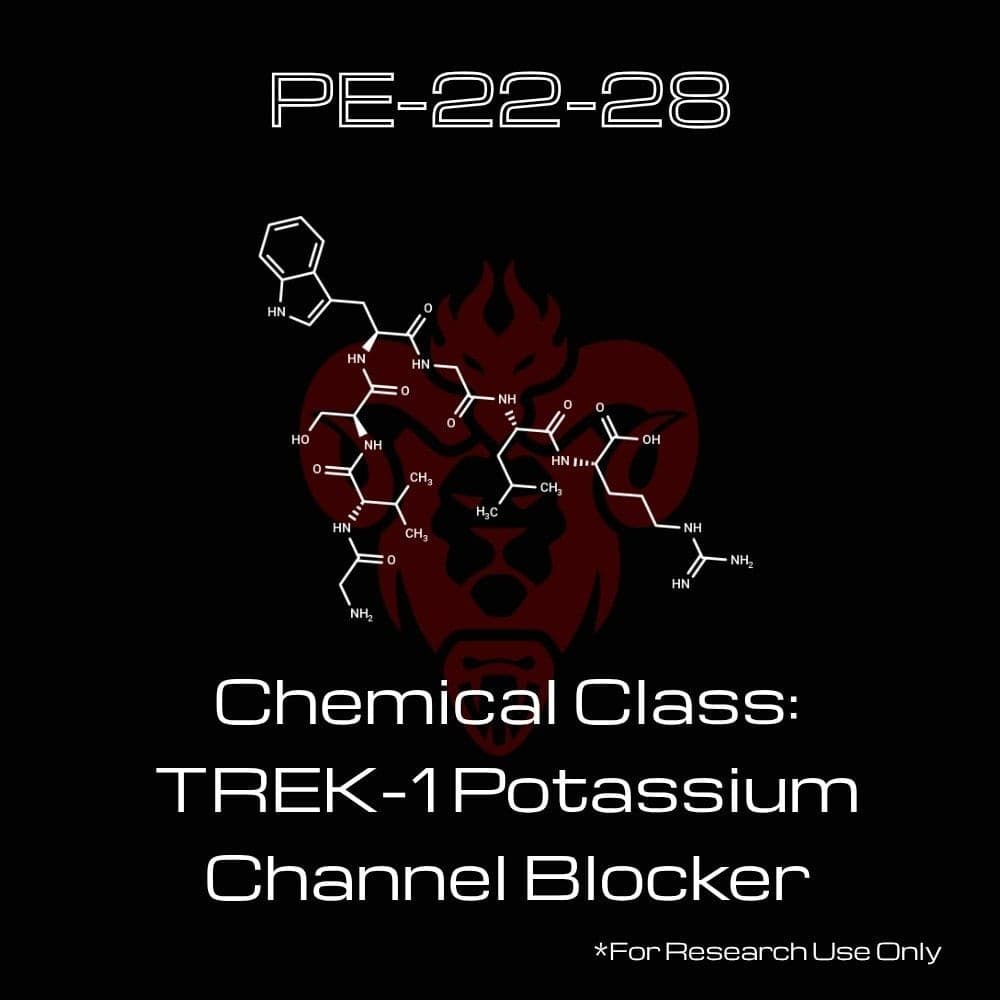
PE-22-28 is a synthetic antidepressant peptide derived from spadin, a naturally occurring peptide. Spadin itself (also called PE 12-28) is a fragment of the propeptide generated when the sortilin receptor, also known as neurotensin receptor-3 (NTSR3), is matured by the protease furin; spadin acts as a specific blocker of the TREK-1 two-pore-domain potassium channel and was identified as the first natural antidepressant peptide [2][4]. PE-22-28 is a shortened seven amino acid analog, corresponding to residues 22 to 28 of the propeptide, engineered from spadin's blood degradation products to improve stability and drug-like properties [1].
The biological premise is striking. TREK-1 is a potassium channel expressed in mood-relevant circuits that normally dampens serotonergic signaling; mice genetically lacking TREK-1 display a depression-resistant phenotype that mimics antidepressant treatment, so pharmacologically blocking the channel reproduces that resilient state [2]. Spadin validated this concept, binding TREK-1 with roughly 10 nM affinity, increasing the firing of serotonin neurons in the dorsal raphe, and producing antidepressant effects with a rapid onset, along with enhanced hippocampal neurogenesis and CREB phosphorylation after only a few days of treatment [2].
PE-22-28 was designed to be a superior, more practical version of spadin. In studies on human TREK-1 expressed in cells, PE-22-28 displayed far better specificity and affinity for the channel than spadin, and in behavioral models of depression such as the forced swimming and novelty-suppressed feeding tests it produced significant antidepressant-like effects; it also induced neurogenesis and enhanced synaptogenesis after short treatment, with a markedly longer duration of action than spadin [1]. Mechanistic work on spadin further showed activation of MAPK and PI3K signaling and increased expression of BDNF and synaptic proteins [3].
PE-22-28 is an investigational research peptide and is not an approved medication. Its evidence base is preclinical but mechanistically rich and internally consistent, and it is frequently highlighted as a fast-acting, novel-mechanism candidate that could offer an alternative to spadin in the treatment of depression [1].
- PE-22-28 was engineered from spadin's own blood breakdown products, and it blocks the TREK-1 channel far more potently than spadin itself.
- Mice bred to lack the TREK-1 potassium channel are naturally resistant to depression, which is the biological rationale behind the peptide's design.
Mechanism
PE-22-28 is one of the more thrilling frontier compounds in the mood space because it lifts from the ground up through a mechanism unlike standard antidepressants. Its target is the TREK-1 potassium channel, which sits in mood circuits and normally suppresses serotonergic signaling; because mice bred without TREK-1 are naturally resistant to depression, blocking the channel pharmacologically mimics that resilient, antidepressant-like state [2]. PE-22-28 is a shortened, stabilized fragment of the natural TREK-1 blocker spadin, engineered to hit this target harder and for longer [1].
The potency gain is the headline quantitative finding. In patch-clamp studies on human TREK-1 expressed in cells, PE-22-28 inhibited the channel with an IC50 of about 0.12 nM, compared with roughly 40 to 60 nM for spadin, making the shortened analog far more potent, while also showing better specificity and stability [1]. The parent spadin binds TREK-1 with about 10 nM affinity and increases neuron firing in the dorsal raphe, establishing the serotonergic disinhibition that underlies the antidepressant effect [2].
Downstream, blocking TREK-1 sets off plasticity-promoting signaling. Spadin activates the MAPK and pathways, protects neurons from apoptosis, and increases expression of the proteins PSD-95 and synapsin as well as in the , translating channel inhibition into synaptogenesis and [3]. PE-22-28 reproduces and extends these effects; in rodents it produced antidepressant-like behavior in the forced swimming and novelty-suppressed feeding tests within days, induced after only a four-day treatment, enhanced synaptogenesis measured by increased PSD-95, and remained active far longer than spadin, up to roughly 23 hours after a single dose compared with about 7 hours for spadin [1].
The reported appeal of PE-22-28 is a rapid, resilience-building antidepressant action that emerges in days rather than the weeks typical of conventional options, without simply masking symptoms. That profile follows directly from its mechanism; potent, durable TREK-1 blockade that disinhibits signaling and drives fresh and neuronal growth [1][2].
receptor fingerprint
TREK-1 potassium channelblocks
/ synaptogenesispromotes
signalingsupports
Dosingtypical ranges, not medical advice
interested in protocols and clinical dosages? make an account to see them! ^_^
Safetyrisks and cautions, not medical advice
Being straight with you, there is no human safety data for PE-22-28; every efficacy and tolerability signal comes from rodents, where it looked clean and, unlike broad TREK-1 blockade might suggest on paper, did not throw obvious cardiac or seizure trouble in those studies. It is an early stage research compound sold for research, not an approved medicine, so purity, dosing, and long term risk are all unsettled. In self experiment reports the gripes are minor: mild injection site irritation, occasional headache, and a little fatigue. It reads as a promising frontier mood tool rather than a proven therapy, and a solid neurogenic option to reach for in the mood peptide lane.
History
PE-22-28 descends from spadin, a naturally occurring peptide fragment shown to block the TREK-1 potassium channel, discovered by Marc Borsotto, Jean Mazella, Catherine Heurteaux and colleagues at the Institut de Pharmacologie Moleculaire et Cellulaire (CNRS) at the Universite Cote d'Azur in France around 2010. Because spadin's antidepressant activity faded within about seven hours of administration, the same team studied its blood breakdown products and designed a shortened, stabilized seven-amino-acid analog, PE-22-28, reported in 2017 [1]. In patch-clamp testing the new peptide inhibited human TREK-1 far more potently than spadin and produced antidepressant-like effects, along with neurogenesis and synaptogenesis, in rodent models. The compound remains a preclinical research peptide.
Reputation
PE-22-28 is regarded as one of the more exciting frontier tools in the mood space because it acts through a genuinely novel mechanism, blocking the TREK-1 channel rather than manipulating monoamine reuptake like conventional antidepressants. Researchers find it compelling that animals bred to lack TREK-1 are naturally resistant to depression, giving the target strong biological rationale, and that the engineered peptide produced antidepressant-like behavior within days while promoting fresh neuronal and synaptic growth. Its dramatically improved potency and duration over spadin add to the appeal. The essential honest caveat is that all of this evidence is preclinical, drawn from cell and rodent studies, with no human clinical data yet available.
Subjective profileweighing the evidence above
The TREK-1 mechanism is one of the more interesting ideas in the mood space and the rodent data look clean, but every efficacy signal is from rodents, and purity and long-term risk are both unsettled. Worth watching closely; too early to recommend buying.
Where to buy
Suppliers
Vendors carrying PE-22-28, with live product details and codes. Links are affiliate links that support the wiki at no cost to you.
Limitless Biochem🌐
PE-22-28
RUO
PE-22-28
Peptira
PE-22-28
Kimera Chems
PE-22-28
Research
- 2010first citedSpadin, a sortilin-derived peptide, targeting rodent TREK-1 channels: a new concept in the anti…
- 2019most recentThe Involvement of Sortilin/NTSR3 in Depression as the Progenitor of Spadin and Its Role in the…
- 1.Shortened Spadin Analogs Display Better TREK-1 Inhibition, In Vivo Stability and Antidepressant Activity.
- 2.Spadin, a sortilin-derived peptide, targeting rodent TREK-1 channels: a new concept in the antidepressant drug design
- 3.In vitro and in vivo regulation of synaptogenesis by the novel antidepressant spadin
- 4.The Involvement of Sortilin/NTSR3 in Depression as the Progenitor of Spadin and Its Role in the Membrane Expression of TREK-1
4 listed here; entry last updated August 2026
Reviews
- Best mood stabilizer I've tried
As someone with autisim and lifelong depression and anxiety this compound has been a life changer and I wish I'd found it sooner. I've had 2 heart attacks this year and I'm drowning in medical debt but I'm still not even depressed...highly recommend to anyone who has struggled life long with this. The first couple days I had a slight headache but that went away after about day 3 I've personally not cycled it and just been running long term as the effects do seem to fade a couple days off
WatcherOfFadingLight · Aug 8, 20260 - Best mood stabilizer I've tried
As someone with autisim and lifelong depression and anxiety this compound has been a life changer and I wish I'd found it sooner. I've had 2 heart attacks this year and I'm drowning in medical debt but I'm still not even depressed...highly recommend to anyone who has struggled life long with this. The first couple days I had a slight headache but that went away after about day 3
0

My notesprivate to this device
FAQ
What is PE-22-28?
It is a synthetic 7 amino acid fragment of spadin that blocks a potassium channel called TREK-1.
What has it shown in research?
In rodent studies it has acted like a fast working antidepressant, lifting mood within days and supporting new neuron growth.
Is it approved for people?
No, it is an early stage research compound and is not an approved medication.
What is TREK-1?
It is a potassium channel tied to mood regulation; animals without it resist depression, so blocking it is the proposed mechanism behind PE-22-28's antidepressant like effects.
Adverse effects
- Mild injection site irritation
- Occasional headache
- Mild fatigue
Notes and cautions
- No published study has administered PE-22-28 by the intranasal route. Only one PubMed paper indexes the peptide by name, and in it the compound and its analogues were given to mice by intraperitoneal injection and by oral gavage. Searches for intranasal spadin, the longer parent peptide it derives from, return nothing either. The nasal route has never been tested for this compound, and nothing is known about whether it survives the nasal mucosa or reaches the brain that way.