
spec sheet13 rows
Oxytocin is a nine-amino-acid neuropeptide made in the hypothalamus and released from the posterior pituitary, best known for driving uterine contraction in labor and milk ejection during nursing, and for its role in social bonding and affiliation. Its release during suckling and birth is a rare biological positive-feedback loop, amplified within the hypothalamus itself, and the neurons that make it synchronize into coordinated bursts to produce the pulsatile milk-ejection reflex. As an intranasal research tool it has generated a large human literature on trust and social cognition, though that work is tempered by a replication debate and by questions about how much intranasal oxytocin reaches the brain, and large trials in autism have been largely negative.
- The bonding molecule, in a nasal spray
- Drives trust, warmth and real connection
- Melts stress; softens the social edge
- Lifts empathy and emotional openness
- Studied heavily for trust and social cognition
- Nature's own positive feedback loop
- Occasional headache
- Mild nasal irritation with sprays
Overview
Oxytocin is a nonapeptide (nine amino acid) hormone and neuropeptide synthesized in the hypothalamus and released both into the bloodstream, where it acts as a classic hormone in childbirth and lactation, and within the brain, where it functions as a neuromodulator of social and emotional behavior. It acts through the oxytocin receptor, a G protein-coupled receptor, and is central to social bonding, trust, and affiliation across species.
As a research and therapeutic tool, oxytocin is most often studied via intranasal administration, which is thought to influence central oxytocin signaling. A large body of controlled human work has examined its effects on social cognition. Randomized, placebo-controlled studies have investigated trust-related decision making, including how oxytocin modulates brain activity after a breach of trust in younger and older adults [1], and its combination with social learning paradigms; a randomized trial in children paired oxytocin with cognitive bias modification training aimed at trust in maternal support [3]. Oxytocin has also been shown to shape self-referential social cognition, increasing the recall of positive social affiliation memories in an autobiographical memory study, with a dose-dependent pattern across 24 and 48 IU [4].
Its effects are context-dependent and not uniformly positive, which the literature captures well. In people at clinical high risk for psychosis, acute intranasal oxytocin altered brain activity in the inferior frontal gyrus during inference of others' social emotions, with effects moderated by baseline social-emotional ability [2]. Other rigorous trials report null results; a randomized, placebo-controlled study found that intranasal oxytocin did not influence eye gaze toward a physician or the perceived patient-physician relationship [5], underscoring that its social effects depend heavily on dose, individual differences, and setting.
Oxytocin is an approved medication in its injectable form for obstetric use, while intranasal oxytocin for social and psychiatric applications remains investigational and is studied under research protocols. It is available as a peptide in nasal spray and injectable forms, and its extensive human literature makes it a touchstone for the neuroscience of social behavior.
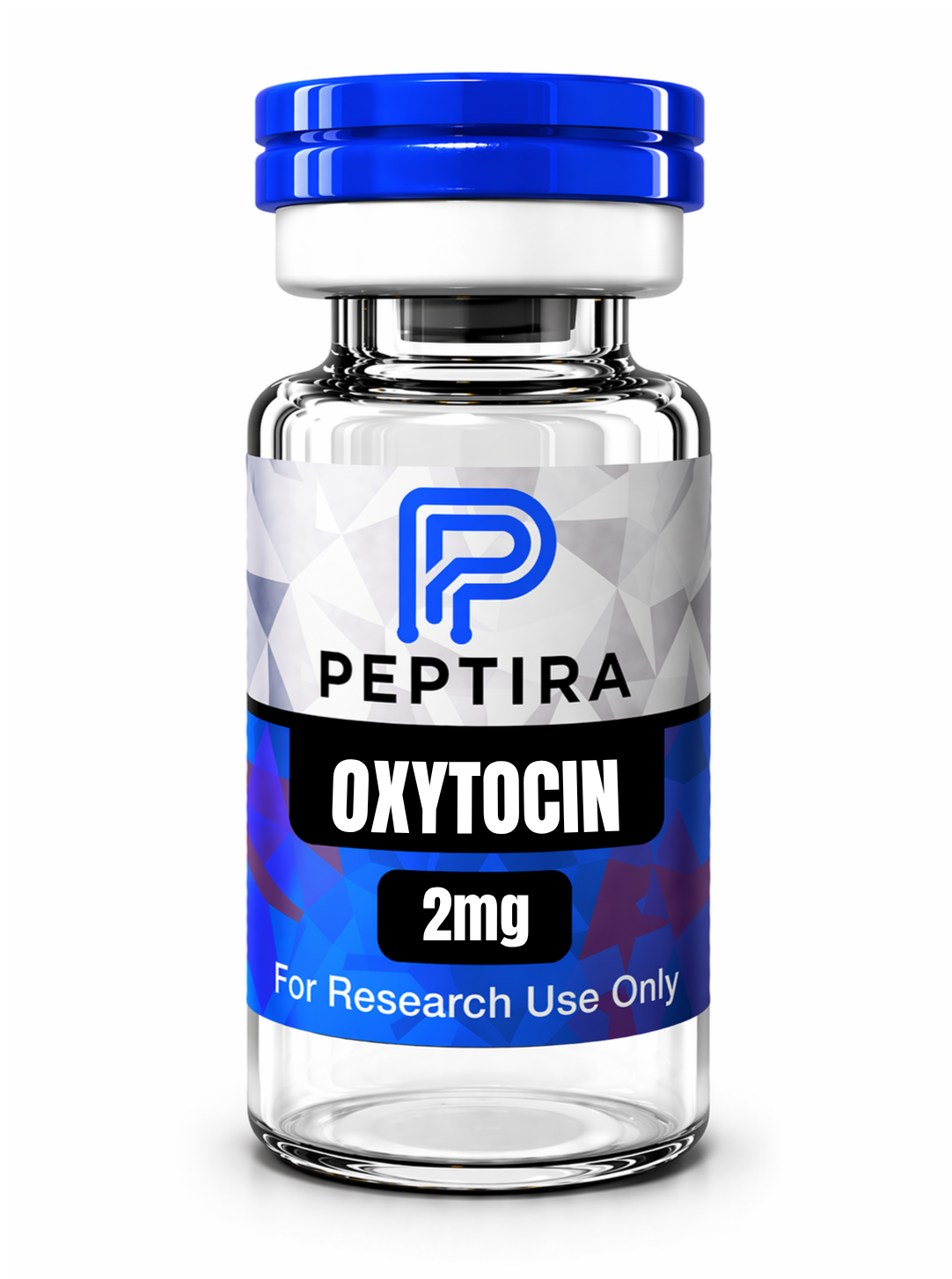
- Oxytocin was the first polypeptide hormone ever chemically synthesized, a 1953 feat that won Vincent du Vigneaud the 1955 Nobel Prize in Chemistry.
- Its name comes from Greek words meaning quick birth, reflecting its original discovery as the substance that drives uterine contraction during labor.
Mechanism
Oxytocin's appeal is its specificity for the social brain; few molecules so directly influence trust, affiliation, and the reading of social cues. It exerts its effects through the oxytocin receptor, a G protein-coupled receptor expressed in brain regions that govern social and emotional processing, including the amygdala and cortical areas involved in interpreting others. Centrally released oxytocin acts as a neuromodulator, tuning the salience and valence of social stimuli rather than producing a broad sedative or stimulant effect.
In human studies, this translates into measurable shifts in social cognition and its neural correlates. After a breach of trust, intranasal oxytocin modulated activity in the superior temporal gyrus in older adults, consistent with an age-differential role in processing cues of untrustworthiness during trust-related decisions [1]. During inference of others' beliefs and social emotions, oxytocin reduced activation in the inferior frontal gyrus in people at clinical high risk for psychosis, an effect interpreted as enhanced neural efficiency and moderated by baseline social-emotional ability [2]. These findings illustrate a mechanism that reshapes how the brain processes social information rather than simply raising or lowering mood.
Behavioral and dose-related effects reinforce this picture. In an autobiographical memory study, a 24 IU dose of intranasal oxytocin increased the number of specific personal memories recalled and promoted recall of more positively rated social affiliation memories, whereas a 48 IU dose did not, a quadratic dose-response the authors attributed to possible receptor saturation at higher doses [4]. Oxytocin has also been combined with social learning interventions to try to strengthen trust, though effects were limited in a pediatric trial [3], and it did not alter eye gaze or perceived bonding in a physician-interaction trial [5], highlighting the strong role of context.
Reported subjective effects include feelings of warmth, closeness, and social ease, though these are individual and setting-dependent. The consistent scientific throughline is that oxytocin acts on a dedicated social-cognitive system, making it a uniquely targeted neuropeptide whose effects are best understood as modulatory and context-sensitive [1][2][4].
receptor fingerprint
Oxytocin receptoragonist
/ lowers
Social / amygdala circuitsmodulates
Dosingtypical ranges, not medical advice
interested in protocols and clinical dosages? make an account to see them! ^_^
Safetyrisks and cautions, not medical advice
Oxytocin can cause headache, nausea, and, when given intranasally, nasal irritation, and because it has mild antidiuretic activity, high or repeated dosing risks water retention and low blood sodium (hyponatremia). It stimulates uterine contractions, so it should be avoided in pregnancy outside a medical obstetric setting. The long-term safety of the intranasal use marketed for mood and social effects is not well established.
Interactionsdocumented pairs only, not exhaustive
Oxytocin acts as a vasopressin V2 receptor agonist and carries a significant risk of inducing hyponatremia through inappropriate antidiuresis, particularly when combined with high fluid intake. This syndrome of inappropriate secretion of antidiuretic hormone (SIADH)-like effect is most concerning in obstetric and perioperative settings where maternal fluid overload accompanies oxytocin administration for labor induction or augmentation; neonates are especially vulnerable to severe hyponatremia under these conditions. [30] Urinary oxytocin secretion correlates directly with natriuresis and serum sodium balance, and abnormally elevated oxytocin levels after transsphenoidal pituitary surgery predict the development of hyponatremia by postoperative day 4-7, suggesting that oxytocin quantification may serve as an early clinical marker for water retention complications. [31] [32]
Checking a whole stack? Run it through interactions + stacks.
Reconstitutionarithmetic only, not dosing advice
arithmetic only; not medical or dosing advice.
History
Oxytocin's biological activity was first described in 1906 by the English pharmacologist Sir Henry Dale, who showed that an extract of the posterior pituitary caused uterine contraction and named the effect from the Greek for quick birth. The hormone's full significance became clear in 1953, when Vincent du Vigneaud at Cornell determined its nine-amino-acid sequence and achieved its complete chemical synthesis, the first time any polypeptide hormone had been synthesized in the laboratory. This achievement earned du Vigneaud the 1955 Nobel Prize in Chemistry and confirmed the structure by reproducing the natural hormone's activity. In later decades oxytocin's roles expanded well beyond labor and lactation, and intranasal formulations became a widely used research tool for studying trust, bonding, and social cognition in humans.
Reputation
Oxytocin is regarded as a uniquely targeted neuropeptide, valued for acting on the brain's social circuitry rather than producing broad sedative or stimulant effects. Its reputation as the bonding or trust molecule has made it one of the most studied peptides in social neuroscience, generating a large and genuinely intriguing human literature. Researchers appreciate that its effects are specific and context-sensitive, shifting how the brain weighs social cues rather than simply altering mood. Its clinical footprint in obstetrics is long-established and secure. Honest appraisal notes an active replication debate around some behavioral findings, open questions about how much intranasal oxytocin actually reaches the brain, and largely negative results in large autism trials, all of which temper the more expansive claims.
Subjective profileweighing the evidence above
The social effects are the appeal, but the only firmly established use is obstetric and given under monitoring, and the intranasal sprays sold for bonding and stress have no long-term safety record. Occasional use is low risk; repeated heavy dosing is not, since it holds water and can drop blood sodium. Avoid in pregnancy outside a medical setting.
Where to buy




Suppliers
Vendors carrying Oxytocin, with live product details and codes. Links are affiliate links that support the wiki at no cost to you.
| supplier | size | price | $/mg |
|---|---|---|---|
| RUOlowest | 5mg | $22.00 | $4.40/mg |
| Moglabs | 5mg | $24.00 | $4.80/mg |
RUPharma🌐
Oxytocin
Exceed Enhancement
Oxytocin
RUO
Oxytocin
Moglabs
Oxytocin
Peptira
Oxytocin
Kimera Chems
Oxytocin
Research
- 1955first citedOxytocin, the principal oxytocic hormone of the posterior pituitary gland: its isolation, struc…
- 2016meta-analysisOxytocin and Autism Spectrum Disorders: A Systematic Review and Meta-Analysis of Randomized Con…
- 2020most active year5 papers
- 2023most recentNasal oxytocin administration does not influence eye gaze or perceived relationship of male vol…
- 1.Age and intranasal oxytocin effects on trust-related decisions after breach of trust: Behavioral and brain evidence
- 2.Acute oxytocin effects in inferring others' beliefs and social emotions in people at clinical high risk for psychosis
- 3.Combining oxytocin and cognitive bias modification training in a randomized controlled trial: Effects on trust in maternal support
- 4.Oxytocin and enhancement of the positive valence of social affiliation memories: an autobiographical memory study
- 5.Nasal oxytocin administration does not influence eye gaze or perceived relationship of male volunteers with physicians in a simulated online consultation: a randomized, placebo-controlled trial
- 6.The oxytocin receptor system: structure, function, and regulation
- 7.Oxytocin release in magnocellular nuclei: neurochemical mediators and functional significance during gestation
- 8.Release of oxytocin within the supraoptic nucleus. Mechanisms, physiological significance and antisense targeting
- 9.Molecular Mechanisms of Oxytocin Signaling at the Synaptic Connection
- 10.Magnocellular dendrites: prototypic receiver/transmitters
- 11.Emergent synchronous bursting of oxytocin neuronal network
- 12.Neuroendocrine regulation of lactation and milk production
34 listed here; entry last updated August 2026
Reviews
My notesprivate to this device
FAQ
What is oxytocin?
It is a naturally occurring hormone often called the bonding or trust hormone for its role in social connection.
How is it typically used?
In research settings it is commonly delivered as an intranasal spray.
Why does it need refrigeration?
Peptide hormones are fragile, so many formulations are kept cold to preserve stability.
Does it work the same for everyone?
Responses vary widely between individuals and contexts, so effects are not uniform.
Adverse effects
- Occasional headache
- Mild nasal irritation with sprays
Notes and cautions
- Effects vary a lot by person and setting
- Oxytocin has been given intranasally in humans for decades, and the route itself has been studied rather than assumed. In healthy volunteers, 24 IU of intranasal oxytocin raised concentrations in both plasma and cerebrospinal fluid, but on different schedules, plasma peaking near 15 minutes and cerebrospinal fluid taking up to 75 minutes, with no correlation between the two [33]. Work with deuterium labelled oxytocin in macaques confirmed that intranasally delivered peptide does reach cerebrospinal fluid, while also finding no advantage for the nasal route over intravenous dosing and no evidence that peripheral dosing triggers central release of the animal's own oxytocin [23]. A human perfusion imaging study found that the drop in amygdala blood flow after intranasal oxytocin was explained entirely by the rise in systemic oxytocin, though the same study confirmed the nasal route can engage specific brain regions [34]. A widely cited critical review argues that only a small fraction of an intranasal dose appears in cerebrospinal fluid while peripheral concentrations reach supraphysiological levels, so many reported behavioural effects may follow from peripheral actions instead [21]. The route is real and measurable; how much of any given effect is central rather than peripheral is still unsettled.