
spec sheet11 rows
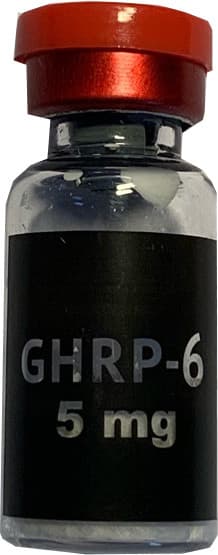
GHRP-6 is one of the original growth hormone-releasing hexapeptides, a ghrelin-receptor agonist that prompts a pulse of the body's own growth hormone along with a marked increase in appetite. A distinct and much-studied second property is growth-hormone-independent cytoprotection: acting through the scavenger receptor CD36, it has reduced oxidative damage and necrosis in animal models of myocardial infarction and other tissue injury. It is used as a research peptide and has been employed diagnostically in tests of growth-hormone secretion.
- Triggers a strong pulse of your own growth hormone
- Ghrelin receptor agonist; appetite climbs fast and hard
- One of the original growth hormone releasing hexapeptides
- Rodent injury models look striking; human trials still pending
- Antioxidant and cell survival signaling through the CD36 receptor
- Used clinically to test growth hormone secretion
- Brief flush or tiredness after a dose
Overview
GHRP-6 is a synthetic hexapeptide and one of the first growth hormone-releasing peptides ever developed, a foundational member of the secretagogue class characterized by Bowers and colleagues [1]. It is a ghrelin-receptor agonist that releases growth hormone through a dual action on the hypothalamus and pituitary, distinct from growth hormone-releasing hormone [1][3].
As a research tool GHRP-6 helped define the biology that later led to the discovery of ghrelin and the growth hormone secretagogue receptor. It stimulates the body's own growth hormone rather than supplying the hormone directly, and it is a notably strong driver of appetite [1].
Its research applications fall into two streams. The endocrine literature uses GHRP-6 to probe growth hormone regulation; central injection studies show it acts largely at the hypothalamus, where its growth hormone release can be blocked by somatostatin, and it has been evaluated as a stimulation test for growth hormone reserve and pituitary stalk integrity [2][3]. A second, striking stream is cardiovascular; acting in part through the scavenger receptor CD36 and independently of the growth hormone pathway, GHRP-6 has shown cardioprotective effects, reducing oxidative damage and necrosis in models of myocardial infarction [5] and preventing doxorubicin-induced cardiac and multi-organ injury by activating pro-survival mechanisms [4].
GHRP-6 is not an approved general medicine and is used as a research peptide; its appetite-stimulating and growth hormone-releasing actions are well characterized in animals and humans. It is supplied as a lyophilized peptide for reconstitution.
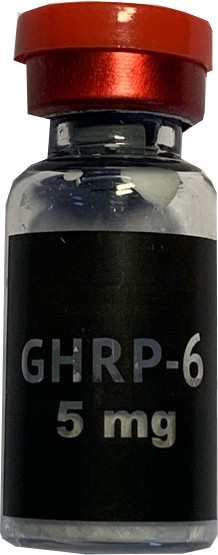
- GHRP-6 was the prototype peptide whose study led to the discovery of the ghrelin receptor and, later, ghrelin itself.
- In a pig model of heart attack, GHRP-6 reduced infarct mass by roughly 78 percent through a growth-hormone-independent protective effect.
Mechanism
GHRP-6 delivers two things at once; a robust pulse of natural growth hormone and, in animal work, meaningful protection of stressed heart tissue. Its reliable appetite boost is a bonus for research on low intake and wasting, and because it amplifies the body's own signaling the released growth hormone still follows a natural rhythm.
The primary mechanism is agonism at the growth hormone secretagogue receptor GHS-R1a, the ghrelin receptor. GHRP-6 engages this receptor at both hypothalamic and pituitary sites; central injection studies in animals showed it stimulates growth hormone release more than tenfold, an effect requiring far less centrally than peripherally and one that can be switched off by somatostatin acting near the growth hormone-releasing neurons, confirming the as a major target [3]. This dual, complementary drive is the hallmark of the secretagogue class [1], and the reliability of the response underlies its use as a diagnostic growth hormone stimulation test [2].
The cardioprotective mechanism is separate and does not depend on growth hormone. In a pig model of acute myocardial infarction, GHRP-6 reduced infarct mass by roughly 78 percent and infarct thickness by about 50 percent, lowered markers of necrosis, and preserved antioxidant defenses by curbing reactive oxygen species [5]. In rats given the chemotherapy agent doxorubicin, GHRP-6 prevented ventricular dilation and preserved systolic function while up-regulating the pro-survival gene Bcl-2, sustaining antioxidant defense, and protecting cardiomyocyte mitochondria; these actions are attributed partly to signaling through the CD36 receptor [4]. Together the two mechanisms give GHRP-6 an unusually broad and interesting profile for a single .
receptor fingerprint
GHS-R1a (ghrelin receptor)Agonist driving pituitary GH release
Appetite / ghrelin pathwaysStrongly stimulates hunger
CD36 receptorBinds ectodomain to trigger prosurvival, antioxidant signaling
Dosingtypical ranges, not medical advice
interested in protocols and clinical dosages? make an account to see them! ^_^
Safetyrisks and cautions, not medical advice
GHRP-6 is a growth-hormone secretagogue that markedly stimulates appetite and, by raising GH and IGF-1, can cause water retention and edema, joint pain, numbness or tingling, and reduced insulin sensitivity with higher blood glucose. It can also modestly increase cortisol and prolactin. Human long-term safety data are limited and it is unapproved; sustained GH/IGF-1 elevation carries theoretical tissue-overgrowth concerns, so it should be considered experimental.
History
GHRP-6 is the first fully characterized growth hormone-releasing hexapeptide, developed by Cyril Y. Bowers and colleagues, and it holds a foundational place in endocrine history. It emerged from the observation that certain enkephalin-derived peptides could release growth hormone through a mechanism separate from growth hormone-releasing hormone, a discovery Bowers traced to the mid-1970s.
GHRP-6 became the prototype used to demonstrate that these peptides act at both the hypothalamus and the pituitary, and studies with it were instrumental in the search that led to identification of the growth hormone secretagogue receptor in 1996 and the endogenous hormone ghrelin in 1999. Its reliable growth hormone response also saw it employed diagnostically in tests of growth hormone secretion. Beyond endocrinology, later animal research uncovered a distinct, growth-hormone-independent cytoprotective action.
Reputation
GHRP-6 is regarded with a certain reverence as one of the original growth hormone-releasing hexapeptides, the molecule that helped open the entire field of growth hormone secretagogues and, eventually, ghrelin biology. Researchers find its profile unusually broad for a single peptide, pairing a robust pulse of natural growth hormone and a marked appetite boost with a separate, much-studied cytoprotective action through the CD36 receptor that has reduced oxidative damage and tissue necrosis in animal models of heart injury. That two-sided biology gives it lasting scientific interest. In fairness, it remains a research peptide rather than an approved drug, and its strong stimulation of hunger may be unwanted for some purposes. Its historical importance and its intriguing cardioprotective findings nonetheless keep it a compound of enduring appeal.
Subjective profileweighing the evidence above
Mostly interesting for the appetite surge and the animal cytoprotection data, neither of which is what most buyers are after. Pushing GH and IGF-1 up brings fluid retention, joint aches and worse insulin sensitivity, long-term human safety is unstudied, and it is unapproved. Not a first choice.
Where to buy



Suppliers
Vendors carrying GHRP-6, with live product details and codes. Links are affiliate links that support the wiki at no cost to you.
| supplier | size | price | $/mg |
|---|---|---|---|
| RUOlowest | 5mg | $14.00 | $2.80/mg |
| Limitless Biochem | 10mg | $32.00 | $3.20/mg |
| Moglabs | 5mg | $16.00 | $3.20/mg |
RUPharma🌐
GHRP-6
RUO
GHRP-6
Moglabs
GHRP-6
Kimera Chems
GHRP-6
Limitless Biochem🌐
GHRP-6
Peptira
GHRP-6
Research
- 1991first citedIntranasal administration of His-D-Trp-Ala-Trp-D-Phe-LysNH2 (growth hormone releasing peptide)…
- 2025most recentIntranasal Delivery of a Ghrelin Mimetic Engages the Brain Ghrelin Signaling System in Mice.
- 1.Growth hormone-releasing peptide (GHRP)
- 2.Growth hormone releasing hexapeptide-6 (GHRP-6) test in the diagnosis of GH-deficiency
- 3.Central effects of growth hormone-releasing hexapeptide (GHRP-6) on growth hormone release are inhibited by central somatostatin action
- 4.Growth hormone releasing peptide-6 (GHRP-6) prevents doxorubicin-induced myocardial and extra-myocardial damages by activating prosurvival mechanisms
- 5.Growth-hormone-releasing peptide 6 (GHRP6) prevents oxidant cytotoxicity and reduces myocardial necrosis in a model of acute myocardial infarction
- 6.Growth hormone-releasing peptide 6 (GHRP-6) hydrogel for acute kidney injury therapy via metabolic regulation
- 7.Use of growth-hormone-releasing peptide-6 (GHRP-6) for the prevention of multiple organ failure
- 8.Growth Hormone-Releasing Peptide 6 Enhances the Healing Process and Improves the Esthetic Outcome of the Wounds
- 9.Growth hormone-releasing peptide 6 prevents cutaneous hypertrophic scarring: early mechanistic data from a proteome study
- 10.Insulin and growth hormone-releasing peptide-6 (GHRP-6) have differential beneficial effects on cell turnover in the pituitary, hypothalamus and cerebellum of streptozotocin (STZ)-induced diabetic rats
- 11.Coadministration of epidermal growth factor and growth hormone releasing peptide-6 improves clinical recovery in experimental autoimmune encephalitis
- 12.Growth hormone releasing peptide (GHRP-6) stimulates phosphatidylinositol (PI) turnover in human pituitary somatotroph cells
23 listed here; entry last updated August 2026
Reviews
My notesprivate to this device
FAQ
Why is GHRP-6 known for hunger?
It is a strong ghrelin-receptor agonist, and ghrelin is the body's hunger hormone, so appetite stimulation is one of its clearest effects.
What is the heart research about?
Animal studies show it can reduce oxidative damage and support survival signaling in injured heart tissue, apparently through the CD36 receptor rather than the GH pathway.
Is it selective for GH?
No; like other early secretagogues it can also raise cortisol and prolactin.
Adverse effects
- Brief flush or tiredness after a dose
Notes and cautions
- Strong hunger surge
- Some water retention
- Tingling in hands or feet
- Can nudge cortisol and prolactin up
- GHRP-6 is one of the few growth hormone secretagogues with direct human intranasal data. Six healthy men received it intranasally at 5, 15 and 30 micrograms per kilogram and showed a dose related growth hormone rise, and seven consecutive intranasal doses every eight hours raised IGF-1 from 94.5 to 125.8 micrograms per litre without the response fading [19]. A sleep endocrine study found 30 micrograms per kilogram intranasally raised growth hormone across the whole night while ten times that dose given orally did nothing [20]. In conscious dogs, intranasal bioavailability measured roughly 34 to 45 percent of intravenous [21], and nasal dosing in a human volunteer left the peptide detectable unchanged in urine for 23 hours [22]. Recent mouse work found intranasal GHRP-6 raised food intake and serum growth hormone where intranasal ghrelin did not [23]. No nasal GHRP-6 product is sold; the human work dates from 1991 and 1999, and long term nasal use is unstudied.