
spec sheet10 rows
DSIP (delta sleep-inducing peptide) is a naturally occurring nonapeptide first isolated from the blood of sleeping rabbits, named for its ability to promote deep, slow-wave (delta) sleep [1]. Beyond sleep, decades of research describe it as a broad stress-protective and adaptogenic peptide that helps the body buffer against physical and psychological stressors and defends tissues from oxidative damage [1][4]. For those seeking better sleep quality and resilience to stress, DSIP is a well-studied endogenous peptide with a uniquely versatile profile.
- Deep slow-wave sleep, the restorative kind
- A non-sedating approach to sleep support
- Stress-protective adaptogenic peptide
- Helps the body buffer physical and mental stress
- Naturally occurring peptide, decades of research
- As an injected research peptide, injection-site reactions are possible
Overview
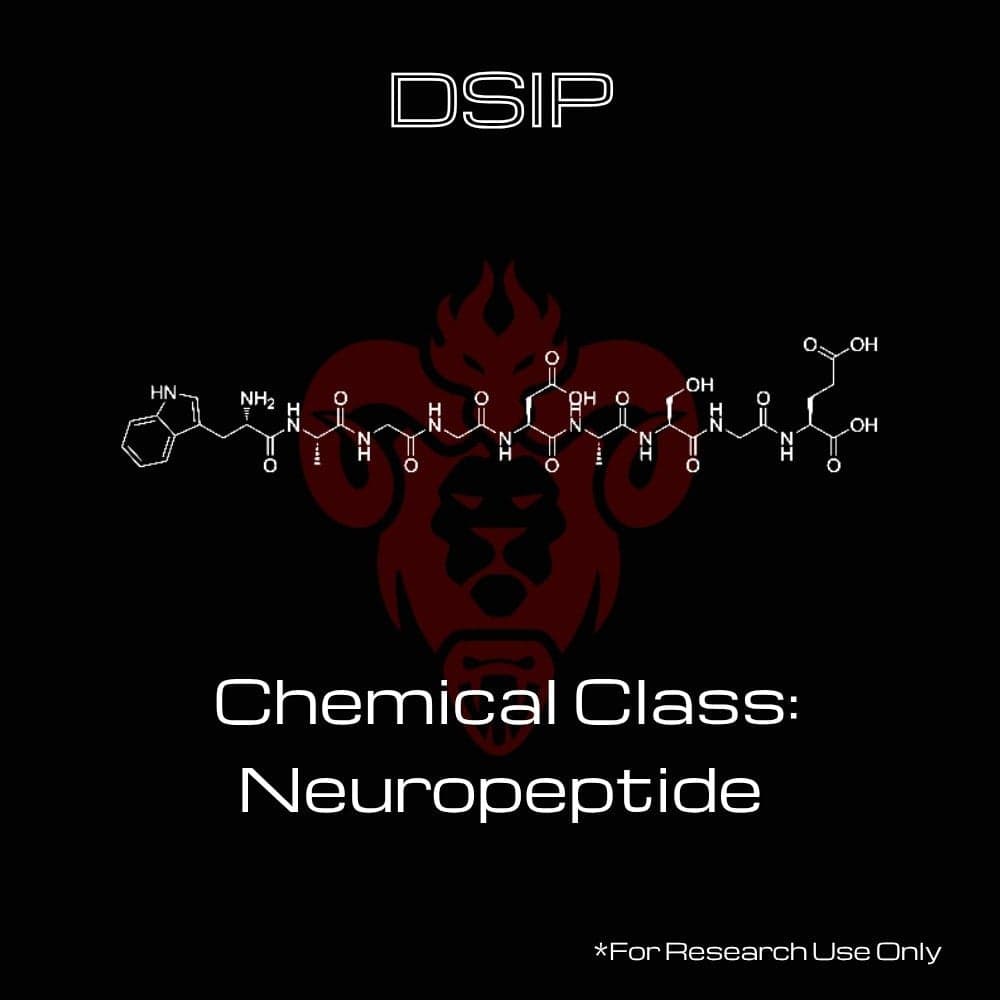
DSIP, delta sleep-inducing peptide, is a small endogenous neuropeptide made up of nine amino acids, with the sequence Trp-Ala-Gly-Gly-Asp-Ala-Ser-Gly-Glu [1]. It was discovered in 1977 by the Swiss researchers Schoenenberger and Monnier, who isolated it from the cerebral venous blood of rabbits in which slow-wave, or delta, sleep had been induced, and named it for that sleep-promoting activity. It is found naturally in the brain and body of mammals, including humans, and is classed as a multifunctional regulatory peptide.
Although its name emphasizes sleep, the research literature portrays DSIP as a remarkably versatile molecule. Numerous studies describe a stress-protective and adaptive activity that appears largely independent of the specific stressor involved, along with antioxidant, neuroprotective, and neuroendocrine-modulating effects [1][4]. Its biosynthetic origin remains only partly understood; the gene and protein precursor have not been definitively identified, though sequence analyses have pointed to candidate precursor proteins that carry a closely related peptide segment [1]. This unusual combination of clear biological activity and uncertain origin has kept DSIP a subject of ongoing investigation.
DSIP is not an approved pharmaceutical in major Western markets and is not a dietary supplement; it circulates as a research peptide, typically supplied as a lyophilized powder for reconstitution, and much of the modern literature is Russian and central European. It is studied for sleep disturbance, stress, chronic pain, and withdrawal states, and within the peptide and longevity communities it is used as an experimental aid for sleep and stress resilience rather than as an established therapy.
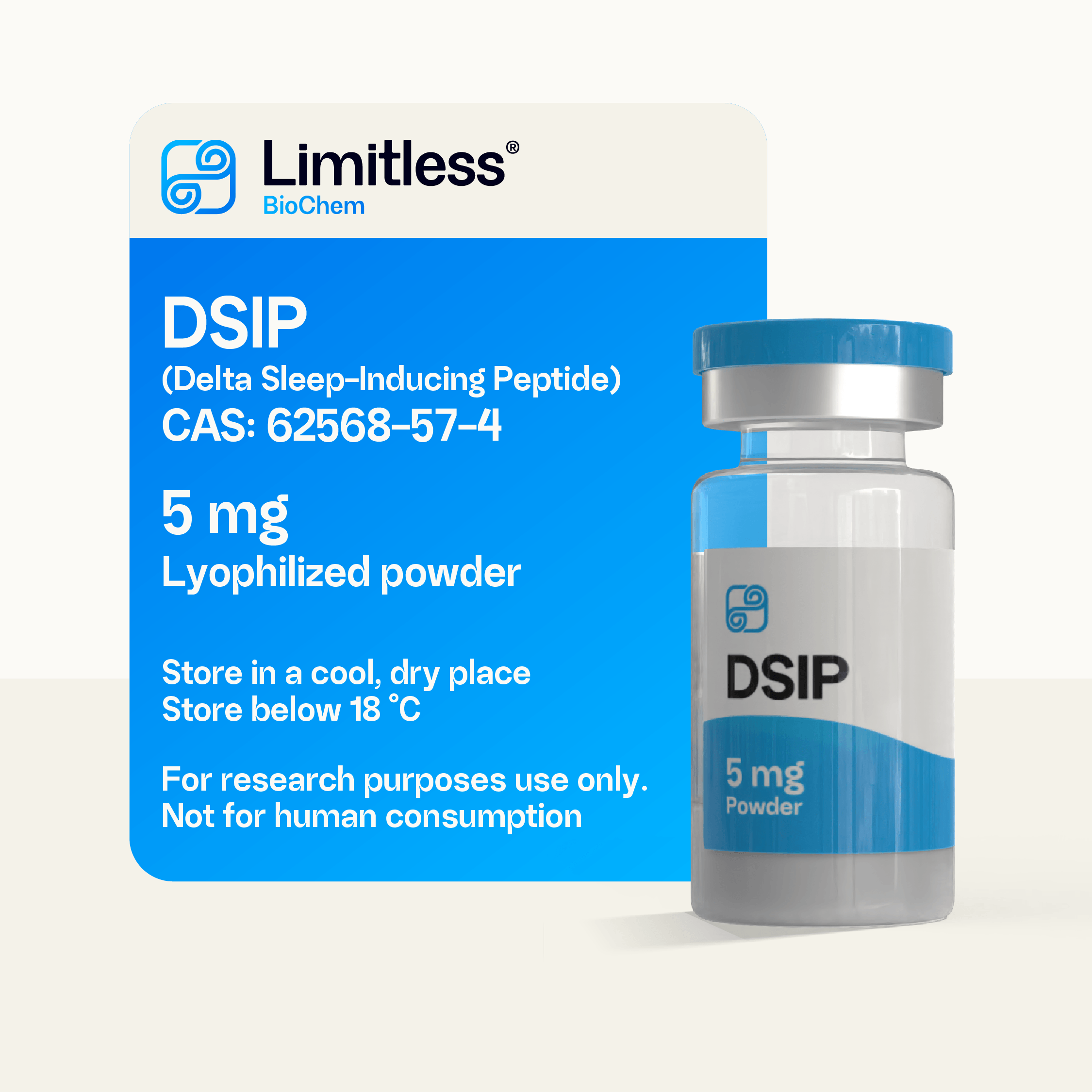
- DSIP was first fished out of the blood of sleeping rabbits, and its name comes from the delta brain waves it enhances.
- Its sleep-promoting effect can be blocked by naloxone, an opioid antagonist, pointing to a surprising link between DSIP and the body's own opioid system.
Mechanism
DSIP behaves less like a simple sleep switch and more like a broad regulator that helps return stressed systems toward balance. Its sleep effects are tied in part to the opioid system: in a model of sleep disruption at simulated high altitude, a phosphorylated form of DSIP increased both non-rapid-eye-movement and rapid-eye-movement sleep and improved spatial memory, and these benefits were blocked by naloxone, an of the mu opioid receptor, implicating opioid signaling in its sleep-inducing action [2]. Consistent with a direct hypnotic role, a DSIP fusion protein engineered for better delivery shortened the time to fall asleep and lengthened sleep duration in a standard sedative test [3].
The 's second major theme is stress protection. DSIP has been shown to dampen the molecular signature of stress, including suppression of the immediate-early gene c-fos in the paraventricular nucleus of the , a control center for the stress response; this suppression involves receptor signaling [5]. In models of physical and psychological stress it also behaves as an antioxidant, influencing the activity of protective enzymes such as superoxide dismutase and catalase and the level of lipid-peroxidation products in tissues, thereby helping to preserve normal organ function under stress [4].
Underlying these effects is the picture of DSIP as an endogenous adaptogen whose stress-protective activity is largely independent of the nature of the stressor [1]. By improving the depth and structure of sleep, tempering the central stress response, and buffering oxidative damage, DSIP is positioned by researchers as a that supports recovery and resilience. For the user, this translates into the reported benefits most associated with DSIP: deeper and more restorative sleep, a calmer response to stress, and general neuroprotective support, though it should be kept in mind that most of this evidence is preclinical [1][2][4].
receptor fingerprint
Sleep regulationpromotes
HPA / stress axismodulates
Substance P / beta-endorphinshifts
Dosingtypical ranges, not medical advice
interested in protocols and clinical dosages? make an account to see them! ^_^
Safetyrisks and cautions, not medical advice
As an endogenous peptide, DSIP is generally reported as low-toxicity and well tolerated in the (mostly small, older) studies available. Modern controlled safety data are limited, and the effects of exogenous long-term use are not well characterized. Research use.
Reconstitutionarithmetic only, not dosing advice
arithmetic only; not medical or dosing advice.
History
DSIP (delta sleep-inducing peptide) was isolated in the mid-1970s by Marcel Monnier and Guido Schoenenberger at the University of Basel in Switzerland. They obtained it from the cerebral venous blood of rabbits whose intralaminar thalamus had been electrically stimulated to induce sleep, and identified it as a nonapeptide with the sequence Trp-Ala-Gly-Gly-Asp-Ala-Ser-Gly-Glu. The synthetic peptide was shown to specifically enhance slow-wave (delta) electroencephalogram activity when infused into the brain, work published in the Proceedings of the National Academy of Sciences in 1977 and detailed further in 1978. It was among the first endogenous sleep-regulating peptides to be chemically characterized, and later decades broadened its reputation to include stress-protective and adaptogenic roles.
Reputation
DSIP holds a respected place in sleep neuroscience as one of the earliest sleep-associated peptides ever isolated and sequenced, and it continues to intrigue researchers for its versatility. Beyond promoting deeper, more restorative slow-wave sleep, it is described in the literature as a broad stress-protective and antioxidant agent that helps return stressed systems toward balance, which is why some call it an endogenous adaptogen. People value it as a gentle, naturally occurring option for sleep quality and resilience rather than a heavy sedative. It is worth noting that most of this evidence remains preclinical and that DSIP's exact mechanism has stayed elusive despite decades of study.
Subjective profileweighing the evidence above
Hard to recommend on what exists. The sleep and stress work is mostly small, decades old and done by infusion, and modern controlled human data is essentially absent, which is a lot of injecting for an unproven effect. Cheaper, better-studied sleep options should be exhausted long before this one.
Where to buy


Suppliers
Vendors carrying DSIP, with live product details and codes. Links are affiliate links that support the wiki at no cost to you.
| supplier | size | price | $/mg |
|---|---|---|---|
| RUOlowest | 5mg | $26.00 | $5.20/mg |
| Moglabs | 5mg | $28.00 | $5.60/mg |
| Limitless Biochem | 5 mg | $32.00 | $6.40/mg |
| Moglabs | 5mg | $38.00 | $7.60/mg |
Exceed Enhancement
DSIP
RUO
DSIP
Moglabs
DSIP
Kimera Chems
DSIP
Limitless Biochem🌐
DSIP

Moglabs
DSIP
Peptira
DSIP
Research
- 1977first citedCharacterization of a delta-electroencephalogram (-sleep)-inducing peptide.
- 2001controlled trialIntranasal administration of delta sleep-inducing peptide increases P300.
- 2003most active year3 papers
- 2021most recentDelta Sleep-Inducing Peptide Recovers Motor Function in SD Rats after Focal Stroke.
- 1.JmjC-domain-containing histone demethylases of the JMJD1B type as putative precursors of endogenous DSIP
- 2.Phosphorylated delta sleep inducing peptide restores spatial memory and p-CREB expression by improving sleep architecture at high altitude
- 3.Expression and Purification of Delta Sleep-Inducing Peptide Fused with Protein Transduction Domain and Human Serum Albumin in Pichia pastoris
- 4.Effect of Delta Sleep-Inducing Peptide on Functional State of Hepatocytes in Rats During Restraint Stress
- 5.[Dizocilpine inhibits suppression of c-fos gene by delta-sleep peptide in the rat hypothalamic paraventricular nucleus]
- 6.Delta-sleep-inducing peptide (DSIP): a review.
- 7.Characterization of a delta-electroencephalogram (-sleep)-inducing peptide.
- 8.The effects of delta-sleep-inducing peptide (DSIP) on wakefulness and sleep patterns in the cat.
- 9.The effect of delta sleep-inducing peptide on the EEG and power spectra in rat.
- 10.Delta sleep inducing peptide (DSIP): effect on respiration activity in rat brain mitochondria and stress protective potency under experimental hypoxia.
- 11.Delta sleep-inducing peptide and Deltaran: potential approaches to antistress protection.
- 12.Effect of delta sleep-inducing peptide on macromolecule biosynthesis in brain tissue of stressed rodents.
20 listed here; entry last updated August 2026
Reviews
My notesprivate to this device
FAQ
What does DSIP stand for?
It stands for delta sleep-inducing peptide, named for its association with deep sleep patterns.
What is it studied for?
It has been researched for steadying sleep and supporting the body's response to stress.
Is it an approved sleep aid?
No; it remains an investigational peptide without broad approval.
How is it typically used?
As a peptide, it is usually administered by injection or nasal route rather than orally.
Limitations of the evidence
- Generally reported as low-toxicity in animal studies, but rigorous human safety data are limited
- Most evidence is preclinical, so real-world effects and interactions are not well characterized
Adverse effects
- As an injected research peptide, injection-site reactions are possible
Notes and cautions
- Not approved as a medicine by Western drug regulators
- DSIP has a real intranasal record rather than an inferred one. A double blind crossover study in humans gave DSIP by the nasal route and recorded a change in the P300 evoked potential [17]. Finished intranasal formulations exist as products; the DSIP preparation Deltaran was given as daily nasal doses to elderly diabetic patients [18], and a related preparation was dosed nasally at 0.0003 g per day for two months in a trial in diabetic retinopathy [19]. Rats received DSIP nasally at 120 micrograms per kilogram for eight days around a middle cerebral artery occlusion and recovered motor performance faster than vehicle controls [20]. The nasal route for DSIP is documented in both humans and animals and is not an extrapolation from injection data.