
spec sheet6 rows
Azathioprine is an immunosuppressant used to prevent transplant rejection and to control autoimmune disease such as lupus nephritis, Crohn's disease and rheumatoid arthritis.
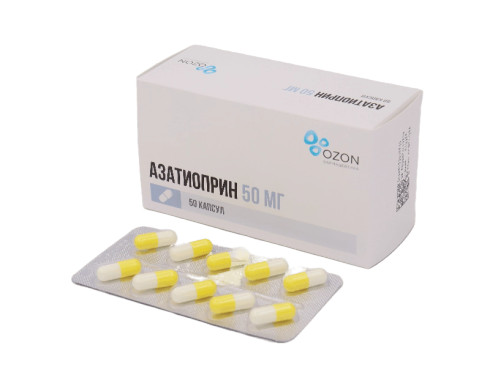
- Azathioprine is a prodrug: it is non-enzymatically cleaved to 6-mercaptopurine, then converted by HPRT to thioinosine monophosphate and ultimately to 6-thioguanine nucleotides that are incorporated into DNA.
- Its specific immunosuppressive action is not DNA incorporation but blockade of Rac1 by 6-thio-GTP, which turns CD28 co-stimulation into an apoptotic signal in activated T cells [1].
- The CESAME prospective cohort of 19,486 patients found that ongoing thiopurine exposure carried a roughly fivefold higher risk of lymphoproliferative disorder than never-exposure [2], the key evidence behind the malignancy boxed warning.
- SONIC showed azathioprine plus infliximab produced higher corticosteroid-free remission at week 26 (56.8%) than infliximab alone (44.4%) or azathioprine alone (30.0%) in 508 patients with Crohn's disease [3].
- Cochrane found azathioprine is not effective for inducing remission in Crohn's disease [5] but does maintain remission [4]; it is a maintenance drug, not a rescue drug, with a several-month onset.
- CPIC recommends testing TPMT and NUDT15 before starting; poor metabolisers of either enzyme need a large dose reduction or an alternative drug to avoid life-threatening myelosuppression [6].
Mechanism
It is a of 6-mercaptopurine, converted onward to thioguanine nucleotides that are incorporated into DNA and block purine synthesis, hitting rapidly dividing lymphocytes hardest. The rate limiting enzyme TPMT varies genetically, so identical doses produce wildly different exposures between people.
receptor fingerprint
Rac1 (Ras-related C3 botulinum toxin substrate 1, small GTPase)Blocked by the metabolite 6-thio-GTP, which binds Rac1 in place of GTP
HPRT1 (hypoxanthine-guanine phosphoribosyltransferase)Substrate-level activation step converting 6-mercaptopurine to thioinosine monophosphate
TPMT (thiopurine S-methyltransferase)Inactivating metabolic enzyme, not a therapeutic target
NUDT15 (nudix hydrolase 15)Inactivating enzyme for thioguanine triphosphate
IMPDH and de novo purine biosynthesis (PPAT/amidophosphoribosyltransferase)Inhibited by thioinosine monophosphate
Safetyrisks and cautions, not medical advice
an immunosuppressant, which the refusal class covers explicitly; it needs full blood count monitoring and TPMT or NUDT15 genotyping before starting, because a deficient metaboliser can be driven into fatal marrow failure by a standard dose
Subjective profileweighing the evidence above
Genetics decide whether an ordinary course of this is a routine treatment or fatal marrow failure. TPMT and NUDT15 activity varies enough between people that genotyping and repeated blood counts come before and during treatment rather than after something has gone wrong, and no amount of care with the tablet substitutes for the test. Deliberate immunosuppression also means infections present late and atypically, and skin cancer risk climbs over years of use. That is why this page documents the drug and refuses the question of where to get it: it requires a monitoring relationship, not a package.
Resources
No suppliers are provided for compounds like this. This entry is here for reference.
Research
- 2003first citedCD28-dependent Rac1 activation is the molecular target of azathioprine in primary human CD4+ T…
- 2015meta-analysisAzathioprine or 6-mercaptopurine for maintenance of remission in Crohn's disease
- 2019most recentClinical Pharmacogenetics Implementation Consortium Guideline for Thiopurine Dosing Based on TP…
- 1.CD28-dependent Rac1 activation is the molecular target of azathioprine in primary human CD4+ T lymphocytes
- 2.Lymphoproliferative disorders in patients receiving thiopurines for inflammatory bowel disease: a prospective observational cohort study
- 3.Infliximab, azathioprine, or combination therapy for Crohn's disease
- 4.Azathioprine or 6-mercaptopurine for maintenance of remission in Crohn's disease
- 5.Azathioprine or 6-mercaptopurine for induction of remission in Crohn's disease
- 6.Clinical Pharmacogenetics Implementation Consortium Guideline for Thiopurine Dosing Based on TPMT and NUDT15 Genotypes: 2018 Update
6 listed here; entry last updated August 2026
Reviews
My notesprivate to this device
Notes and cautions
- Azathioprine carries a BOXED WARNING for malignancy: chronic immunosuppression increases the risk of lymphoma and other malignancies, notably post-transplant lymphoproliferative disease, and a rare but usually fatal hepatosplenic T-cell lymphoma seen predominantly in adolescent and young adult males with inflammatory bowel disease, most of whom also received a TNF blocker.
- The label also warns of mutagenic potential and haematologic toxicity, and requires that the drug be prescribed by physicians experienced in immunosuppressive therapy with regular complete blood counts.
- Patients deficient in TPMT or NUDT15 develop severe, sometimes fatal, myelosuppression at conventional doses, so genotype or phenotype testing before starting is now standard.
- Serious infection, an idiosyncratic hypersensitivity syndrome resembling sepsis, pancreatitis, hepatotoxicity including nodular regenerative hyperplasia, and marked skin-cancer risk requiring sun protection round out the profile; allopurinol co-administration blocks xanthine oxidase and requires a 66 to 75 percent dose reduction.