
spec sheet13 rows
Tofacitinib is a small-molecule Janus kinase (JAK) inhibitor used to treat several autoimmune and inflammatory diseases, including rheumatoid arthritis, psoriatic arthritis, and ulcerative colitis [1]. Taken by mouth, it dampens overactive immune signaling by blocking enzymes inside cells that relay cytokine messages [2]. Developed by Pfizer and first approved in the United States in 2012, it is marketed chiefly as Xeljanz and carries boxed safety warnings.
- A pill, not an injection, for stubborn inflammatory disease
- Joint pain and swelling ease within weeks
- Blocks the JAK enzymes that relay overactive immune signals
- A real option after methotrexate or a biologic falls short
- Also carries approval in ulcerative colitis
- Slows the joint damage arthritis leaves behind
- Common effects include upper respiratory infections, headache, diarrhea, and raised blood pressure
- It raises the risk of serious and opportunistic infections, including shingles and tuberculosis reactivation
- Labeling carries warnings for blood clots, major cardiovascular events, and certain cancers, especially at higher doses and in older patients with heart risk factors
Overview
Tofacitinib is an orally administered small-molecule drug of the Janus kinase inhibitor class, a group of targeted immunomodulators often counted among the newer disease-modifying antirheumatic drugs [1]. Its molecular formula is C16H20N6O, and it was known during development by the code CP-690550. The compound emerged from a public-private research effort involving the United States National Institutes of Health and Pfizer that began in the 1990s, and it became one of the first JAK inhibitors to reach the market [1].
The United States Food and Drug Administration first approved tofacitinib in 2012 for moderate-to-severe rheumatoid arthritis in patients who had responded inadequately to methotrexate [1]. Later approvals extended its use to psoriatic arthritis, ulcerative colitis (where it was the first oral JAK inhibitor cleared for the condition), ankylosing spondylitis, and polyarticular-course juvenile idiopathic arthritis. It is available as immediate-release and extended-release tablets and as an oral solution, marketed principally under the brand name Xeljanz, and it is prescription-only across major markets. Following safety findings, its labeling carries a boxed warning covering serious infections, malignancy, major cardiovascular events, blood clots, and death.
A large postmarketing safety trial known as ORAL Surveillance compared tofacitinib with tumor necrosis factor inhibitors in older rheumatoid arthritis patients who had cardiovascular risk factors, and it found higher rates of major cardiovascular events and cancers with tofacitinib, results that shaped its warnings and positioned it as a treatment generally reserved for use after other options [3]. Beyond its approved indications, the drug has been investigated for conditions such as plaque psoriasis, alopecia areata, vitiligo, and atopic dermatitis [2]. The most common side effects include upper respiratory infections, headache, diarrhea, and raised blood pressure, while more serious risks involve opportunistic infections, herpes zoster, and blood clots [3].
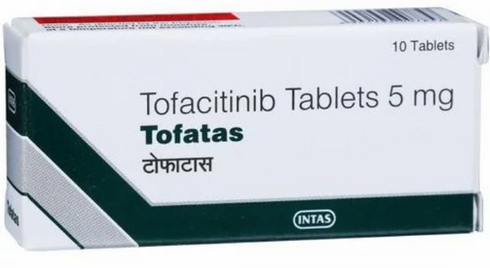

- Tofacitinib was the first oral Janus kinase (JAK) inhibitor approved anywhere in the world, launching an entirely new class of autoimmune drugs when it reached the US market in 2012.
- Unlike injectable biologics that neutralize a single cytokine, tofacitinib blocks a signaling hub inside the cell and so blunts the effects of many inflammatory cytokines at once.
- It has a very short half-life of roughly three hours, yet a large safety trial in older, higher-risk patients revealed cardiovascular and cancer signals that led to boxed warnings across the JAK-inhibitor class.
Mechanism
Tofacitinib works inside immune cells by inhibiting the Janus kinase family of enzymes, principally JAK1 and JAK3 and to a lesser degree JAK2 [1][2]. These kinases sit on the inner surface of receptors for many inflammatory cytokines; when a binds its receptor, the associated Janus kinases become active and phosphorylate signaling proteins called STATs, which then travel to the nucleus and switch on genes that drive immune responses [1]. By blocking the kinase activity, tofacitinib interrupts this JAK-STAT pathway and blunts the cell's response to a broad set of cytokines at once, rather than neutralizing a single as injectable biologics do [2].
In laboratory and animal studies this translated into reduced differentiation of pro-inflammatory helper T cell subsets such as Th1 and Th17 cells, suppression of STAT1-dependent genes in inflamed joint tissue, and dampened innate immune signaling [2]. Because the JAK-STAT pathway also governs blood cell production and antiviral and antitumor defenses, this same broad inhibition helps explain the drug's characteristic risks, including susceptibility to infection and changes in blood counts and lipids [3]. Tofacitinib has a short elimination of roughly three hours and is cleared mainly by the liver enzyme CYP3A4 with a contribution from CYP2C19.
receptor fingerprint
Janus kinase 1 (JAK1)inhibits
Janus kinase 3 (JAK3)inhibits
STAT phosphorylationblocks
Janus kinase 2 (JAK2)inhibits
Tyrosine kinase 2 (TYK2)inhibits
Dosingtypical ranges, not medical advice
interested in protocols and clinical dosages? make an account to see them! ^_^
Safetyrisks and cautions, not medical advice
Tofacitinib is a prescription immunosuppressant and it dampens immune defenses, so it raises the risk of serious infections, including reactivation of herpes zoster. It carries boxed warnings for serious infections, certain cancers, major cardiovascular events, blood clots and death, based on a large safety study comparing it with tumor necrosis factor inhibitors. It can raise cholesterol and liver enzymes and lower blood counts, so regular monitoring is needed, and live vaccines are avoided during treatment.
Interactionsdocumented pairs only, not exhaustive
Tofacitinib is metabolized mainly by CYP3A4 with a minor CYP2C19 contribution, and its interaction profile falls out of that split. Strong CYP3A4 inhibitors such as ketoconazole raise its exposure, and so does fluconazole, which is a moderate CYP3A4 inhibitor and a strong CYP2C19 inhibitor at once; the label flags that combination specifically. Strong inducers run the other way, and rifampin lowers tofacitinib exposure enough to lose the treatment effect, with carbamazepine, phenytoin and St John's wort acting similarly. Inhibitors of CYP2C19 alone, or of P-glycoprotein alone, do not shift it meaningfully.
The pharmacodynamic interaction is the one that causes harm. Tofacitinib blocks JAK1 and JAK3 signaling and suppresses immunity in its own right, so combining it with biologic DMARDs such as TNF inhibitors or abatacept, or with potent immunosuppressants like azathioprine, cyclosporine or tacrolimus, stacks that suppression and raises serious infection risk without buying extra efficacy. Live vaccines given during treatment carry a risk of disseminated infection for the same reason.
Checking a whole stack? Run it through interactions + stacks.
History
Tofacitinib was discovered by Pfizer in collaboration with the United States National Institutes of Health, originating from a research effort in the 1990s and 2000s to target the Janus kinase family of enzymes as a way to dampen overactive immune signaling. It was the first oral Janus kinase inhibitor to reach the market, receiving United States Food and Drug Administration approval in 2012 for rheumatoid arthritis under the brand name Xeljanz, a milestone that opened the era of small-molecule targeted therapies for autoimmune disease.
Its indications subsequently expanded to include psoriatic arthritis, ulcerative colitis, and polyarticular juvenile idiopathic arthritis, and an extended-release formulation, Xeljanz XR, was introduced. A large post-authorization safety trial, ORAL Surveillance, later compared it against tumor necrosis factor inhibitors in an older, cardiovascular-risk-enriched population and found higher rates of major cardiovascular events and cancers, prompting boxed safety warnings. Tofacitinib nonetheless remains an important and widely studied representative of the JAK-inhibitor class.
Reputation
Tofacitinib is a landmark medication, celebrated as the first oral Janus kinase inhibitor and the drug that ushered in a whole new class of targeted small-molecule therapies for autoimmune disease. For many patients with rheumatoid arthritis, psoriatic arthritis, or ulcerative colitis, it offers meaningful control of symptoms in convenient pill form, a welcome alternative to injectable biologics, and its efficacy has been demonstrated across numerous randomized controlled trials, including a pivotal study in children with juvenile arthritis.
Its broad action on cytokine signaling is a genuine therapeutic strength. That same breadth, however, demands honesty about its risks: because JAK-STAT signaling governs immune defense, blood-cell production, and lipid handling, tofacitinib carries recognized concerns including infections, herpes zoster, and, in a large safety trial of higher-risk patients, elevated cardiovascular and cancer signals that led to boxed warnings. Used with appropriate patient selection and monitoring, it remains a valuable and influential option.
Subjective profileweighing the evidence above
A real option when methotrexate or a biologic has not worked, with the convenience of a pill instead of an injection. The boxed warnings are not boilerplate: serious infections, blood clots, major cardiovascular events and certain cancers, weighted toward older patients with heart risk.
Where to buy

1 other outlet

Suppliers
Vendors carrying Tofacitinib, with live product details and codes. Links are affiliate links that support the wiki at no cost to you.
RUPharma🌐
Tofacitinib
PCT.Zone
Tofacitinib
Research
- 2011first citedModulation of innate and adaptive immune responses by tofacitinib (CP-690,550).
- 2022most recentCardiovascular and Cancer Risk with Tofacitinib in Rheumatoid Arthritis.
- 1.Janus kinase inhibitors in autoimmune diseases.
- 2.Modulation of innate and adaptive immune responses by tofacitinib (CP-690,550).
- 3.Cardiovascular and Cancer Risk with Tofacitinib in Rheumatoid Arthritis.
- 4.Tofacitinib in juvenile idiopathic arthritis: a double-blind, placebo-controlled, withdrawal phase 3 randomised trial
4 listed here; entry last updated August 2026
Reviews
My notesprivate to this device
FAQ
Is tofacitinib a biologic?
No. It is an oral small molecule JAK inhibitor, not an injected biologic, though it targets similar inflammatory pathways.
Why the warnings about infections and clots?
Because it dampens immune signaling it raises the risk of infections like shingles, and studies showed higher rates of clots and heart events in some patients.
How fast does it work?
Many people notice less joint pain and swelling within a few weeks of starting.
Do I need blood tests?
Yes. Your clinician monitors blood counts, liver tests and cholesterol during treatment.
Can I get vaccines on it?
Inactivated vaccines are fine, but live vaccines are generally avoided while on the drug.
Adverse effects
- Common effects include upper respiratory infections, headache, diarrhea, and raised blood pressure
- It raises the risk of serious and opportunistic infections, including shingles and tuberculosis reactivation
- Labeling carries warnings for blood clots, major cardiovascular events, and certain cancers, especially at higher doses and in older patients with heart risk factors
- Screening for latent tuberculosis and certain infections is standard before starting
Notes and cautions
- It can alter blood counts and cholesterol levels, so periodic blood tests are used to monitor treatment