
spec sheet7 rows
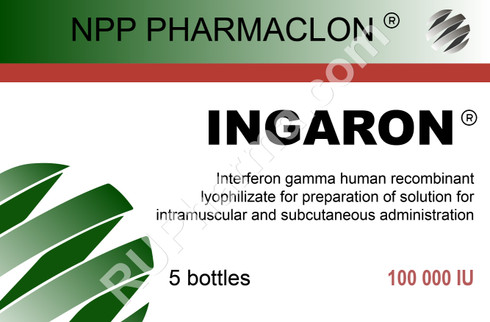
Interferon gamma is the single type II interferon, a cytokine that activates macrophages and drives Th1 immunity; the Russian product Ingaron supplies it as a recombinant lyophilisate for intranasal or subcutaneous use.
- The 1991 International Chronic Granulomatous Disease Cooperative Study Group trial randomised 128 patients and found interferon gamma reduced serious infections by about 70% (14 of 63 patients versus 30 of 65 on placebo), which remains the drug's principal indication [1].
- The CGD benefit appeared without a consistent improvement in measured superoxide production or bacterial killing, so the operative mechanism is still not fully explained [1].
- Key's 1995 NEJM trial established interferon gamma for severe malignant osteopetrosis, where it increases osteoclastic bone resorption, expands marrow space and reduces infection rates [3].
- Interferon gamma-1b failed decisively in idiopathic pulmonary fibrosis: Raghu's 2004 NEJM trial missed its primary endpoint [4], and the larger INSPIRE trial was stopped early for futility with no survival benefit [5].
- Randomised evidence supports modest benefit in severe atopic dermatitis, consistent with its capacity to counter Th2-skewed immunity [2], but it is not a standard therapy there.
- Interferon gamma signals through STAT1 homodimers at GAS elements, a genuinely different transcriptional programme from the type I interferons, which is why alfa and gamma interferons are not interchangeable.
Mechanism
Interferon gamma binds the IFNGR1 and IFNGR2 receptor pair and signals through JAK1, JAK2 and STAT1, switching on hundreds of genes that raise MHC class I and II expression, prime the macrophage respiratory burst and skew helper T cells toward Th1. In the West the same is approved for chronic granulomatous disease and severe malignant osteopetrosis and nothing else, which is a far narrower use than the respiratory infection indication sold here, and the difference reflects how much systemic toxicity the dose carries.
receptor fingerprint
IFNGR1/IFNGR2 (type II interferon receptor)Agonist (homodimeric ligand binding two receptor chains)
Phagocyte NADPH oxidase (CYBB/gp91-phox, NCF1/p47-phox)Expression and oxidative burst augmented
Osteoclast superoxide-dependent bone resorptionEnhanced
JAK1 and JAK2, then STAT1 homodimer (gamma-activated factor) at GAS elementsActivated downstream of IFNGR
MHC class I and class II expression and antigen presentationUpregulated
Safetyrisks and cautions, not medical advice
a recombinant cytokine biologic; systemic interferon gamma causes dose-limiting flu-like syndrome, neutropenia, thrombocytopenia and hepatotoxicity, and it is not something to self-administer from an import pharmacy
Subjective profileweighing the evidence above
The distance between what this cytokine is licensed for in the West (chronic granulomatous disease and severe malignant osteopetrosis, and nothing else) and what it is sold for here (respiratory infection) is the whole verdict. That distance is not regulatory timidity; systemic interferon gamma pays for its immune activation with flu-like syndrome, neutropenia, thrombocytopenia and liver injury. Self-administering a recombinant cytokine biologic for a cold is a bad trade, and the site will not help anyone make it.
Resources
No suppliers are provided for compounds like this. This entry is here for reference.
Research
- 1991first citedA controlled trial of interferon gamma to prevent infection in chronic granulomatous disease
- 2009most recentEffect of interferon gamma-1b on survival in patients with idiopathic pulmonary fibrosis (INSPI…
- 1.A controlled trial of interferon gamma to prevent infection in chronic granulomatous disease
- 2.Recombinant interferon gamma therapy for atopic dermatitis
- 3.Long-term treatment of osteopetrosis with recombinant human interferon gamma
- 4.A placebo-controlled trial of interferon gamma-1b in patients with idiopathic pulmonary fibrosis
- 5.Effect of interferon gamma-1b on survival in patients with idiopathic pulmonary fibrosis (INSPIRE): a multicentre, randomised, placebo-controlled trial
5 listed here; entry last updated August 2026
Reviews
My notesprivate to this device
Notes and cautions
- Interferon gamma-1b carries no boxed warning.
- The near-universal adverse effect is a flu-like syndrome of fever, headache, chills, myalgia and fatigue, usually manageable with bedtime administration and paracetamol and tending to attenuate with continued use.
- Dose-related and reversible neutropenia, thrombocytopenia and transaminase elevation occur, and are most pronounced in children under one year of age, so complete blood counts, liver function and renal function should be checked at baseline and periodically.
- At doses greater than 100 micrograms per square metre, cardiac events including arrhythmia, ischaemia and heart failure, and central nervous system events including seizure, confusion and gait disturbance have been reported; caution is needed in pre-existing cardiac disease, seizure disorder or compromised central nervous system function.
- Critically, interferon gamma-1b must not be used for idiopathic pulmonary fibrosis: INSPIRE was stopped for futility and showed no survival benefit [5].