
spec sheet5 rows
Allohol is a Soviet-era four ingredient choleretic tablet combining dried bile, garlic powder, nettle leaf and activated charcoal, taken to increase bile flow and ease heaviness after meals.
- Soviet era choleretic tablet still going strong
- Oral bile acids genuinely stimulate further bile flow
- Taken for heaviness after meals
- Bile, garlic, nettle and activated charcoal in one tablet
- A pharmacy staple across the region for decades
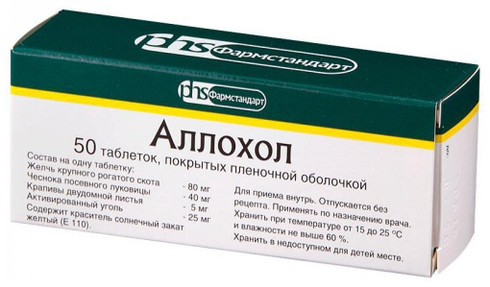
- Allohol is a Soviet-era fixed combination of dried animal bile, dry garlic extract, dry nettle extract and activated charcoal, registered as a choleretic in Russia and neighbouring markets and not approved in the EU, UK or US.
- A PubMed search for 'Allohol OR allochol' returns essentially nothing: two obscure Russian-language records, of which only one (a 1976 Vrach Delo comparative evaluation in chronic cholecystocholangitis, PMID 969428) concerns the product itself. There is no indexed randomised trial, no meta-analysis and no pharmacokinetic study.
- Its evidence base is therefore not weak, it is effectively absent from indexed Western literature; the studies array is intentionally empty rather than padded with tangential bile-acid papers.
- The activated charcoal constituent is a real pharmacological interaction hazard: charcoal adsorbs co-administered oral drugs non-selectively.
- Bile acid preparations of this kind are contraindicated in biliary obstruction and in acute hepatitis, where increasing bile flow against an obstruction is harmful.
Mechanism
Bile acids taken by mouth enter the enterohepatic circulation and stimulate further bile secretion, which is the choleretic part and the only component with a clear rationale. The garlic and nettle contribute little that has been measured, and the 25 mg of charcoal per tablet is orders of magnitude below any adsorbent dose. No controlled trial has tested the combination as a whole, and it is contraindicated in acute hepatitis, obstructive jaundice and active peptic ulcer.
receptor fingerprint
Bile acid pool (dried bovine bile, the principal active constituent)Exogenous bile acid supplementation increasing bile-acid-dependent bile flow; a choleretic rather than a cholekinetic action
Gastrointestinal lumen (activated charcoal constituent)Non-specific adsorption of luminal contents
No receptor, enzyme or transporter mechanism has been characterised for the garlic or nettle extract constituents in the indexed literatureUnknown
Safetyrisks and cautions, not medical advice
Allohol is a fixed combination product in the gastrointestinal class. A full adverse effect profile has not been compiled for this entry yet, so nothing here should be read as evidence that it is well tolerated; the absence is missing work rather than a finding. What is documented is what the compound is and what it is used for.
Subjective profileweighing the evidence above
Four ingredients, one of which has a rationale. Oral bile acids do stimulate bile flow, so the choleretic claim is not invented, but the garlic and nettle are decoration and the charcoal sits at a small fraction of any adsorbent quantity, which leaves a bile acid tablet wearing three extra labels. No controlled trial has tested the combination as a whole. Biliary obstruction, acute hepatitis and active peptic ulcer are firm contraindications, so the situation where the heaviness feels most urgent can also be the one where this is the wrong tablet.
Where to buy

Suppliers
Vendors carrying Allohol, with live product details and codes. Links are affiliate links that support the wiki at no cost to you.
RUPharma🌐
Allohol
Reviews
My notesprivate to this device
Notes and cautions
- Allohol should not be used where there is any suspicion of biliary obstruction, obstructive jaundice, acute hepatitis, acute pancreatitis or gastric or duodenal ulceration, because stimulating bile flow into a blocked or inflamed system can worsen the picture.
- Because it contains activated charcoal, it can reduce the absorption of any oral medicine taken near the same time, including oral contraceptives and thyroid replacement; separate doses by at least two hours.
- There is no indexed clinical trial evidence supporting any claimed benefit, so it should not be substituted for investigation of biliary or hepatic symptoms.
- Right upper quadrant pain warrants imaging, not a choleretic.