
spec sheet12 rows
Albendazole is a broad-spectrum benzimidazole medication used to treat a wide range of parasitic worm infections. It is effective against intestinal worms such as roundworm, hookworm, and pinworm, as well as serious tissue infections including neurocysticercosis and hydatid disease. Inexpensive and widely used in mass deworming programs, it appears on the World Health Organization's List of Essential Medicines.
- Clears a wide range of parasitic worms
- A single dose handles many intestinal worm infections
- Effective against hydatid disease and neurocysticercosis
- Longer courses reach infections that once required surgery
- Inexpensive and widely used in mass deworming programs
- On the World Health Organization essential medicines list
- Usually well tolerated, with mostly mild digestive upset
- Headache and dizziness can occur, especially on longer courses
- Prolonged treatment may affect the liver or blood counts, so monitoring is sometimes used
Overview
Albendazole is an anthelmintic drug of the benzimidazole class, a group of antiparasitic agents built around a fused double-ring chemical structure [1]. It has an unusually broad spectrum of activity, working against many nematodes (roundworms), some cestodes (tapeworms), and certain protozoa, which makes it one of the most versatile deworming medicines available [1]. After it is absorbed, it is rapidly converted in the liver to an active form, albendazole sulfoxide, which carries much of its antiparasitic effect [1].
The compound was developed in the 1970s and introduced first for veterinary use before being registered for human treatment in the early 1980s [1]. In people it is used for common intestinal worm infections such as ascariasis, hookworm, pinworm, and whipworm, and, in longer courses, for more serious diseases in which larvae lodge in body tissues, most importantly cystic and alveolar echinococcosis (hydatid disease) and neurocysticercosis, an infection of the brain by tapeworm larvae [1][3]. For echinococcosis it has become a central part of management, used on its own or alongside surgery [3].
Albendazole is taken by mouth, often as a chewable tablet, and has a strong safety record across hundreds of millions of treatments, with side effects that are usually mild [1]. It is listed by the World Health Organization as an essential medicine and is distributed on a very large scale in community deworming and neglected tropical disease programs, supported by extensive manufacturer donations [1]. It is available as an inexpensive generic worldwide [1].

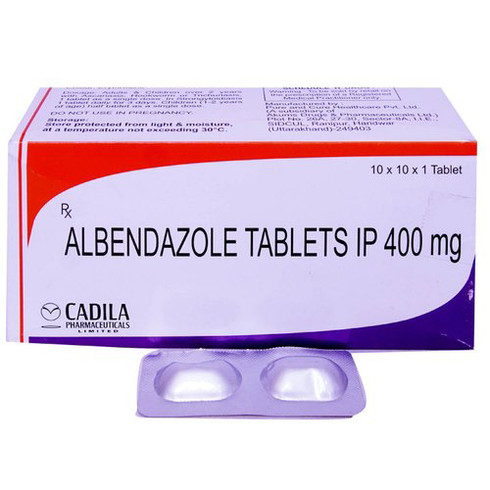
- Albendazole is absorbed only poorly from the gut, and taking it with a fatty meal can substantially increase how much reaches the bloodstream, which matters when treating deep tissue infections rather than intestinal worms.
- The drug starves parasites by binding their beta-tubulin and collapsing the microtubule 'scaffolding' inside their cells, blocking their ability to take up glucose while largely sparing human cells.
Mechanism
Albendazole kills or paralyzes parasites by attacking their cytoskeleton, the internal scaffolding of their cells [2]. Like other benzimidazoles, it binds selectively to beta-tubulin, the protein subunit that assembles into microtubules, and prevents those subunits from polymerizing into functional microtubules [2]. Because the drug binds the parasite's tubulin much more tightly than the host's, it damages the worm while largely sparing human cells, the basis of its selective toxicity [2].
Loss of intact microtubules has severe consequences for the parasite. It disrupts the uptake of glucose, so the worm's stores of glycogen are progressively depleted and it can no longer generate enough energy [1]. Cellular processes that depend on microtubules, including the transport of secretory vesicles and cell division, also fail, and the parasite is gradually immobilized and dies [1][2]. This slow, energy-starving action explains why tissue infections such as hydatid disease generally require prolonged courses rather than a single treatment [3]. Differences in tubulin structure between species account for both the drug's selectivity and the emergence of benzimidazole resistance when the target protein is altered [2].
receptor fingerprint
Parasite beta-tubulinblocks
Helminth glucose uptakeinhibits
Parasite glycogen and ATP storesmodulates
Microtubule-dependent secretory transportblocks
Fumarate reductaseinhibits
Dosingtypical ranges, not medical advice
interested in protocols and clinical dosages? make an account to see them! ^_^
Safetyrisks and cautions, not medical advice
Albendazole is prescription only. Short courses are usually mild, with occasional nausea, stomach ache or headache. Longer, higher-dose treatment for tissue infections can raise liver enzymes and, less often, suppress blood counts or cause temporary hair thinning, so liver tests and blood counts are monitored. It is avoided in pregnancy, especially the first trimester, because of possible harm to the baby. When treating neurocysticercosis, killing the cysts can inflame the surrounding brain tissue, so steroids and sometimes anti-seizure drugs are added, and the eyes are checked first for cysts. Dexamethasone, praziquantel and cimetidine can raise its blood levels.
Interactionsdocumented pairs only, not exhaustive
Albendazole is a prodrug; the active species is albendazole sulfoxide, formed largely by CYP3A4 and flavin-containing monooxygenases, so anything that shifts that conversion shifts the effect.
Inducers cut it. Phenytoin, carbamazepine and phenobarbital lower albendazole sulfoxide exposure by roughly a third to a half, which matters a great deal because those anticonvulsants are exactly what neurocysticercosis patients tend to be taking. Ritonavir reduces exposure by around 40%.
Inhibitors raise it, sometimes usefully. Dexamethasone, routinely co-administered to control the inflammatory response to dying cysts, increases albendazole sulfoxide AUC by roughly 250%. Praziquantel raises it as well, and cimetidine does so by prolonging the elimination half-life.
Because higher systemic exposure is generally wanted in tissue infections such as hydatid disease and neurocysticercosis, several of these interactions are exploited rather than avoided; the risk then sits on the side of hepatotoxicity and bone marrow suppression.
Checking a whole stack? Run it through interactions + stacks.
History
Albendazole is a benzimidazole anthelmintic developed by SmithKline (a corporate ancestor of GlaxoSmithKline), introduced in the late 1970s for veterinary use and subsequently established for human medicine in the following decade. It belongs to the benzimidazole family that grew out of mid-twentieth-century research into agents that disrupt parasite microtubules by binding beta-tubulin. Marketed under names such as Albenza and Zentel, it proved effective across a broad spectrum of worm infections, from common intestinal helminths to serious tissue diseases including neurocysticercosis and hydatid disease. Its combination of low cost, oral dosing, and wide activity made it a mainstay of large-scale deworming programs, and it is listed on the World Health Organization's List of Essential Medicines.
Reputation
Albendazole is widely respected as a workhorse of global parasitology, valued for being inexpensive, orally administered, and effective against an unusually broad range of parasitic worms. Public-health authorities rely on it heavily in mass deworming campaigns, and its inclusion on the WHO Essential Medicines list reflects a strong track record of benefit at population scale. For single-dose treatment of common intestinal worms it is generally very well tolerated. It is honest to note that serious tissue infections such as hydatid disease and neurocysticercosis require prolonged, higher-dose courses, and that these extended regimens carry a greater need for monitoring, particularly of liver function and blood counts; in that setting it is often paired with other agents to improve parasite clearance.
Subjective profileweighing the evidence above
One of the genuinely great cheap medicines; a single dose clears most intestinal worms and longer courses treat tissue infections that once required surgery. Prescription only, avoided in pregnancy, and long courses need liver and blood-count monitoring.
Where to buy

1 other outlet

Suppliers
Vendors carrying Albendazole, with live product details and codes. Links are affiliate links that support the wiki at no cost to you.
PCT.Zone
Albendazole
RUPharma🌐
Albendazole
Research
- 1988first citedThe role of the cytoskeletal protein, tubulin, in the mode of action and mechanism of drug resi…
- 2018most recentAlbendazole and Praziquantel: Review and Safety Monitoring in Korea
- 1.Albendazole: a review of anthelmintic efficacy and safety in humans
- 2.The role of the cytoskeletal protein, tubulin, in the mode of action and mechanism of drug resistance to benzimidazoles
- 3.Albendazole for the treatment of echinococcosis
- 4.Pharmacokinetics of combined treatment with praziquantel and albendazole in neurocysticercosis
- 5.Albendazole and Praziquantel: Review and Safety Monitoring in Korea
5 listed here; entry last updated August 2026
Reviews
My notesprivate to this device
FAQ
Do I need to take it with food?
For simple intestinal worms it does not matter much, but for tissue infections take it with a fatty meal because that greatly boosts absorption.
Is it one dose or a course?
Common worms like pinworm often need just a single dose repeated in two weeks, while brain or organ infections need weeks to months of treatment.
Should the whole family be treated?
For pinworm, treating household members together and repeating in two weeks helps stop reinfection.
Are blood tests needed?
For short courses usually not, but long or high-dose treatment calls for checking liver enzymes and blood counts.
Can I take it in pregnancy?
It is generally avoided, especially in the first trimester, because of possible harm to the developing baby.
Adverse effects
- Usually well tolerated, with mostly mild digestive upset
- Headache and dizziness can occur, especially on longer courses
- Prolonged treatment may affect the liver or blood counts, so monitoring is sometimes used
- Temporary hair thinning has been reported with extended treatment
- Not recommended during pregnancy, particularly early on