
spec sheet10 rows
TMG (trimethylglycine, sold as betaine anhydrous) is a methyl donor; a small molecule that carries three methyl groups (CH3 chemical tags) it can hand off to other molecules. It comes originally from beets, and its headline job in the body is recycling homocysteine (an amino acid that damages blood vessels when it builds up too high) back into methionine, using an enzyme called BHMT (betaine-homocysteine methyltransferase). By feeding that reaction, TMG lowers homocysteine and supports the whole methylation system, which touches everything from DNA maintenance to neurotransmitter and mood chemistry. People take it for three main reasons: reliably lowering homocysteine, supporting liver health in fatty liver (NAFLD), and squeezing out a bit more strength and power in training. One point of confusion worth clearing up: TMG is chemically the exact same molecule as betaine, but it is NOT the same product as Betaine HCl; Betaine HCl is the hydrochloride salt people use to add stomach acid for digestion, while TMG/anhydrous betaine is the plain methylation form. Same core molecule, very different job.
- reliably drops elevated homocysteine, a real vascular marker
- works through its own enzyme when folate and B12 lag
- feeds the methylation system that regenerates methionine and SAMe
- early human trials improved liver enzymes in fatty liver
- about 2.5 g daily added strength and power in lifters
- cheap, beet derived, water soluble and very well tolerated
- Gastrointestinal upset (nausea, bloating, loose stools), mostly at higher single doses; splitting the dose helps
- Can raise LDL and total cholesterol in some people at higher doses, so lipids are worth monitoring on long-term high-dose use
- Rare, dose-dependent cerebral edema (brain swelling) reported only in the clinical high-dose homocystinuria setting, not in normal supplement use
Overview
A cheap, food-derived methyl donor whose best-proven trick is lowering homocysteine; also has decent liver and modest athletic evidence. Not the same product as Betaine HCl despite sharing the betaine molecule.

- The name 'betaine' comes from the beet (Beta vulgaris), where it was first isolated in the 1800s.
- Your own body makes TMG by oxidizing choline, so it is both a nutrient you eat and one you produce.
- TMG's methyl handoff leaves behind DMG (dimethylglycine), which is itself sold as a separate supplement.
- It doubles as an osmolyte; the same class of 'water-holding' molecules that lets some organisms survive extreme salt and drought.
- In food processing, betaine is recovered as a byproduct of beet-sugar manufacturing, which is part of why it is so cheap.
- Betaine is added to some animal feed to improve growth and carcass leanness, an early hint at its human body-composition effects.
Mechanism
Here is the plumbing in plain terms. Methylation is the body's habit of sticking a methyl group (a CH3 tag) onto DNA, proteins, neurotransmitters, and other molecules to switch their behavior; it runs on a currency called SAMe (S-adenosylmethionine), the universal methyl donor. When SAMe hands off its methyl group it becomes SAH (S-adenosylhomocysteine) and then homocysteine, an amino acid that is fine in small amounts but corrosive to blood vessels when it piles up.
The body has two ways to clear that homocysteine back into methionine (which then regenerates SAMe). One route uses folate and B12. The OTHER route uses TMG: the enzyme BHMT (betaine-homocysteine methyltransferase) grabs a methyl group off TMG and slaps it onto homocysteine, turning it back into methionine and leaving behind DMG (dimethylglycine).
That is the core of what TMG does; it is a backup methyl supply for the methionine cycle that works independently of folate and B12, which is why it can lower homocysteine even when the folate pathway is sluggish. Two downstream consequences follow. First, better methionine/SAMe recycling supports overall methylation capacity, which is why it gets floated for mood and general methylation support (SAMe itself is a mood-active molecule, and TMG helps keep the SAMe tank topped up).
Second, in the liver, healthier methylation and TMG's role in making phosphatidylcholine (a fat-packaging molecule) help the liver export fat rather than store it, which is the rationale behind its use in fatty liver. Separately from all the methyl chemistry, TMG is also an osmolyte; a molecule cells pull inside to hold water and stay stable under stress. That osmolyte role is the leading (if still debated) explanation for the small strength and power boosts seen in training studies.
receptor fingerprint
BHMT (betaine-homocysteine methyltransferase)Serves as the methyl-group donor substrate for the enzyme, driving conversion of homocysteine to methionine
HomocysteineLowers circulating levels by feeding its remethylation
Methionine / SAMe cycleReplenishes methionine, helping regenerate SAMe (the universal methyl donor)
Hepatic fat metabolism (liver)Supports methylation-dependent fat export and phosphatidylcholine synthesis
Cellular osmolyte balanceAccumulates inside cells to hold water and stabilize proteins under stress
Evidencehow good the literature is
The evidence is strongest for the thing TMG is chemically built to do. Homocysteine lowering is well established: multiple controlled trials show 1.5 to 6 g/day reliably drops fasting homocysteine, and the effect is larger after a methionine load, which makes mechanistic sense because that is exactly when the BHMT backup pathway earns its keep. What is NOT settled is whether that homocysteine drop translates into fewer heart attacks or strokes; lowering homocysteine has repeatedly failed to produce clear cardiovascular outcome benefits in the broader literature, so this is best read as a solid biomarker effect with an unproven hard-outcome payoff. For liver health, there is real but earlier-stage human evidence in NAFLD showing improvements in liver enzymes and fat, though the trials are small, not all positive, and used much higher doses (~20 g/day) than people take for methylation; promising, not conclusive. For athletic performance, the picture is genuinely mixed but leans mildly positive: several studies show small improvements in power output, strength, and body composition at ~2.5 g/day, while others show nothing, and the mechanism (osmolyte effect versus methylation) is still argued. Mood and general methylation support is the softest claim; it is mechanistically reasonable through the SAMe connection (and SAMe itself has antidepressant data), but direct trials of TMG for mood are sparse, so that one sits in plausible-but-thin territory rather than proven. Overall: strong for the biomarker (homocysteine), moderate for liver, weak-to-moderate and inconsistent for performance, and speculative for mood.
Dosingtypical ranges, not medical advice
interested in protocols and clinical dosages? make an account to see them! ^_^
Safetyrisks and cautions, not medical advice
TMG is generally very well tolerated; it is a normal component of food (beets, spinach, wheat bran, shellfish) and the body makes it from choline, so this is not an exotic drug. Doses up to around 3 g/day for methylation and homocysteine, and up to roughly 6 g/day in athletic studies, have been used without serious problems; the fatty-liver trials went much higher (on the order of 20 g/day) under clinical supervision.
The most common issues are gastrointestinal: nausea, bloating, or loose stools, usually at higher single doses. The one metabolic caveat worth flagging: high-dose TMG can RAISE LDL and total cholesterol in some people, an effect seen fairly consistently in trials, so anyone already managing cholesterol should keep doses moderate and check their lipids.
In the rare inherited disorder homocystinuria, TMG is used therapeutically at much higher doses under medical supervision and can occasionally cause dangerous brain swelling (cerebral edema); that is a clinical-supervision scenario, not a general-supplement one. Because TMG feeds the methylation cycle, some people pair it with B12, folate, and B6 so the whole system moves together, though TMG works on its own too. Pregnancy and breastfeeding data are thin, so supplemental doses are not advisable there without a clinician. As always, this is general educational information, not medical advice; if you have kidney, liver, or cardiovascular conditions or take medications, run it past your doctor first.
History
Betaine was first identified in sugar beets in the 19th century and takes its name from the beet's genus, Beta. For most of its history it was a food-science and agriculture curiosity; it turns up naturally in beets, spinach, wheat bran, and shellfish, and it became a common animal-feed additive prized for improving growth and leanness. Its human medical debut came through metabolism: betaine (as anhydrous betaine) became an approved therapy for homocystinuria, a rare inherited disorder in which homocysteine builds to dangerous levels, where it is used to force the BHMT remethylation pathway.
From that clinical foothold the biomarker story generalized; researchers showed it lowers homocysteine in ordinary people too, and the supplement world adopted 'TMG' as a friendlier name for the methylation crowd. Over the last couple of decades it picked up two more constituencies: sports-nutrition researchers testing it for strength and power, and hepatology studying it for fatty liver. Today it sits in a slightly funny spot; a genuinely food-derived, well-characterized molecule with one rock-solid effect (homocysteine) and a cluster of promising-but-softer ones around it.
Reputation
In the supplement community TMG has a solid, no-nonsense reputation as a cheap methylation staple. It is especially popular with two crowds: the methylation/genetics-minded folks (often people worried about MTHFR (a common gene variant that slows the folate-based methylation pathway) and homocysteine) who use it to support the methionine cycle, and lifters who add it for a small strength edge. It is widely regarded as safe, boring in a good way, and hard to mess up. The main reputational pitfalls are the persistent confusion with Betaine HCl (a completely different use case) and some overselling of its mood and 'detox' benefits beyond what the evidence supports. Among more evidence-minded users it is respected precisely for what it verifiably does to homocysteine, with appropriate skepticism about whether that translates into real-world heart or mood outcomes.
Subjective profileweighing the evidence above
Genuinely worth it if homocysteine is the target, since it lowers it reliably through a pathway independent of folate and B12, and it is cheap and food-derived. The performance and mood claims are much softer. Split the dose to avoid gut upset, and watch LDL on long-term high intakes.
Where to buy
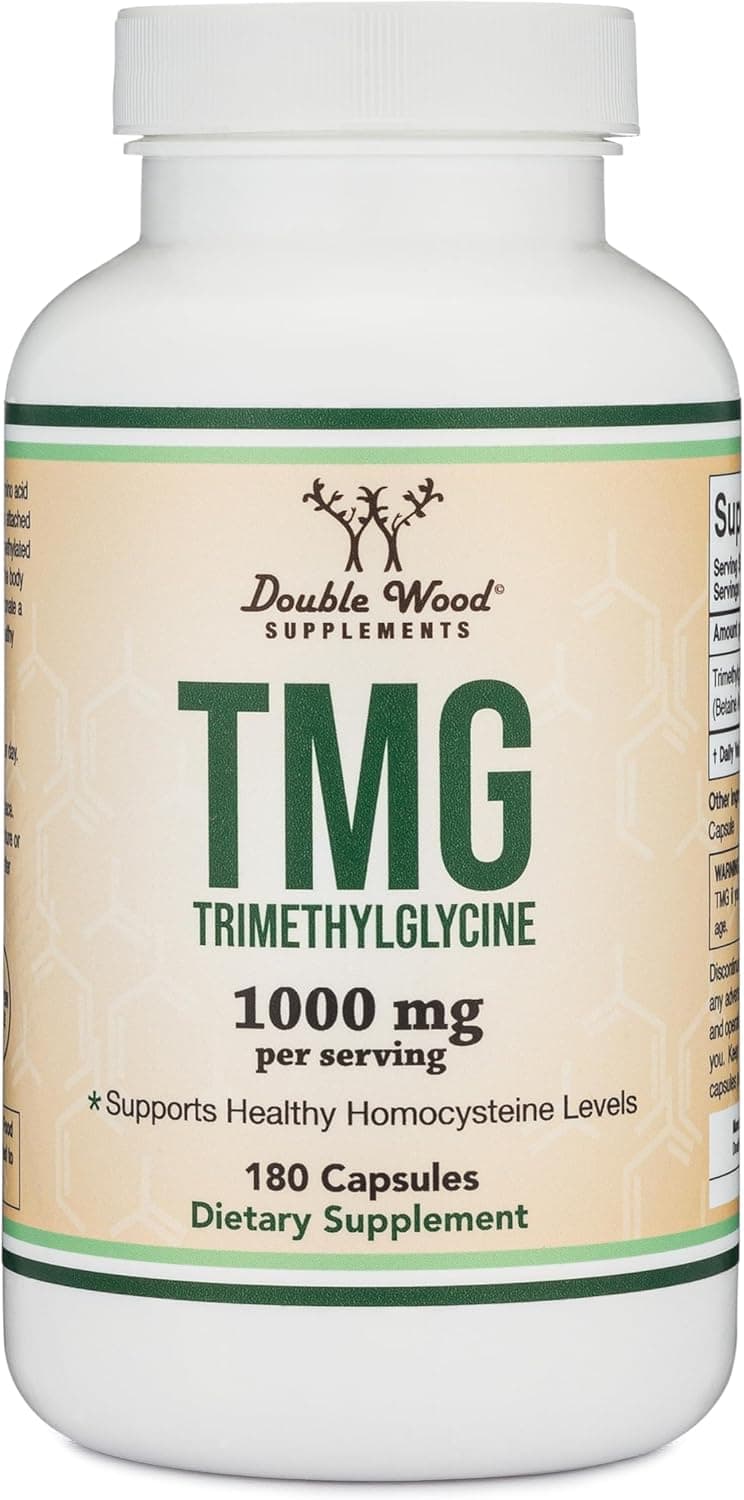
Suppliers
Vendors carrying TMG, with live product details and codes. Links are affiliate links that support the wiki at no cost to you.
Amazon
TMG
Research
- 1995first citedMolecular basis of osmotic regulation
- 2021meta-analysisBetaine Supplementation Moderately Increases Total Cholesterol Levels: A Systematic Review and…
- 2023most recentBetaine consumption as a new clinical approach to treatment and prophylaxis of folate-related p…
- 1.Betaine supplementation lowers plasma homocysteine in healthy men and women
- 2.Low dose betaine supplementation leads to immediate and long term lowering of plasma homocysteine in healthy men and women
- 3.The natural history of vascular disease in homocystinuria and the effects of treatment
- 4.Betaine, a promising new agent for patients with nonalcoholic steatohepatitis: results of a pilot study
- 5.The effects of chronic betaine supplementation on exercise performance, skeletal muscle oxygen saturation and associated biochemical parameters in resistance trained men
- 6.Effects of betaine on body composition, performance, and homocysteine thiolactone
- 7.Molecular basis of osmotic regulation
- 8.Betaine consumption as a new clinical approach to treatment and prophylaxis of folate-related pathologies
- 9.Betaine Supplementation Moderately Increases Total Cholesterol Levels: A Systematic Review and Meta-Analysis
9 listed here; entry last updated August 2026
Reviews
My notesprivate to this device
FAQ
Is TMG the same thing as betaine?
Yes, chemically they are the identical molecule; TMG (trimethylglycine) IS betaine, and supplements labeled 'betaine anhydrous' or 'anhydrous betaine' are the same product. The name 'betaine' is just the older/food-science term for it.
Then how is it different from Betaine HCl?
This is the key mix-up. Betaine HCl is betaine bonded to hydrochloric acid (a hydrochloride salt); people take it to add stomach acid for digestion. TMG/anhydrous betaine is the plain form used for methylation and lowering homocysteine. Same betaine core, but you would not swap one for the other; Betaine HCl is dosed for its acid, not its methyl groups.
How much should I take?
For homocysteine and general methylation, 500 mg to 3 g per day (many settle around 1 to 1.5 g). For strength and power in the gym, about 2.5 g/day split into two doses, taken consistently for a couple of weeks. For fatty liver, the trials used much higher amounts, on the order of ~20 g/day, which is a therapeutic dose to run only with medical guidance. Start low and split larger amounts to avoid stomach upset.
Does TMG actually help my heart?
It clearly lowers homocysteine, a risk-associated biomarker; but lowering homocysteine has not been shown to reliably cut heart attacks or strokes in outcome trials. So it improves the number, but the hard-outcome benefit is unproven. It should not be treated as a cardiovascular drug.
Should I stack it with B vitamins?
It is reasonable. Folate, B12, and B6 run the parallel homocysteine-clearance pathway, so pairing them covers both routes; but TMG lowers homocysteine on its own through BHMT even without them.
Will it help my mood?
Maybe, indirectly. TMG helps regenerate SAMe, and SAMe itself has real antidepressant data. But direct trials of TMG for mood are thin, so treat mood support as plausible-but-unproven rather than a reason to rely on it.
Adverse effects
- Gastrointestinal upset (nausea, bloating, loose stools), mostly at higher single doses; splitting the dose helps
- Can raise LDL and total cholesterol in some people at higher doses, so lipids are worth monitoring on long-term high-dose use
- Rare, dose-dependent cerebral edema (brain swelling) reported only in the clinical high-dose homocystinuria setting, not in normal supplement use
Notes and cautions
- A faintly sweet-savory taste some people dislike in the loose powder