
Article and paper data contributed by Molecular
spec sheet14 rows
Telmisartan is an orally active angiotensin II receptor blocker (ARB) of the benzimidazole class, used mainly to treat high blood pressure and to lower cardiovascular risk by blocking the angiotensin II type 1 (AT1) receptor. Unusually for its class it also behaves as a partial agonist of the nuclear receptor PPAR-gamma, the same target as the diabetes glitazones, which underlies its interest in metabolic disease; it also has the longest plasma half-life and highest lipophilicity of the marketed ARBs, giving persistent blood-pressure control and central nervous system penetration that has prompted study of cognitive and neuroprotective effects. It is given once daily.
- Supports healthy blood pressure around the clock
- Doubles as a PPAR-gamma activator
- Aimed at insulin sensitivity and metabolic health
- Longest acting ARB on the market
- Crosses into the brain, unlike most ARBs
- Studied for favorable lipid and glucose effects
- Dizziness or lightheadedness
- Low blood pressure
- Higher blood potassium
Overview
Telmisartan is a long-acting angiotensin II receptor blocker in the benzimidazole family, with the molecular formula C33H30N4O2. It belongs to the group of antihypertensive agents that interrupt the renin-angiotensin system, and it is sold under brand names such as Micardis as well as in generic form.[1][2] Chemically it is a highly lipophilic, strongly protein-bound molecule, a property that helps explain its broad tissue distribution and unusually prolonged action.[2]
What sets telmisartan apart from most other ARBs is a second, receptor-level action. Beyond competitively blocking the angiotensin II type 1 receptor, it partially activates peroxisome proliferator-activated receptor gamma (PPAR-gamma), a nuclear receptor that is also the target of the thiazolidinedione class of anti-diabetic drugs.[3] Because it engages PPAR-gamma only partially, it can nudge glucose and lipid handling in a favorable direction without the fluid retention and weight gain seen with full PPAR-gamma agonists.[3] Laboratory studies suggest it can also touch PPAR-alpha and PPAR-delta, though whether these in-vitro findings translate into distinct clinical benefits remains debated.[4]
Clinically, telmisartan is used to treat hypertension, to reduce cardiovascular events in higher-risk patients, and it has been examined in diabetic kidney disease and the wider metabolic syndrome.[1][2] The large ONTARGET program reported that telmisartan protected high-risk cardiovascular patients roughly as well as the reference ACE inhibitor ramipril while being better tolerated, and it remains the ARB with the strongest evidence for cardiovascular risk reduction in that population.[2] Reviews of its metabolic effects describe benefits touching several components of metabolic syndrome, including blood pressure, glucose, obesity and lipids, while cautioning that larger long-term trials are still needed.[1]
From a pharmacokinetic standpoint, telmisartan carries the longest plasma half-life of the marketed ARBs, on the order of a full day, and is more than 99 percent bound to plasma proteins.[1][2] It is cleared largely unchanged in bile and feces with minimal hepatic metabolism, and food has little clinically meaningful effect on its absorption. It is supplied as oral tablets, both on its own and in fixed-dose combinations with agents such as hydrochlorothiazide or amlodipine.
Telmisartan is a prescription-only medicine in the United States, the United Kingdom and Australia. Like other renin-angiotensin blockers it is contraindicated in pregnancy because of the risk of fetal harm. First patented in the early 1990s and introduced for medical use at the end of that decade, it is today a widely prescribed generic worldwide.[1]

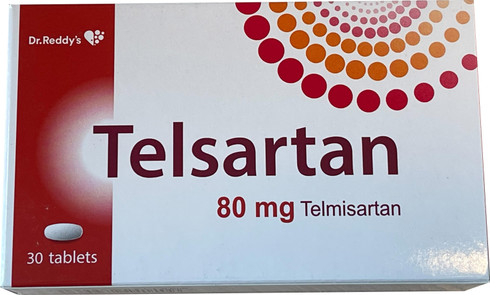
- Telmisartan has the longest plasma half-life of any marketed angiotensin receptor blocker, about 24 hours, which is why a single daily dose covers the full day.
- Almost alone among ARBs, it also switches on PPAR-gamma, the very receptor targeted by the glitazone diabetes drugs, giving it a metabolic dimension its cousins lack.
Mechanism
Telmisartan works chiefly by competitively and selectively blocking the angiotensin II type 1 (AT1) receptor, the site through which angiotensin II drives blood-vessel constriction and aldosterone release; it binds AT1 with very high affinity and stays bound for a long time, which yields sustained vessel widening and a durable fall in blood pressure.[2][3] Uniquely among widely used ARBs, it also acts as a partial at PPAR-gamma, a nuclear transcription factor that governs genes involved in glucose and fat metabolism, and this selective modulation is thought to underlie its favorable effects on sensitivity and lipids without the classic PPAR-gamma side effects.[3]
Its high lipophilicity and strong receptor binding give it deep tissue penetration and a long duration of action; some researchers argue that part of what looks like a special metabolic signature may simply reflect this greater potency and tissue reach rather than a truly unique property.[4] In the laboratory it has additionally been reported to engage PPAR-alpha and PPAR-delta, receptors tied to lipid oxidation, though the clinical weight of these actions is not settled.[4]
receptor fingerprint
Angiotensin II AT1 receptorantagonist (ARB)
PPAR-gammapartial agonist
Cardiometabolic riskimproves
Dosingtypical ranges, not medical advice
interested in protocols and clinical dosages? make an account to see them! ^_^
Safetyrisks and cautions, not medical advice
Telmisartan is generally well tolerated; it can cause dizziness or low blood pressure and can raise potassium, so kidney function and electrolytes are monitored. It is contraindicated in pregnancy because of the risk of fetal harm. Prescription medicine.
Interactionsdocumented pairs only, not exhaustive
Telmisartan is a potent inhibitor of organic anion transporting polypeptides (OATP) and acts as an uptake transporter competitor; it inhibits OATP2B1 with an IC50 of 0.075 µM, making it the most potent OATP2B1 inhibitor in a broad screening study [31]. When telmisartan is combined with SGLT2 inhibitors (empagliflozin, ertugliflozin, henagliflozin), a pharmacokinetic interaction occurs; telmisartan increases the plasma AUC and peak levels of these SGLT2 inhibitors by reducing their clearance through transporter inhibition, an effect that has been demonstrated in animal models and may require monitoring in patients [32]. NSAIDs are not systematically studied with telmisartan in recent literature, though standard pharmacological principles predict reduced renal function due to angiotensin blockade loss. Most common drug classes lack documented interactions in the published record.
Checking a whole stack? Run it through interactions + stacks.
History
Telmisartan was developed by the German pharmaceutical company Boehringer Ingelheim and introduced around 1998 to 1999, reaching the US market under the brand name Micardis. It belongs to the benzimidazole class of angiotensin II receptor blockers, a group of antihypertensives that emerged in the 1990s as a better-tolerated successor to the ACE inhibitors, avoiding the dry cough associated with that older class.
Among the ARBs, telmisartan was distinguished from the outset by its exceptional pharmacokinetics, possessing the longest plasma half-life of the class, roughly 24 hours, which supports smooth once-daily blood-pressure control. In the 2000s researchers discovered that, unusually for an ARB, telmisartan also acts as a partial agonist of the nuclear receptor PPAR-gamma, the same target as the glitazone antidiabetic drugs, which prompted extensive study of its metabolic effects. The large ONTARGET and TRANSCEND cardiovascular outcome trials later examined its role in reducing cardiovascular risk in high-risk patients.
Reputation
Telmisartan is well regarded as one of the more pharmacologically interesting members of its class, combining reliable, long-lasting blood-pressure control with a favorable metabolic profile. Its long half-life and high lipophilicity give it durable 24-hour coverage that holds up even toward the end of the dosing interval, a practical advantage for patients who occasionally take a dose late.
Its partial PPAR-gamma activity has generated genuine scientific interest, with studies suggesting modest improvements in insulin sensitivity and lipid handling without the fluid retention and other drawbacks of full PPAR-gamma agonists, which has made it a favored ARB in patients with metabolic syndrome or diabetes. It is generally very well tolerated and, like other ARBs, avoids the cough of ACE inhibitors. In balance, its metabolic effects are modest rather than transformative, and some researchers argue they partly reflect its greater potency and tissue penetration rather than a wholly unique mechanism.
Subjective profileweighing the evidence above
A blood pressure ARB that pulls double duty: the PPAR-gamma activity helps metabolism, and animal data hint at an antidepressant effect on par with fluoxetine. If you need an ARB anyway it is a sensible pick; the mood angle is promising but still preclinical.
Where to buy
2 other outlets

Suppliers
Vendors carrying Telmisartan, with live product details and codes. Links are affiliate links that support the wiki at no cost to you.
| supplier | size | price | $/mg |
|---|---|---|---|
| PCT.Zonelowest | 80MG | $5.10 | $0.064/mg |
| PCT.Zone | 40MG | $4.28 | $0.107/mg |
PCT.Zone
Telmisartan
PCT.Zone
Telmisartan
RUPharma🌐
Telmisartan
Research
- 2001first citedComparison of 26-week efficacy and tolerability of telmisartan and atenolol, in combination wit…
- 2007most active year5 papers
- 2013meta-analysisTelmisartan as a metabolic sartan: the first meta-analysis of randomized controlled trials in m…
- 2026most recentIn vitro inhibition of organic anion transporting polypeptide 2B1 (OATP2B1) is common among mar…
- 1.Effects of telmisartan on metabolic syndrome components: a comprehensive review.
- 2.Telmisartan: a different angiotensin II receptor blocker protecting a different population?
- 3.Beyond the classic angiotensin-receptor-blocker profile.
- 4.Metabolic actions of angiotensin receptor antagonists: PPAR-gamma agonist actions or a class effect?
- 5.Telmisartan, ramipril, or both in patients at high risk for vascular events.
- 6.Effects of the angiotensin-receptor blocker telmisartan on cardiovascular events in high-risk patients intolerant to angiotensin-converting enzyme inhibitors: a randomised controlled trial.
- 7.Achieved blood pressure and cardiovascular outcomes in high-risk patients: results from ONTARGET and TRANSCEND trials.
- 8.Telmisartan to prevent recurrent stroke and cardiovascular events.
- 9.Erectile dysfunction predicts cardiovascular events in high-risk patients receiving telmisartan, ramipril, or both: The ONgoing Telmisartan Alone and in combination with Ramipril Global Endpoint Trial/Telmisartan Randomized AssessmeNt Study in ACE iNtolerant subjects with cardiovascular Disease (ONTARGET/TRANSCEND) Trials.
- 10.Telmisartan: a review of its use in cardiovascular disease prevention.
- 11.Vascular protection in diabetes: a pharmacological view of angiotensin II type 1 receptor blockers.
- 12.Telmisartan as a metabolic sartan: the first meta-analysis of randomized controlled trials in metabolic syndrome.
34 listed here; entry last updated August 2026
Reviews
My notesprivate to this device
FAQ
What class of drug is telmisartan?
It is an angiotensin II receptor blocker (ARB) used mainly for high blood pressure.
Why is it noted for metabolic effects?
Unlike some other ARBs, it partially activates PPAR gamma, a pathway involved in glucose and lipid metabolism.
How long does it last in the body?
It has one of the longest half-lives among ARBs, which supports once-daily use.
Does it need to be taken with food?
It can generally be taken with or without food, which makes timing flexible.
Can telmisartan help mood?
Possibly. In a mouse depression model it cut immobility about as much as fluoxetine, hinting at an antidepressant effect from blocking brain AT1 receptors. That is preclinical, so treat it as a bonus rather than a reason to take it on its own.
Adverse effects
- Dizziness or lightheadedness
- Low blood pressure
- Higher blood potassium
- Back or muscle pain
- Rare angioedema
Notes and cautions
- Angiotensin blockade lowers red cell mass as well as blood pressure; the renin-angiotensin system is one of the controls on erythropoiesis [33]. That is the reason this class comes up in discussions of androgen-driven high haematocrit rather than only in blood-pressure ones.