
spec sheet9 rows
Telmisartan + Cilnidipine + Chlorthalidone Telmisartan with cilnidipine and chlorthalidone is a fixed-dose combination medicine that unites three blood-pressure-lowering drugs with complementary actions in a single tablet. It pairs an angiotensin II receptor blocker (telmisartan), a dual L-type and N-type calcium channel blocker (cilnidipine), and a thiazide-like diuretic (chlorthalidone). Single-pill combinations of this kind are used when hypertension is not adequately controlled by one or two agents, and they aim to simplify treatment and improve adherence.
- Three complementary blood pressure drugs in one tablet
- Answer when two drugs are not controlling blood pressure
- Cilnidipine means less ankle swelling than plain calcium blockers
- One pill a day, so adherence gets easier
- Telmisartan adds kidney protective potential
- Diuretic, vessel relaxant, and hormone blocker working together
- Dizziness or lightheadedness
- Low sodium or potassium
- Increased urination
Overview
Telmisartan combined with cilnidipine and chlorthalidone is a fixed-dose, single-pill combination of three antihypertensive drugs that lower blood pressure through different and complementary pathways. The three ingredients represent three of the main drug families used in hypertension: a renin-angiotensin system blocker, a calcium channel blocker, and a diuretic. Treatment guidelines have long favored pairing agents with distinct mechanisms, and packaging them together in one tablet is meant to cut pill burden and support adherence.[5]
Telmisartan, the renin-angiotensin component, is a long-acting angiotensin II receptor blocker that relaxes blood vessels by blocking the AT1 receptor; it carries the longest half-life of the marketed ARBs along with partial PPAR-gamma activity that has attracted metabolic interest.[1]
Cilnidipine, the calcium channel blocker, is unusual in blocking both L-type and N-type calcium channels rather than L-type alone. The added N-type blockade dampens sympathetic norepinephrine release and dilates both the afferent and efferent arterioles of the kidney, an effect associated with reduced protein in the urine and, in comparative reports, less of the ankle swelling that often accompanies drugs such as amlodipine.[2][3] It also tends not to raise the heart rate the way some other calcium antagonists can.[3]
Chlorthalidone is a thiazide-like diuretic that lowers blood pressure by promoting sodium and water loss through inhibition of the sodium-chloride co-transporter in the kidney. It has a notably long duration of action, and analyses of long-term outcomes suggest it reduces major cardiovascular events at least as effectively as, and possibly more than, the more commonly prescribed hydrochlorothiazide.[4]
Because the three components act on independent systems, their blood-pressure effects add together, so a low dose of each can be combined to hold down side effects while still achieving control.[5] Fixed-dose triple combinations of this general design have been studied and marketed chiefly for patients whose pressure is not controlled on one or two drugs. The product is supplied as an oral tablet available by prescription; this particular pairing of telmisartan, cilnidipine and chlorthalidone is marketed mainly in parts of Asia, and like all renin-angiotensin blockers it is avoided in pregnancy.[1][5]
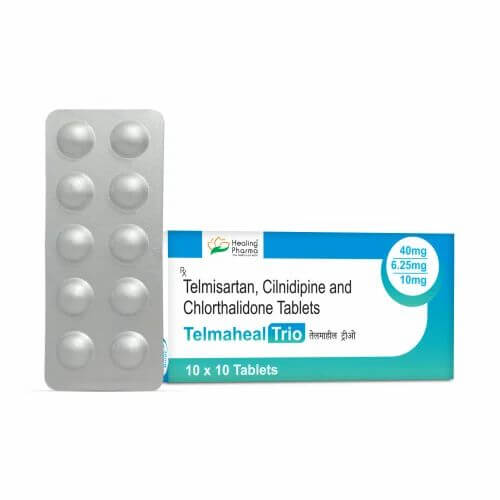
- Cilnidipine is unusual among calcium channel blockers in blocking N-type channels on sympathetic nerve endings as well as the L-type channels in arteries, an action tied in studies to less proteinuria.
- Chlorthalidone, the diuretic in this trio, dates from the 1950s yet remains one of the most evidence-backed blood-pressure drugs, anchoring the landmark ALLHAT trial.
Mechanism
The three ingredients lower blood pressure through separate but complementary mechanisms. Telmisartan competitively blocks the angiotensin II type 1 receptor, stopping angiotensin II from constricting blood vessels and triggering aldosterone release, which yields sustained , and as a partial PPAR-gamma it adds some favorable metabolic effects.[1] Cilnidipine blocks voltage-gated calcium channels in vascular smooth muscle; by inhibiting L-type channels it relaxes arteries, and by additionally inhibiting N-type channels on sympathetic nerve endings it curbs release and widens both kidney arterioles, an action linked to lower glomerular pressure and less proteinuria.[2][3]
Chlorthalidone blocks the sodium-chloride co-transporter in the distal kidney tubule, raising the excretion of sodium, chloride and water; the resulting fall in fluid volume, together with longer-term effects on vascular tone, lowers pressure over an unusually long duration.[4] Combining a receptor blocker, a calcium channel blocker and a diuretic lets their effects sum, so lower doses of each can be paired to control pressure while limiting the side effects of any one drug.[5]
receptor fingerprint
Angiotensin II type 1 (AT1) receptorblocks
L-type calcium channel (arteries)blocks
Sodium chloride cotransporter (NCC)inhibits
Plasma volume and peripheral resistancemodulates
N-type calcium channel (sympathetic nerves)blocks
PPAR-gammaagonist
Safetyrisks and cautions, not medical advice
This triple pill is prescription only and is meant for blood pressure that needs more than one or two drugs. It can cause dizziness and low blood pressure, and the chlorthalidone part can lower sodium and potassium, raise uric acid and nudge up blood sugar. The telmisartan part can raise potassium and affect the kidneys, so the two are watched together. It is avoided in pregnancy, in people who make little or no urine, and in those with a sulfonamide allergy. Adding extra diuretics, potassium supplements, lithium or anti-inflammatory painkillers should only be done under supervision.
History
This product is a fixed-dose triple combination rather than a single discovered molecule, and its history is that of its three components, each introduced separately over the late twentieth century. Telmisartan, a benzimidazole angiotensin receptor blocker, was developed by Boehringer Ingelheim in the late 1990s; cilnidipine, a dual L-type and N-type calcium channel blocker, was developed in Japan by Fuji Viton and Ajinomoto and introduced there in 1995; and chlorthalidone, a thiazide-like diuretic, dates to the late 1950s and has one of the longest track records of any antihypertensive, having featured in landmark outcome trials such as ALLHAT.
Triple single-pill combinations of this kind are a relatively recent development, popularized particularly in India and other markets to simplify treatment of hypertension that is not controlled by one or two agents. The specific telmisartan, cilnidipine, and chlorthalidone tablet is a generic combination product; the pairing itself has not been the subject of the large dedicated outcome trials that support its individual ingredients.
Reputation
The appeal of this combination lies in uniting three complementary and individually well-established mechanisms in a single daily tablet, an approach that guidelines increasingly favor for improving adherence in hypertension that needs more than one drug. Each component brings a respected pedigree: telmisartan offers long-acting renin-angiotensin blockade with a favorable metabolic profile, chlorthalidone is a diuretic with some of the strongest long-term cardiovascular outcome data in its class, and cilnidipine adds a distinctive twist by blocking both L-type and N-type calcium channels, the latter action on sympathetic nerve endings being linked in studies to reduced proteinuria and kidney protection.
Combining agents at lower individual doses can also blunt the side effects of any one of them, such as the ankle swelling common with calcium channel blockers. The honest caveat is that the evidence rests on the components rather than the fixed triple itself, and diuretic-containing regimens require monitoring of electrolytes and kidney function.
Subjective profileweighing the evidence above
A sensible single-pill answer when two drugs are not controlling blood pressure, and the N-type calcium blockade means less ankle swelling than a plain calcium blocker. Prescription only, with sodium, potassium, uric acid and kidney function needing monitoring, and it is avoided entirely in pregnancy.
Where to buy
Suppliers
Vendors carrying Telmisartan + Cilnidipine + Chlorthalidone, with live product details and codes. Links are affiliate links that support the wiki at no cost to you.
PCT.Zone
Telmisartan + Cilnidipine + Chlorthalidone
Research
- 2012first citedN-type calcium channel inhibition with cilnidipine elicits glomerular podocyte protection indep…
- 2021meta-analysisChlorthalidone versus hydrochlorothiazide: major cardiovascular events, blood pressure, left ve…
- 2024most recentEffects of telmisartan on metabolic syndrome components: a comprehensive review.
- 1.Effects of telmisartan on metabolic syndrome components: a comprehensive review.
- 2.L-/N-type calcium channel blockers and proteinuria.
- 3.Cilnidipine, a Dual L/N-type Ca(2+) Channel Blocker in Hypertension Management: A Review.
- 4.Chlorthalidone versus hydrochlorothiazide: major cardiovascular events, blood pressure, left ventricular mass, and adverse effects.
- 5.Single-Pill Combination with Three Antihypertensive Agents to Improve Blood Pressure Control in Hypertension: Focus on Olmesartan-Based Combinations.
- 6.N-type calcium channel inhibition with cilnidipine elicits glomerular podocyte protection independent of sympathetic nerve inhibition
6 listed here; entry last updated August 2026
Reviews
My notesprivate to this device
FAQ
Why three drugs in one tablet?
Each works differently; together an ARB, a calcium channel blocker, and a diuretic control stubborn blood pressure with one pill.
Why is cilnidipine less likely to cause ankle swelling?
It blocks nerve (N-type) as well as vessel (L-type) calcium channels, which balances blood flow and reduces leg swelling.
When is the best time to take it?
Take it in the morning so the diuretic does not make you wake up at night to urinate.
What should be monitored?
Your doctor may check blood pressure, kidney function, sodium, potassium, and uric acid.
Can I take extra water pills with it?
Do not add diuretics on your own; it already contains one, and doubling up can drop your salts and pressure too far.
Adverse effects
- Dizziness or lightheadedness
- Low sodium or potassium
- Increased urination
- Higher uric acid
- Headache
- Occasional ankle swelling