
spec sheet7 rows
Sulodexide is a purified mixture of glycosaminoglycans, roughly 80 percent fast moving heparin and 20 percent dermatan sulfate, licensed in Italy and several other countries for chronic venous disease and vascular occlusive disorders.
- A heparinoid that survives the stomach, genuinely unusual
- Thrombin inhibited by two independent routes
- Restores the endothelial glycocalyx
- Licensed in Italy for chronic venous disease
- Lowers plasma fibrinogen levels
- More coherent pharmacology than most vein products offer
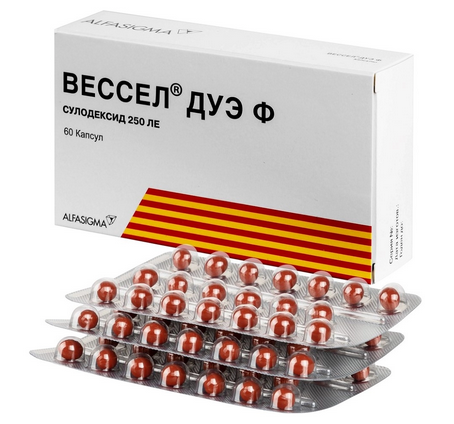
- Sulodexide is not a single molecule: it is a highly purified glycosaminoglycan mixture of roughly 80% fast-moving heparin fraction and 20% dermatan sulfate, and it is orally bioavailable, which ordinary heparins are not [1].
- SURVET is the strongest trial: in 615 patients with first unprovoked VTE who had finished 3-12 months of anticoagulation, sulodexide 500 LSU twice daily for two years cut recurrence from 30/308 to 15/307, HR 0.49 (95% CI 0.27-0.92, p=0.02), with no major bleeding in either arm [1].
- A pooled analysis of 6 RCTs and 7,596 patients found reduced all-cause mortality (OR 0.67, 95% CI 0.52-0.85), cardiovascular mortality (OR 0.44), myocardial infarction (OR 0.70) and DVT (OR 0.41), with no significant increase in bleeding (OR 1.14, 95% CI 0.47-2.74) [3].
- Cochrane found sulodexide added to local wound care raised complete venous leg ulcer healing from 29.8% to 49.4% (RR 1.66, 95% CI 1.30-2.12) but graded the evidence low quality and noted the trials did not report a standard dose, route or frequency [2].
- Sulodexide lowers blood pressure modestly overall (2.2/1.7 mmHg) but substantially in hypertensive subjects (10.2/5.4 mmHg, p<0.001), and the BP fall correlates with albuminuria reduction [4].
- Sulodexide is a registered medicine in Italy, Poland, Russia and much of Europe and Asia but is not an FDA-approved drug in the USA.
Mechanism
The heparin fraction potentiates antithrombin III and the dermatan sulfate fraction potentiates heparin cofactor II, so thrombin is inhibited by two independent routes. It also restores the endothelial glycocalyx and lowers plasma fibrinogen, which is the rationale behind the venous and nephropathy work, and unusually for a glycosaminoglycan it is absorbed orally.
receptor fingerprint
Antithrombin III (SERPINC1)Potentiation, via the fast-moving heparin fraction (approx. 80% of the mixture)
Heparin cofactor II (SERPIND1)Potentiation, via the dermatan sulfate fraction (approx. 20%)
Plasminogen activator inhibitor-1 (SERPINE1) / tissue plasminogen activator balanceProfibrinolytic shift (PAI-1 suppression)
Endothelial glycosaminoglycan glycocalyxRestoration / replacement
Safetyrisks and cautions, not medical advice
a heparinoid, so it carries bleeding risk and adds to anticoagulants and antiplatelets; the listing includes an injectable form that needs a clinician
Subjective profileweighing the evidence above
A heparinoid that survives the stomach is unusual enough to be worth attention, and inhibiting thrombin by two independent routes while restoring the endothelial glycocalyx gives it a more coherent story than most chronic venous treatments have. The evidence is mostly Italian, mostly modest in size, and has never convinced regulators outside a handful of countries, so calling it established overstates it. The caveat is not negotiable: this is an anticoagulant, it adds to anything else affecting clotting, and it needs stopping before surgery, none of which fits the way it gets shelved as a vein supplement.
Where to buy
Suppliers
Vendors carrying Sulodexide, with live product details and codes. Links are affiliate links that support the wiki at no cost to you.
RUPharma🌐
Sulodexide
Research
- 2015first citedThe blood pressure lowering potential of sulodexide; a systematic review and meta-analysis
- 2016meta-analysisSulodexide for treating venous leg ulcers
- 2024most recentEfficacy of sulodexide in treating idiopathic membranous nephropathy among Chinese patients: a…
- 1.Sulodexide for the Prevention of Recurrent Venous Thromboembolism: The Sulodexide in Secondary Prevention of Recurrent Deep Vein Thrombosis (SURVET) Study: A Multicenter, Randomized, Double-Blind, Placebo-Controlled Trial
- 2.Sulodexide for treating venous leg ulcers
- 3.Sulodexide versus Control and the Risk of Thrombotic and Hemorrhagic Events: Meta-Analysis of Randomized Trials
- 4.The blood pressure lowering potential of sulodexide; a systematic review and meta-analysis
- 5.Sulodexide for Diabetic-Induced Disabilities: A Systematic Review and Meta-Analysis
- 6.Efficacy of sulodexide in treating idiopathic membranous nephropathy among Chinese patients: a meta-analysis
- 7.Sulodexide Monotherapy in Chronic Idiopathic Subjective Tinnitus: A Randomized Controlled Trial
7 listed here; entry last updated August 2026
Reviews
My notesprivate to this device
Notes and cautions
- There is no boxed warning.
- The defining safety feature is how little bleeding it causes for an antithrombotic: SURVET recorded zero major bleeds over two years of continuous use, and the pooled RCT meta-analysis found no significant excess of bleeding events versus control (PMID 26408273, PMID 33086402).
- That is also the reason it must not be treated as a substitute for full anticoagulation where anticoagulation is indicated; the SURVET population had already completed 3-12 months of oral anticoagulant therapy.
- Reported adverse effects are mainly gastrointestinal (epigastric pain, nausea) and occasional injection-site reactions with the parenteral form; a heparin-like product should still be used cautiously in anyone with a history of heparin-induced thrombocytopenia.