
spec sheet13 rows
Spironolactone is a medication that blocks the hormone aldosterone at the mineralocorticoid receptor, making it a potassium-sparing diuretic and antimineralocorticoid. It is used to treat heart failure, resistant high blood pressure, fluid retention, and primary hyperaldosteronism, and because it also weakly blocks androgen receptors it is widely prescribed for acne, hirsutism, and as part of feminizing hormone therapy. Discovered in the late 1950s, it is a generic drug on the World Health Organization's list of essential medicines.
- Improves survival in heart failure, proven in major trials
- Brings down blood pressure that other drugs cannot budge
- Clears fluid while sparing potassium instead of wasting it
- A go to prescription for stubborn hormonal acne
- Reduces unwanted hair growth driven by androgens
- Generic, decades old, and on the WHO essential list
- elevated blood potassium, which can be serious and is monitored with blood tests
- breast tenderness or enlargement, including gynecomastia in men
- menstrual irregularities in women
Overview
Spironolactone is a synthetic steroid that acts mainly as an antagonist of aldosterone, a hormone that governs the body's handling of salt and water [1]. By blocking aldosterone at its receptor it behaves as a potassium-sparing diuretic, promoting the loss of sodium and water while conserving potassium [1]. Because the same drug also blocks androgen receptors to a modest degree, it additionally functions as an antiandrogen, and this dual character explains its unusually broad range of uses [1].
The drug was discovered in 1957 and introduced at the end of that decade, initially as a diuretic and a treatment for the hormone disorder primary hyperaldosteronism [1]. Its role expanded dramatically after the landmark Randomized Aldactone Evaluation Study, known as RALES, which was stopped early in the late 1990s because adding spironolactone to standard therapy cut the risk of death in patients with severe heart failure by roughly thirty percent [1][2]. It is now a standard part of treatment for heart failure with reduced pumping function and is used as an add-on for blood pressure that resists other medicines [4].
Beyond the heart, spironolactone is used to relieve fluid buildup in conditions such as liver cirrhosis, and its antiandrogen activity has made it a mainstay in dermatology, where it treats acne, excess facial and body hair, and female-pattern hair loss, particularly in the context of polycystic ovary syndrome [1]. It is also widely used as an antiandrogen in feminizing hormone therapy for transfeminine people. It is taken by mouth as tablets or a liquid and is available generically worldwide.
Spironolactone is a prescription-only medicine. Its most important safety concern is a rise in blood potassium, which can become dangerous, so potassium levels and kidney function are usually monitored, and combining it with potassium supplements or certain other drugs increases the risk [3]. Its hormonal actions can cause breast tenderness or enlargement, including gynecomastia in men, and menstrual changes in women [1]. It is generally avoided in pregnancy because of theoretical effects on the developing fetus.

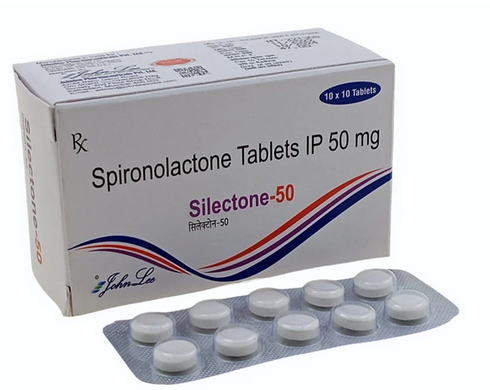
- In the RALES trial, adding just 25 mg of spironolactone daily cut the risk of death in severe heart failure by roughly 30 percent, a result so striking the study was stopped early.
- Much of spironolactone's activity comes not from the drug itself but from active metabolites such as canrenone that form after it is taken.
- Spironolactone is on the World Health Organization's list of essential medicines and is available as a low-cost generic worldwide.
Mechanism
Spironolactone acts principally by competitively blocking the mineralocorticoid receptor, the target of the hormone aldosterone [3]. Much of its activity comes from active metabolites, including canrenone, that form after it is taken [1]. In the kidney, blocking aldosterone reduces the reabsorption of sodium and water and limits the excretion of potassium, producing a mild diuretic effect that spares potassium rather than wasting it [1]. Aldosterone also drives inflammation and scarring in the heart and blood vessels, and by opposing these effects spironolactone reduces cardiac fibrosis and improves outcomes in heart failure, actions that go beyond simple fluid removal [1][2]. Separately, the drug binds androgen receptors and interferes with androgen production, which gives it the antiandrogen effects used to treat acne and hirsutism [1].
receptor fingerprint
Mineralocorticoid (aldosterone) receptorantagonist
Epithelial sodium channel (via receptor block)blocks
Cardiac and vascular remodelingblocks
antagonist
Androgen biosynthesis enzymesinhibits
Safetyrisks and cautions, not medical advice
Spironolactone is prescription only. Its signature risk is high potassium, which can be dangerous, so potassium and kidney function need checking, especially alongside ACE inhibitors, ARBs, or potassium supplements. Because it touches sex hormones, men can get breast tenderness or enlargement, and women may notice menstrual changes; these are dose-related. Other effects include dizziness, low blood pressure, and stomach upset. It should be avoided in significant kidney impairment, existing hyperkalemia, and Addison's disease, and used carefully in pregnancy given its hormonal activity. Older warnings about tumors came from very high animal doses and are not considered relevant at human doses.
Interactionsdocumented pairs only, not exhaustive
Hyperkalemia is the interaction that kills. Spironolactone blocks aldosterone at the distal nephron and holds potassium back, so it adds to ACE inhibitors, angiotensin receptor blockers, direct renin inhibitors, potassium supplements, other potassium sparing diuretics, calcineurin inhibitors, heparin, which suppresses aldosterone, and trimethoprim, which blocks the epithelial sodium channel much as amiloride does. NSAIDs belong on that list twice: they raise potassium and they blunt the diuretic and antihypertensive effect while worsening renal function.
Spironolactone reduces the clearance of digoxin and raises its concentration, and its metabolite canrenone cross reacts with several digoxin immunoassays, so a reported level can mislead as well as rise. Lithium clearance falls with any effective diuretic, spironolactone included, which pushes lithium toward toxic concentrations.
Added to other antihypertensives it deepens hypotension, and cholestyramine given alongside has produced hyperkalemic metabolic acidosis. The antiandrogen activity that makes spironolactone useful in acne also works against exogenous androgen therapy.
Checking a whole stack? Run it through interactions + stacks.
History
Spironolactone was developed by the American pharmaceutical company G.D. Searle & Company in the late 1950s, with the synthesis of the compound credited to chemists including John A. Cella and colleagues who were searching for a competitive antagonist of the salt-retaining hormone aldosterone. It was introduced clinically around 1959 to 1960 under the brand name Aldactone, becoming the first practical steroidal aldosterone antagonist.
For decades it was used chiefly as a potassium-sparing diuretic for fluid retention and hypertension, but its role expanded dramatically with the landmark Randomized Aldactone Evaluation Study (RALES), which in 1999 showed a substantial reduction in death among patients with severe heart failure. Its off-label use in dermatology and endocrinology, exploiting its antiandrogen activity, developed gradually over the same period. Today spironolactone is an inexpensive generic medicine and appears on the World Health Organization's list of essential medicines.
Reputation
Spironolactone is regarded as one of the more versatile and enduring drugs in modern medicine, valued for combining a gentle potassium-sparing diuretic effect with genuine disease-modifying benefit in heart failure. Cardiologists respect it as a cornerstone of therapy for reduced-ejection-fraction heart failure and for resistant hypertension, where it often succeeds after other agents have failed.
In dermatology and women's health it has earned a devoted following as a well-tolerated oral option for persistent acne and hirsutism, and it plays an important supportive role in feminizing hormone therapy. Its main honest limitations are the need to monitor potassium and kidney function, and hormonal side effects such as breast tenderness that stem from its antiandrogen activity. That it remains a first-choice medicine more than sixty years after its introduction speaks to a remarkably favorable balance of benefit, safety, and affordability.
Subjective profileweighing the evidence above
One of the most useful old drugs there is, with real evidence across heart failure survival, stubborn blood pressure and hormonal acne, and it spares potassium rather than wasting it. That same potassium can climb dangerously, so bloodwork is not optional, and men can expect breast tenderness at higher doses.
Where to buy

Suppliers
Vendors carrying Spironolactone, with live product details and codes. Links are affiliate links that support the wiki at no cost to you.
| supplier | size | price | $/mg |
|---|---|---|---|
| PCT.Zonelowest | 100MG | $4.46 | $0.045/mg |
| PCT.Zone | 50MG | $3.16 | $0.063/mg |
| PCT.Zone | 25MG | $1.99 | $0.080/mg |
PCT.Zone
Spironolactone
PCT.Zone
Spironolactone
PCT.Zone
Spironolactone

RUPharma🌐
Spironolactone
RUPharma🌐
Spironolactone
Research
- 1999first citedThe effect of spironolactone on morbidity and mortality in patients with severe heart failure.…
- 2024most recentGuidelines of care for the management of acne vulgaris
- 1.The spironolactone renaissance
- 2.Spironolactone in congestive heart failure
- 3.Steroidal and non-steroidal mineralocorticoid receptor antagonists in cardiorenal medicine
- 4.Heart failure.
- 5.The effect of spironolactone on morbidity and mortality in patients with severe heart failure. Randomized Aldactone Evaluation Study Investigators.
- 6.Guidelines of care for the management of acne vulgaris
6 listed here; entry last updated August 2026
Reviews
My notesprivate to this device
FAQ
Why does it need blood tests?
It holds on to potassium, which can climb too high; your doctor checks potassium and kidney function after starting or raising the dose.
How long until it helps my acne?
Hormonal acne usually takes about 3 months to respond, since it works by gradually lowering androgen activity in the skin.
Can men take it?
Yes, and it is used for several conditions, but its anti-androgen action can cause breast tenderness or enlargement in men.
Should I avoid high-potassium foods?
Often it is wise to go easy on potassium-rich foods and salt substitutes, and to skip potassium supplements unless your doctor says otherwise.
Is it a strong water pill?
It is a mild diuretic on its own; its bigger value is blocking aldosterone for the heart, blood pressure, and hormone-driven conditions.
Adverse effects
- elevated blood potassium, which can be serious and is monitored with blood tests
- breast tenderness or enlargement, including gynecomastia in men
- menstrual irregularities in women
- increased urination, dizziness, or low blood pressure
- generally avoided during pregnancy