
spec sheet12 rows
Nimodipine is a dihydropyridine calcium channel blocker developed mainly to act on the blood vessels of the brain rather than as a general antihypertensive. Its principal approved role is preventing the delayed cerebral ischemia that can follow aneurysmal subarachnoid hemorrhage, a form of bleeding around the brain. It was patented in 1971 and reached clinical use in the 1980s, gaining United States approval in 1988. Because it relaxes cerebral arteries and shows relative selectivity for that circulation, it remains the only medication specifically approved to improve neurological outcomes after this type of stroke.
- Calcium blocker built for the brain's arteries
- Widens cerebral vessels where it matters most
- Shields neurons from calcium overload
- Crosses into brain tissue with ease
- Rare approval backed by real outcome evidence
- Decades of clinical use since 1988
- Low blood pressure (hypotension) is the most common effect, since the drug relaxes blood vessels
- Headache, flushing, nausea, or other digestive upset
- Slowed heart rate or fluid swelling in some patients
Overview
Nimodipine is a member of the dihydropyridine family of calcium channel blockers, the same broad chemical class as amlodipine and nifedipine, but it is distinguished by its lipophilic structure, which lets it cross the blood-brain barrier and act preferentially on the cerebral circulation [1][3]. Chemically it is a dihydropyridine dicarboxylate ester bearing a nitrophenyl group, and the marketed drug is a racemate containing equal parts of its two mirror-image forms.
The compound was patented in 1971 and entered medical use during the 1980s, with approval in Germany in 1985 and clearance by the United States Food and Drug Administration in 1988 [1]. Unlike most agents in its class, it was never developed chiefly for the routine treatment of high blood pressure; instead its niche became the neurological setting of subarachnoid hemorrhage.
Its central and best-established use is in aneurysmal subarachnoid hemorrhage, a serious bleeding stroke in which a ruptured aneurysm spills blood into the space surrounding the brain [3]. Survivors of the initial event remain at risk of delayed cerebral ischemia, a secondary decline linked to narrowing of cerebral arteries and other processes; nimodipine, started early and continued for roughly three weeks, has been shown to improve outcomes and is endorsed by management guidelines as the only pharmacologic therapy with proven benefit in this condition [1][2][3]. Notably, its clinical benefit is thought to reflect neuroprotection rather than a simple reversal of visible arterial spasm, since it improves outcomes without consistently abolishing angiographic vasospasm [2][3].
Beyond subarachnoid hemorrhage, nimodipine has been studied in other cerebrovascular and neurological settings. In reversible cerebral vasoconstriction syndrome, a disorder of recurrent thunderclap headache with transient artery narrowing, it appears to ease the headaches although it has not been shown to prevent the syndrome's strokes or bleeds [4]. Because standard nimodipine has pharmacokinetic drawbacks, including a short half-life and variable absorption, researchers have investigated longer-acting alternatives and intra-arterial or sustained-release approaches for vasospasm [1].
Nimodipine is a prescription medicine dispensed as oral capsules or tablets and as an oral liquid, with the liquid or capsule contents given by feeding tube when a patient cannot swallow [1]. It is widely available as a generic. Regulators require that it be given only by the oral or enteral route, and the product carries a prominent warning against any form of injection.
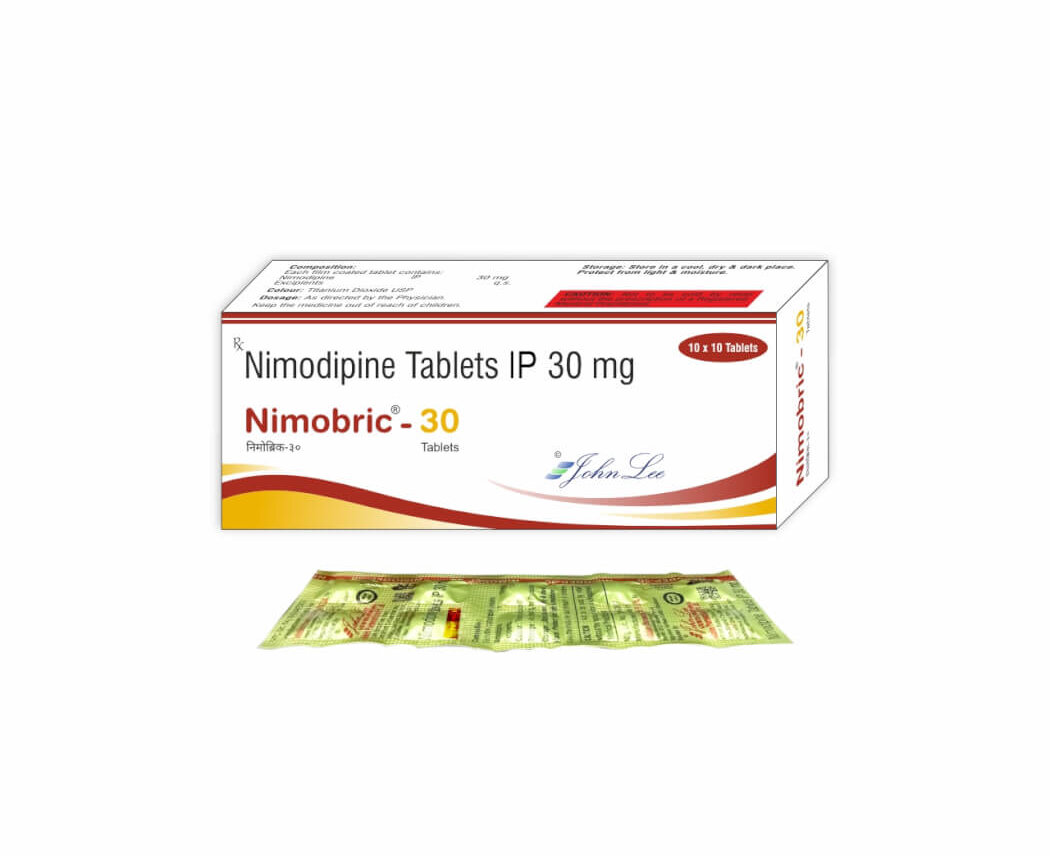
- Nimodipine is the only medication specifically approved to improve neurological outcomes after aneurysmal subarachnoid hemorrhage.
- It appears to help patients even when brain imaging shows no reversal of arterial narrowing, which is why its benefit is now described as neuroprotective rather than simply vessel-widening.
- Its high lipid solubility is the key that lets it cross into the central nervous system and act with relative selectivity on the brain's own arteries.
Mechanism
Nimodipine works by blocking L-type voltage-gated calcium channels in the smooth muscle cells that line arterial walls [1][3]. When these channels are inhibited, less calcium enters the muscle cells, so the vessels relax and dilate and their tendency to constrict is reduced. What sets nimodipine apart from other dihydropyridines is its high lipid solubility, which allows it to cross into the central nervous system and act with relative selectivity on the cerebral vasculature [1][3].
In the context of subarachnoid hemorrhage, this vasodilating action was originally expected to counter the arterial narrowing known as vasospasm, yet clinical experience suggests the drug improves neurological recovery even when it does not clearly reverse that narrowing on imaging [2][3]. For this reason its benefit is now generally described as neuroprotective, with proposed contributions from improved microcirculatory flow, reduced calcium-mediated injury to neurons, and limitation of the cascade that produces delayed [2][3].
receptor fingerprint
L-type voltage-gated calcium channelblocks
Cerebral arterial smooth musclemodulates
Neuronal calcium overloadinhibits
Peripheral vascular smooth muscleblocks
Microvascular collateral flowactivates
Dosingtypical ranges, not medical advice
interested in protocols and clinical dosages? make an account to see them! ^_^
Safetyrisks and cautions, not medical advice
Nimodipine is prescription only and carries an important safety rule; it must be given by mouth or feeding tube, never by intravenous injection, because accidental IV use has caused deaths from severe cardiovascular collapse. The most common side effect is low blood pressure, which needs monitoring since it can reduce brain perfusion. Headache, flushing, nausea, and slow or fast heartbeat can also occur. It is broken down by the liver enzyme CYP3A4, so strong inhibitors such as certain antifungals and macrolide antibiotics can dangerously raise its levels, while strong inducers like rifampin can make it ineffective. Grapefruit juice should be avoided.
Interactionsdocumented pairs only, not exhaustive
Polysorbate 80, a solubilizing excipient commonly used in nimodipine formulations, competitively inhibits nimodipine's CYP3A-mediated metabolism, increasing systemic exposure by 51% and decreasing clearance by 36.5% in animal models [23]. This is a pharmacokinetic interaction at the metabolic level. Beyond excipient interactions, nimodipine's interactions with other medications remain understudied in the published literature. No major drug-drug interactions with common co-medications were documented in recent peer-reviewed sources. Nimodipine activates pregnane X receptor, which could theoretically cause induction of metabolic enzymes and reduce levels of other CYP3A substrates, but clinical documentation of this effect is absent.
Checking a whole stack? Run it through interactions + stacks.
History
Nimodipine was developed by Bayer as a dihydropyridine calcium channel blocker deliberately tailored to act on the blood vessels of the brain rather than to serve as a general antihypertensive. The compound was patented in 1971, and after more than a decade of development it entered clinical use in the 1980s, receiving United States Food and Drug Administration approval in 1988 under the brand name Nimotop. Its defining property is a high lipid solubility that allows it to cross into the central nervous system and act with relative selectivity on the cerebral circulation.
Its principal approved role became the prevention of delayed cerebral ischemia following aneurysmal subarachnoid hemorrhage, a dangerous complication of bleeding around the brain. A ready-to-use oral solution, Nymalize, was later approved in the United States in 2013 to ease administration, particularly for patients unable to swallow capsules. To this day it remains the only medication specifically approved to improve neurological outcomes after this type of stroke.
Reputation
Nimodipine holds a distinguished and rather singular place in neurology and neurosurgery as the standard-of-care agent for aneurysmal subarachnoid hemorrhage, the only drug specifically approved to improve neurological recovery after this devastating form of bleeding. It is valued for its brain-selective action, made possible by a lipid solubility that lets it reach the cerebral arteries, and it is a fixture of intensive-care protocols worldwide.
One of the most intriguing aspects of its reputation is that it appears to help patients even when imaging shows no clear reversal of the arterial narrowing it was originally expected to counter, which has led clinicians to describe its benefit as broadly neuroprotective rather than purely a matter of widening vessels. Honesty demands acknowledging its limits; it can lower systemic blood pressure, which must be managed carefully, and researchers actively continue to seek agents with better pharmacokinetics. Nonetheless, its decades-long track record and unique approved indication keep it firmly established as a mainstay.
Subjective profileweighing the evidence above
One of very few genuinely proven treatments after an aneurysmal brain bleed, which makes it valuable and also entirely a hospital drug. Its nootropic reputation is a stretch, and the safety rule attached is serious: oral or feeding tube only, because accidental intravenous use has killed people.
Where to buy

Suppliers
Vendors carrying Nimodipine, with live product details and codes. Links are affiliate links that support the wiki at no cost to you.
PCT.Zone
Nimodipine
Research
- 1988first citedPharmacology of nimodipine. A review.
- 1996meta-analysisEfficacy of prophylactic nimodipine for delayed ischemic deficit after subarachnoid hemorrhage:…
- 2019most active year3 papers
- 2026most recentHidden Drug-Excipient Interaction by HPLC-MS/MS Analysis: Polysorbate 80 Enhances Nimodipine Sy…
- 1.Aneurysmal Subarachnoid Hemorrhage: the Last Decade.
- 2.A Review of the Management of Cerebral Vasospasm After Aneurysmal Subarachnoid Hemorrhage.
- 3.Beyond nimodipine: advanced neuroprotection strategies for aneurysmal subarachnoid hemorrhage vasospasm and delayed cerebral ischemia.
- 4.Reversible cerebral vasoconstriction syndrome.
- 5.Pharmacology of nimodipine. A review.
- 6.Nimodipine. A review of its pharmacodynamic and pharmacokinetic properties, and therapeutic potential in cerebrovascular disease.
- 7.Nimodipine Pharmacokinetic Variability in Various Patient Populations.
- 8.Nimodipine Reappraised: An Old Drug With a Future.
- 9.Nimodipine in Clinical Practice: A Pharmacological Update.
- 10.Nimodipine and the recovery of memory.
- 11.Nimodipine Reduces Microvasospasms After Experimental Subarachnoid Hemorrhage.
- 12.Nimodipine Exerts Time-Dependent Neuroprotective Effect after Excitotoxical Damage in Organotypic Slice Cultures.
23 listed here; entry last updated August 2026
Reviews
My notesprivate to this device
FAQ
What is nimodipine actually used for?
Its main proven use is preventing delayed brain damage after a subarachnoid hemorrhage from a ruptured brain aneurysm, not routine blood pressure control.
Why can it only be taken by mouth?
Giving it intravenously has caused fatal cardiovascular collapse, so it is strictly oral or through a feeding tube; this is a hard safety rule.
How long do people take it?
The standard course is 60 mg every 4 hours for 21 days, started as soon as possible after the bleed.
Can I drink grapefruit juice with it?
No; grapefruit blocks the enzyme that clears nimodipine and can push its levels and blood-pressure effects too high.
Is it a nootropic or memory drug?
It has been studied for brain aging and blood flow, but its solid, approved role is protecting the brain after aneurysmal subarachnoid hemorrhage.
Adverse effects
- Low blood pressure (hypotension) is the most common effect, since the drug relaxes blood vessels
- Headache, flushing, nausea, or other digestive upset
- Slowed heart rate or fluid swelling in some patients
Notes and cautions
- Carries a boxed warning that it must never be given by injection; the capsule or liquid is for oral or feeding-tube use only
- Used with caution alongside other blood-pressure-lowering medications