
spec sheet13 rows
Verapamil is a prescription medication of the calcium channel blocker class, specifically a non-dihydropyridine agent of the phenylalkylamine type. It is used to treat high blood pressure, angina and certain fast heart rhythms that arise above the ventricles, and it also serves as a first-line drug for preventing cluster headaches. Introduced in the 1960s, it works by slowing the movement of calcium into heart and blood-vessel cells.
- Used to treat high blood pressure, angina and fast heart rhythms
- First-line for preventing cluster headaches, where little else works
- Slows calcium entry into heart and blood-vessel cells
- Controls rate in atrial fibrillation
- Eases coronary artery spasm
- In routine use since the 1960s, a proven workhorse
- Constipation
- Dizziness or headache
- Low blood pressure
Overview
Verapamil is a synthetic small-molecule drug belonging to the calcium channel blocker family; within that family it is a non-dihydropyridine of the phenylalkylamine subclass and functions as a class IV antiarrhythmic agent [1]. Unlike the dihydropyridine calcium blockers, which mainly relax blood vessels, verapamil also has strong effects on the electrical tissues of the heart [1]. It is taken by mouth as immediate-release and long-acting formulations and can also be given by injection.
Its established medical uses include lowering high blood pressure, relieving the chest pain of angina, and controlling or terminating supraventricular tachycardias by slowing conduction through the atrioventricular node [1]. It is regarded as the preventive drug of choice for cluster headache, a severe headache disorder, although the doses used for this purpose are often higher than those used in heart disease and call for monitoring of the heart's electrical intervals [2]. Verapamil has also been examined in other settings; a meta-analysis in recent-onset type 1 diabetes found that it helped preserve the body's own insulin-producing capacity over the first year, as measured by C-peptide levels [3].
Verapamil was introduced in the early 1960s and gained prominence over the following decades as one of the first agents shown to selectively interfere with the transport of calcium across cell membranes [1]. It received regulatory approval long ago and is now available as a generic medicine, and it appears on the World Health Organization's List of Essential Medicines. Both immediate-release and extended-release oral products exist, alongside an injectable form for hospital use.
Common side effects include constipation, dizziness, nausea, low blood pressure, headache and swelling of the ankles [1]. Because it slows the heart and reduces its force of contraction, it can worsen certain conduction problems and heart failure, and it is generally avoided in people with severe left-ventricular dysfunction, very low blood pressure, or specific pre-excitation arrhythmias such as Wolff-Parkinson-White syndrome accompanied by atrial fibrillation [1]. Verapamil is extensively processed by the liver and can interact with a number of other medicines [1].

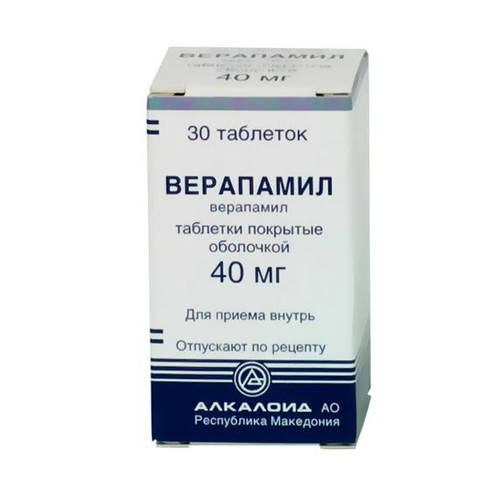
- Verapamil was the very first calcium channel blocker; studies of how it worked gave rise to the entire concept of calcium antagonism in medicine.
- Despite being a heart drug, it is the first-line preventive treatment for cluster headache, recommended at daily doses of at least 240 mg.
- It is listed on the World Health Organization's Model List of Essential Medicines.
Mechanism
Verapamil works by blocking L-type voltage-gated calcium channels, reducing the entry of calcium ions into cardiac muscle, the specialized conducting tissue of the heart, and the smooth muscle of blood vessels [1]. In the heart, its greatest effect is on the sinoatrial and atrioventricular nodes, where calcium currents drive electrical activity; by slowing conduction through the atrioventricular node it lowers the heart rate and can interrupt or control supraventricular tachyarrhythmias, which is the basis of its class IV antiarrhythmic action [1].
Reduced calcium entry into heart muscle also lessens the force of each contraction, an effect that lowers the heart's oxygen demand and helps relieve angina [1]. In the walls of arteries, less calcium influx relaxes smooth muscle, dilating coronary and peripheral vessels and reducing blood pressure [1]. Because these actions are largely independent of the autonomic nervous system, verapamil produces its cardiac and vascular effects directly at the level of the calcium channel [1].
receptor fingerprint
L-type calcium channel (cardiac and nodal)blocks
L-type calcium channel (vascular smooth muscle)blocks
Cardiac contractility (calcium influx)blocks
P-glycoprotein transporterinhibits
CYP3A4 enzymeinhibits
Dosingtypical ranges, not medical advice
interested in protocols and clinical dosages? make an account to see them! ^_^
Safetyrisks and cautions, not medical advice
Verapamil is prescription only. Constipation is very common; other effects include low blood pressure, dizziness, flushing, headache, and ankle swelling. Because it slows the heart, it can cause bradycardia or heart block and is dangerous when stacked with beta blockers or in people with certain conduction problems. It is avoided in heart failure with reduced ejection fraction because it further weakens contraction. It raises blood levels of digoxin and interacts with many CYP3A4 drugs and grapefruit juice. Do not stop abruptly in angina patients. Overdose causes profound low blood pressure and bradycardia and is a medical emergency.
Interactionsdocumented pairs only, not exhaustive
Verapamil is a CYP3A4 substrate and an inhibitor of both CYP3A4 and P-glycoprotein, so it interacts in both directions.
The cardiac interactions come first. With beta blockers it adds negative inotropic and dromotropic effects, and the combination can cause severe bradycardia, AV block, hypotension and heart failure; intravenous verapamil given after a beta blocker is particularly hazardous. Ivabradine and dantrolene are both contraindicated with it.
By inhibiting P-glycoprotein, verapamil raises digoxin concentrations substantially, and digoxin toxicity follows. Colchicine accumulates through the same transporter plus CYP3A4, and the result can be neuromyopathy or marrow suppression. Simvastatin, lovastatin and atorvastatin build up through CYP3A4 inhibition, raising myopathy and rhabdomyolysis risk.
In the other direction, rifampin, phenytoin, carbamazepine and St John's wort can strip verapamil of most of its effect, while grapefruit juice, clarithromycin and azole antifungals raise it. Verapamil also raises carbamazepine levels.
Checking a whole stack? Run it through interactions + stacks.
History
Verapamil was first synthesized in 1962 by the German pharmaceutical company Knoll AG, where chemist Ferdinand Dengel prepared it as a derivative intended to relax coronary vessels. Its true mechanism became clear only after the physiologist Albrecht Fleckenstein, working in Germany during the mid-1960s, demonstrated that the compound blocked the movement of calcium into heart muscle; this insight established the very concept of calcium antagonism and made verapamil the prototype of the calcium channel blocker class.
It entered clinical use as an antianginal and antiarrhythmic agent and was later classified as a class IV antiarrhythmic and a phenylalkylamine, distinguishing it from the dihydropyridine blockers. Verapamil subsequently became a first-line preventive treatment for cluster headache, a role reaffirmed in modern European neurology guidelines. It appears on the World Health Organization's list of essential medicines and remains in broad use more than half a century after its introduction.
Reputation
Verapamil is regarded as a foundational cardiovascular medicine, credited with opening the entire field of calcium channel pharmacology. It is trusted for slowing rapid heart rhythms that arise above the ventricles and for easing angina and high blood pressure, acting directly at the calcium channel rather than through the autonomic nervous system. Among neurologists it holds a distinctive place as the preferred prophylactic drug for cluster headache, one of the most painful conditions in medicine, where it can substantially reduce attack frequency. Its long track record gives clinicians confidence, although its tendency to slow cardiac conduction means it must be used carefully alongside beta-blockers and in patients with certain conduction abnormalities, and constipation is a common nuisance. Decades of accumulated experience keep it a dependable, versatile agent.
Subjective profileweighing the evidence above
A reliable old drug that still earns its place, especially as first-line prevention for cluster headache where little else works as well. Constipation is close to inevitable, it must not be casually stacked with beta-blockers, and it is avoided in heart failure with reduced ejection fraction.
Where to buy
1 other outlet

Suppliers
Vendors carrying Verapamil, with live product details and codes. Links are affiliate links that support the wiki at no cost to you.
PCT.Zone
Verapamil
RUPharma🌐
Verapamil
Research
- 1978first citedVerapamil: a review of its pharmacological properties and therapeutic use
- 2023most recentVerapamil improves One-Year C-Peptide Levels in Recent Onset Type-1 Diabetes: A Meta-Analysis
- 1.Verapamil: a review of its pharmacological properties and therapeutic use
- 2.Management of cluster headache
- 3.Verapamil improves One-Year C-Peptide Levels in Recent Onset Type-1 Diabetes: A Meta-Analysis
- 4.European Academy of Neurology guidelines on the treatment of cluster headache
- 5.Drug Treatment of Cluster Headache
5 listed here; entry last updated August 2026
Reviews
My notesprivate to this device
FAQ
Why does verapamil cause constipation?
It relaxes smooth muscle throughout the body, including the gut wall, which slows bowel movement; extra fluids and fiber usually help.
How fast does verapamil act on a racing heart?
Given by IV in a hospital it can slow certain fast rhythms within minutes; oral forms are for ongoing rate and blood pressure control.
Can I take it with a beta blocker?
Only with caution and medical supervision; both slow the heart, so together they can cause dangerous bradycardia or heart block.
Is it safe in heart failure?
Generally no if the heart's pumping is weak; verapamil reduces contraction force and can worsen reduced-ejection-fraction heart failure.
Why avoid grapefruit juice?
Grapefruit blocks CYP3A4, the enzyme that clears verapamil, which can push its levels and side effects higher.
Adverse effects
- Constipation
- Dizziness or headache
- Low blood pressure
- Ankle or leg swelling
- Slowed heart rate