
spec sheet12 rows
Enalapril is an angiotensin-converting enzyme (ACE) inhibitor used to treat high blood pressure and chronic heart failure and to help protect kidney function in some patients. It is a prodrug that the body converts into its active form, enalaprilat, which relaxes blood vessels and reduces the strain on the heart. Landmark trials established that it prolongs survival in people with heart failure, and it is taken as an oral tablet.
- Landmark trials show it prolongs survival in heart failure
- Lowers high blood pressure at a very low price
- Relaxes blood vessels and reduces the strain on the heart
- Helps protect kidney function in some patients
- Cheap generic with decades of clinical evidence
- Simple once daily oral tablet
- Dry, persistent cough
- Dizziness or low blood pressure
- Elevated blood potassium
Overview
Enalapril is a member of the ACE inhibitor class, drugs that block the renin-angiotensin-aldosterone system that governs blood pressure and fluid balance. It is itself inactive; after absorption, the liver converts it into enalaprilat, the form that inhibits the enzyme. Enalaprilat is poorly absorbed when taken by mouth, which is why the prodrug enalapril is used for oral therapy while enalaprilat is reserved for intravenous use.
Physicians prescribe enalapril for high blood pressure (hypertension), for chronic heart failure with a weakened, reduced-ejection-fraction heart, and to slow kidney damage in some people with diabetes or protein in the urine. It is frequently combined with other agents such as diuretics.
Enalapril has an unusually strong evidence base in heart failure. The CONSENSUS trial showed that adding enalapril to standard treatment reduced deaths among patients with severe heart failure [1], and the SOLVD trial demonstrated a survival benefit in patients with milder heart failure and reduced pumping function [2]. Enalapril went on to become the standard comparator against which newer heart-failure drugs were tested; in the PARADIGM-HF trial, the combination sacubitril and valsartan proved superior to enalapril in reducing death and hospitalization, a result that reshaped treatment guidelines [3].
As is typical of ACE inhibitors, enalapril can cause a persistent dry cough, raised blood potassium, dizziness from lowered blood pressure, and, rarely, a dangerous tissue swelling called angioedema. It can harm a developing fetus and must be avoided during pregnancy. It is available as oral tablets, with enalaprilat available as an injection [1][2].
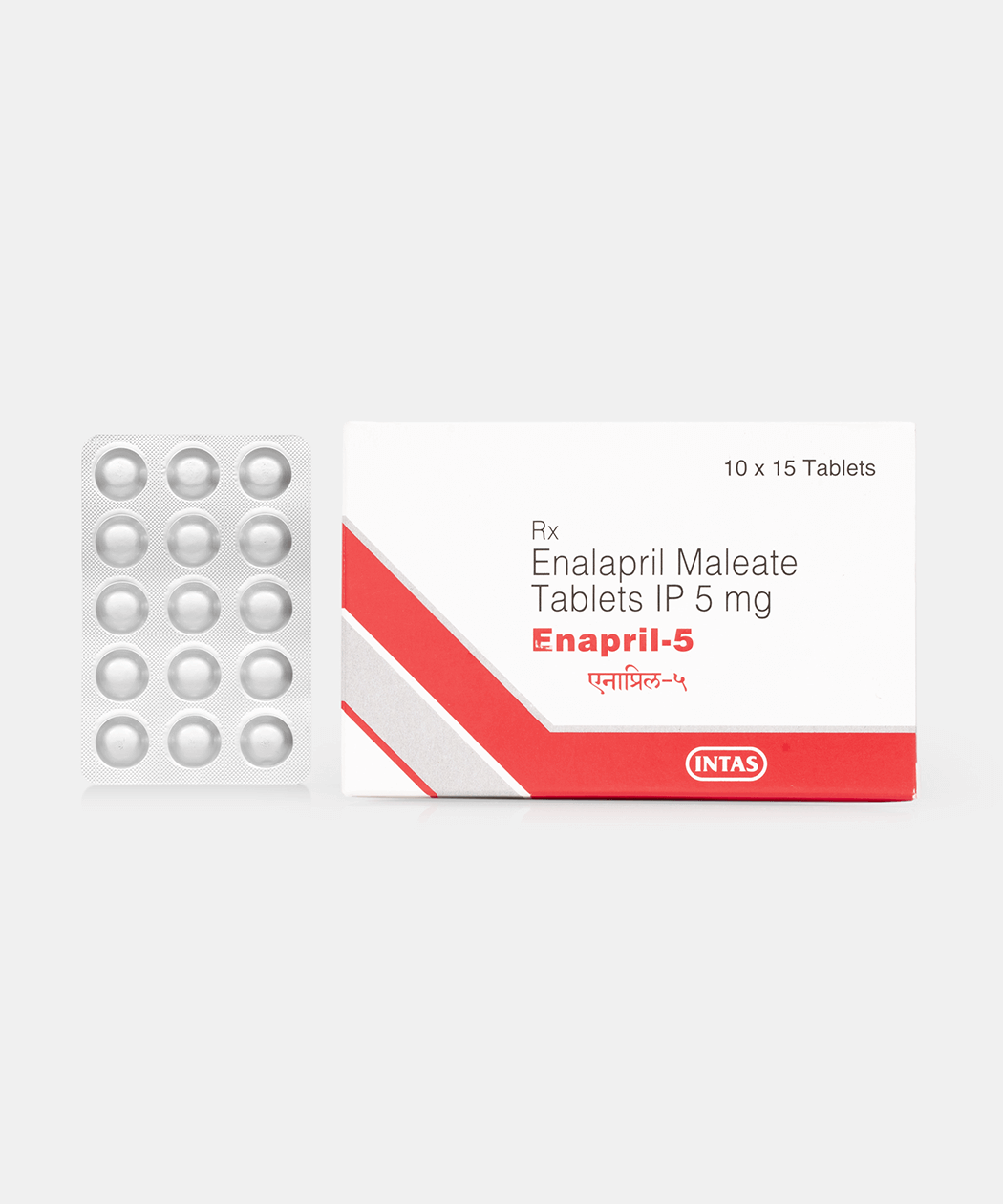
- The entire class of ACE inhibitors, enalapril included, owes its existence to research on venom peptides from the Brazilian pit viper Bothrops jararaca, which were found to potentiate the blood-pressure-lowering hormone bradykinin.
- Enalapril is a prodrug; it is essentially inactive until the liver converts it into enalaprilat, which is also available as a direct intravenous formulation for hospital use.
- The characteristic dry cough some patients develop is not a coincidence but a direct consequence of the same enzyme blockade, since ACE also breaks down bradykinin in the airways.
Mechanism
Enalapril, acting through its active form enalaprilat, blocks angiotensin-converting enzyme (ACE), the enzyme that converts angiotensin I into angiotensin II. Angiotensin II is a powerful constrictor of blood vessels and a trigger for the release of aldosterone, a hormone that makes the body hold on to salt and water. By suppressing angiotensin II, enalapril relaxes arteries and veins, reduces the salt and fluid the body retains, and lowers blood pressure while easing the workload on the heart [1][2]. The same enzyme, also known as kininase II, normally breaks down bradykinin; because enalapril inhibits it, bradykinin builds up, which contributes both to blood-vessel relaxation and to the characteristic dry cough. In heart failure, dialing down this hormonal overdrive slows the harmful remodeling of the heart muscle and improves survival [1][2].
receptor fingerprint
Angiotensin converting enzyme (ACE)inhibits
Angiotensin IIblocks
Aldosterone releasemodulates
Bradykinin (kininase II)inhibits
Efferent glomerular arteriolemodulates
Safetyrisks and cautions, not medical advice
Enalapril is prescription only. Common effects include a persistent dry cough, dizziness from low blood pressure, headache, and raised potassium. More serious risks are angioedema (swelling of the lips, tongue, or throat), sharp drops in blood pressure after the first dose, and worsening kidney function, especially in people with narrowing of both renal arteries. It must not be used in pregnancy because it can harm a developing baby. Pairing it with potassium supplements, potassium sparing diuretics, or the drug aliskiren raises the risk of dangerous potassium levels, and taking it alongside regular NSAIDs can blunt its effect and stress the kidneys.
Interactionsdocumented pairs only, not exhaustive
Enalapril is a prodrug hydrolyzed by esterases to enalaprilat, so it has no meaningful cytochrome P450 interactions; the problems come from RAAS blockade itself.
Hyperkalemia is the recurring one. Potassium supplements, potassium-sparing diuretics, spironolactone, eplerenone, trimethoprim and heparin all add to it, and reduced renal function magnifies the effect.
NSAIDs reduce the antihypertensive response and, alongside a diuretic, can precipitate acute kidney injury through loss of prostaglandin-mediated glomerular autoregulation.
Dual RAAS blockade with an ARB or aliskiren increases hypotension, hyperkalemia and renal impairment; the aliskiren combination is contraindicated in diabetes. Sacubitril/valsartan, mTOR inhibitors and DPP-4 inhibitors each raise angioedema risk.
Injectable gold as sodium aurothiomalate has produced nitritoid reactions with enalapril: flushing, nausea, vomiting and hypotension. Lithium clearance falls and toxicity has been reported.
Checking a whole stack? Run it through interactions + stacks.
History
Enalapril was developed by Merck and emerged from the wave of research that followed the discovery of captopril, the first orally active angiotensin-converting enzyme inhibitor, whose own lineage traced back to peptides isolated from the venom of the Brazilian pit viper. Chemists sought a successor that would inhibit ACE without the sulfhydryl group implicated in some of captopril's side effects, and the result was enalapril, a carboxyl-containing prodrug converted in the body to its active form enalaprilat.
It received approval from the United States Food and Drug Administration in 1985 and was marketed as Vasotec. Its place in cardiology was cemented by two landmark trials: the CONSENSUS study in severe heart failure, published in 1987, and the SOLVD trial in patients with reduced ejection fraction, published in 1991, both of which demonstrated a genuine survival benefit. Enalapril remains one of the most widely prescribed ACE inhibitors and appears on the World Health Organization's List of Essential Medicines.
Reputation
Enalapril is regarded as a foundational and thoroughly validated cardiovascular medicine, one of the drugs that established ACE inhibition as a cornerstone of modern heart failure and hypertension care. Its reputation rests on hard outcome data rather than surrogate measures; the CONSENSUS and SOLVD trials showed that it prolongs life, not merely that it lowers numbers on a chart. Clinicians value its predictable action, its once or twice daily oral dosing, and decades of accumulated safety experience across millions of patients. It is honest to note that, like all ACE inhibitors, it can provoke a persistent dry cough in some users, can raise potassium, and must be avoided in pregnancy. Even so, few blood pressure medications carry such a deep and reassuring evidence base, which is why enalapril continues to be a trusted first-line option worldwide.
Subjective profileweighing the evidence above
A cheap drug with landmark survival data behind it in heart failure, which is a rare thing to be able to say. The dry cough is the usual reason people move to an ARB, potassium and kidney function need watching, and it must never be used in pregnancy.
Where to buy

Suppliers
Vendors carrying Enalapril, with live product details and codes. Links are affiliate links that support the wiki at no cost to you.
PCT.Zone
Enalapril
Research
- 1987first citedEffects of enalapril on mortality in severe congestive heart failure (CONSENSUS)
- 2014most recentAngiotensin-neprilysin inhibition versus enalapril in heart failure (PARADIGM-HF)
- 1.Effects of enalapril on mortality in severe congestive heart failure (CONSENSUS)
- 2.Effect of enalapril on survival in patients with reduced left ventricular ejection fractions and congestive heart failure (SOLVD)
- 3.Angiotensin-neprilysin inhibition versus enalapril in heart failure (PARADIGM-HF)
3 listed here; entry last updated August 2026
Reviews
My notesprivate to this device
FAQ
Why does enalapril make me cough?
It raises bradykinin levels in the airways, which can trigger a dry, tickly cough in some people; switching to an ARB usually fixes it.
Can I take enalapril during pregnancy?
No; ACE inhibitors can seriously harm a developing baby, so it should be stopped before or as soon as pregnancy is planned or confirmed.
How long does it take to work?
Blood pressure starts to fall within about an hour, but the full effect on hypertension usually settles in over a few weeks.
Do I need blood tests on enalapril?
Yes; your doctor will check kidney function and potassium shortly after starting and after any dose change.
Should I avoid potassium rich foods?
Moderate intake is usually fine, but skip potassium supplements or salt substitutes unless your doctor approves, since the drug already raises potassium.
Adverse effects
- Dry, persistent cough
- Dizziness or low blood pressure
- Elevated blood potassium
- Reduced kidney function
- Angioedema (rare but serious)
- Not safe during pregnancy