
spec sheet10 rows
Evolocumab is a biologic medication used to lower cholesterol, belonging to a class of drugs called PCSK9 inhibitors. It is a monoclonal antibody that blocks the protein PCSK9, allowing the liver to clear more low-density lipoprotein (LDL) cholesterol from the blood. Given by injection under the skin, it is used to treat high cholesterol, including the inherited form known as familial hypercholesterolemia, and to reduce the risk of heart attacks and strokes in people with cardiovascular disease. Developed by Amgen and approved in 2015, it is sold under the brand name Repatha.
- Treats high cholesterol, including familial hypercholesterolemia
- Reduces the risk of heart attacks and strokes in cardiovascular disease
- Drops LDL substantially even on top of a statin
- Blocks PCSK9 so the liver clears more LDL
- One small injection every two weeks or monthly
- Well tolerated, with little worse than injection site reactions
- Injection-site reactions such as redness or pain are the most common effect
- Cold-like symptoms and muscle aches can occur
Overview
Evolocumab is a fully human monoclonal antibody, a large protein produced by biotechnology to bind a specific target [1][2]. It belongs to the PCSK9 inhibitor class of cholesterol-lowering drugs, named for the protein they block [1]. Unlike statins, which are small molecules taken as pills, evolocumab is a biologic administered by subcutaneous injection [1][2]. It works alongside, rather than in place of, other lipid-lowering treatments and can drive LDL cholesterol to very low levels [1][2].
The drug is used to treat hypercholesterolemia, particularly in people who cannot reach their cholesterol goals on statins alone or who cannot tolerate statins, and in those with familial hypercholesterolemia, an inherited condition of very high LDL cholesterol [1][3]. In a trial in patients with heterozygous familial hypercholesterolemia, evolocumab reduced LDL cholesterol by roughly 60% on top of existing therapy and was well tolerated [3]. It is also approved to lower the risk of heart attack, stroke, and coronary procedures in people with established cardiovascular disease [1][2].
The pivotal evidence for its cardiovascular benefit came from the large FOURIER trial, which enrolled more than 27,000 patients with atherosclerotic disease already taking statins [2]. Adding evolocumab lowered LDL cholesterol to a median of about 30 mg per deciliter and significantly reduced the combined risk of cardiovascular death, heart attack, stroke, hospitalization for unstable angina, and coronary revascularization, with the main side-effect difference being more frequent injection-site reactions [2]. A prespecified analysis found the benefit was consistent in patients with and without diabetes and that the drug did not raise the risk of developing diabetes or worsen blood sugar control [4].
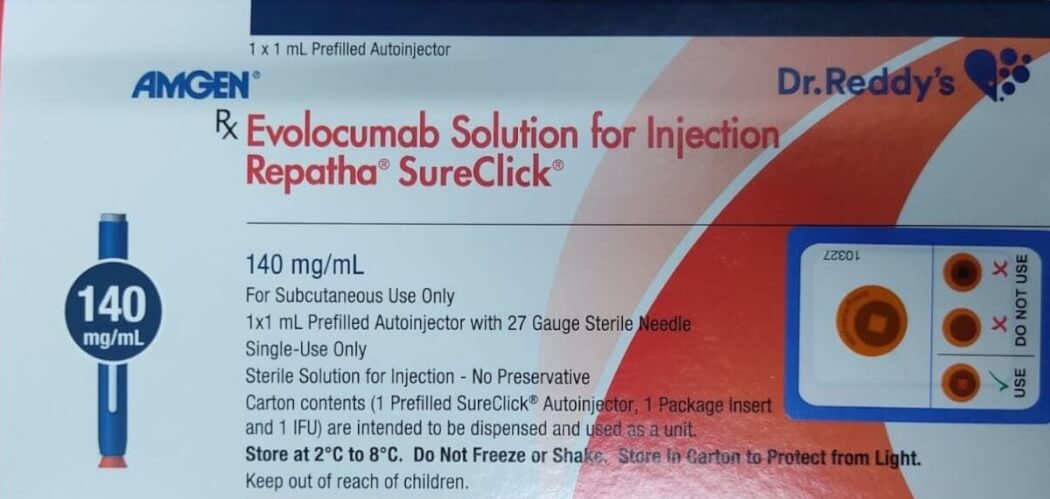
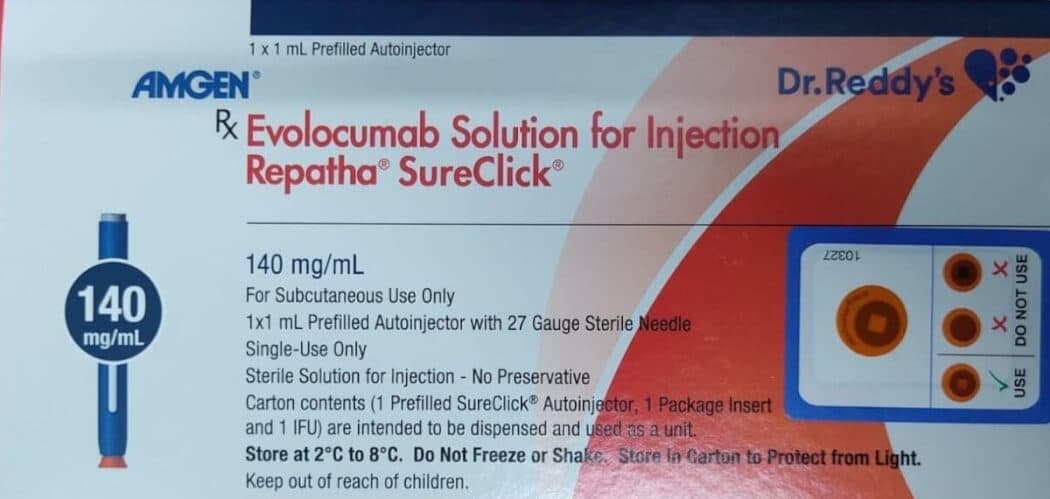
Evolocumab was developed by the biotechnology company Amgen and approved in the United States, Europe, and Canada in 2015, marketed as Repatha [1]. It is a prescription-only medicine supplied as a prefilled pen or syringe for injection under the skin, typically every two weeks or once a month [1]. It is generally well tolerated; the most common adverse effects are reactions at the injection site, such as redness or pain, along with cold-like symptoms and muscle aches [1][3]. Its high cost was initially a barrier to access, and prices were later reduced [1].
- The entire rationale for evolocumab came from studying families whose genetic quirks in the PCSK9 gene left them with either dangerously high or remarkably low cholesterol.
- In the FOURIER trial, evolocumab drove the median LDL cholesterol down to about 30 milligrams per deciliter, roughly a third of the starting level, without a signal of harm from such low numbers.
- Some people naturally carry loss-of-function PCSK9 variants that keep their LDL very low for life and are associated with markedly reduced heart disease, essentially a natural preview of what the drug mimics.
Mechanism
Evolocumab lowers cholesterol by targeting a protein called PCSK9 (proprotein convertase subtilisin/kexin type 9) [1][2]. The liver clears LDL cholesterol from the blood using LDL receptors on its surface, which capture LDL particles and pull them into the cell; PCSK9 normally binds these receptors and marks them for destruction, leaving fewer available to remove cholesterol [1]. By binding to PCSK9 and preventing it from attaching to the LDL receptors, evolocumab spares the receptors, allowing more of them to recycle back to the cell surface and take up additional LDL cholesterol [1][2]. The result is a substantial fall in blood LDL cholesterol, on the order of 60%, which in people with cardiovascular disease translates into a lower risk of major cardiovascular events [2][3].
receptor fingerprint
PCSK9 proteinblocks
LDL receptor degradationinhibits
Hepatic LDL receptor recyclingactivates
LDL cholesterolblocks
Lipoprotein(a)modulates
Dosingtypical ranges, not medical advice
interested in protocols and clinical dosages? make an account to see them! ^_^
Safetyrisks and cautions, not medical advice
Evolocumab is a prescription biologic given by injection and is generally very well tolerated. The most common effects are injection site reactions, cold like symptoms, muscle aches and occasional flu like feelings, with rare allergic reactions. In the large outcomes trial it did not raise rates of new diabetes or meaningful memory problems, and driving LDL to very low levels appeared safe. Because it is an antibody rather than a small molecule, it does not carry the liver or muscle interaction concerns of some oral drugs. People allergic to the product should not use it, and it should be stored cold until shortly before injecting.
History
Evolocumab is a fully human monoclonal antibody developed by Amgen to target PCSK9, a protein whose role in cholesterol metabolism had been uncovered only about a decade before the drug's approval. The story began in the early 2000s, when geneticists studying families with unusually high and unusually low cholesterol traced the differences to mutations in the PCSK9 gene, revealing that the protein controls how many LDL receptors the liver keeps on its surface.
This discovery pointed directly to a therapeutic strategy: block PCSK9, spare the receptors, and let the liver clear more LDL cholesterol from the blood. Evolocumab, an antibody that binds PCSK9 and prevents it from degrading the receptors, received United States Food and Drug Administration approval in 2015 and was marketed as Repatha. Its cardiovascular benefit was confirmed by the large FOURIER outcomes trial, published in 2017, which showed that adding evolocumab to statin therapy reduced the risk of major cardiovascular events.
Reputation
Evolocumab is widely regarded as one of the most powerful cholesterol-lowering agents available, capable of reducing LDL cholesterol by roughly 60 percent on top of a statin, often driving levels lower than was previously thought achievable or even desirable. Its reputation is anchored in the FOURIER trial, which enrolled more than 27,000 patients and demonstrated that pushing LDL down to very low levels translated into fewer heart attacks, strokes, and revascularizations.
It has proven especially valuable for people with familial hypercholesterolemia or established cardiovascular disease who cannot reach their targets with statins alone, and its safety profile in trials was reassuring, with injection-site reactions being the main distinguishing complaint. The candid caveats are that it is given by subcutaneous injection every two weeks or monthly and that, as a biologic, it is considerably more expensive than generic statins. For patients who need aggressive LDL reduction, however, it represents a genuinely potent and evidence-backed advance.
Subjective profileweighing the evidence above
One of the clearest wins in modern cardiovascular medicine: it drops LDL substantially even on top of a statin and turns that into fewer heart attacks and strokes, with little worse than injection-site reactions and cold-like symptoms. Prescription and expensive, but when LDL will not come down, this works.
Where to buy
Suppliers
Vendors carrying Evolocumab, with live product details and codes. Links are affiliate links that support the wiki at no cost to you.
PCT.Zone
Evolocumab
Research
- 2015first citedPCSK9 inhibition with evolocumab (AMG 145) in heterozygous familial hypercholesterolaemia (RUTH…
- 2025most recentEffects of Inclisiran, Alirocumab, Evolocumab, and Evinacumab on Lipids: A Network Meta-Analysi…
- 1.Effects of Inclisiran, Alirocumab, Evolocumab, and Evinacumab on Lipids: A Network Meta-Analysis.
- 2.Evolocumab and Clinical Outcomes in Patients with Cardiovascular Disease.
- 3.PCSK9 inhibition with evolocumab (AMG 145) in heterozygous familial hypercholesterolaemia (RUTHERFORD-2): a randomised, double-blind, placebo-controlled trial
- 4.Cardiovascular safety and efficacy of the PCSK9 inhibitor evolocumab in patients with and without diabetes and the effect of evolocumab on glycaemia and risk of new-onset diabetes: a prespecified analysis of the FOURIER randomised controlled trial
4 listed here; entry last updated August 2026
Reviews
My notesprivate to this device
FAQ
How much can evolocumab lower my cholesterol?
On top of a statin it typically lowers LDL by around sixty percent, reaching levels most oral drugs cannot.
Does it actually prevent heart attacks?
Yes; the FOURIER trial showed it reduced heart attacks, strokes and artery procedures in people with cardiovascular disease.
Is very low LDL from this drug safe?
In the trials pushing LDL very low with evolocumab did not raise memory or diabetes problems and was well tolerated.
How is it given?
As a subcutaneous injection either every two weeks or once a month, often with a self injection device at home.
Can I stop my statin once I start it?
Usually no; it is designed to work alongside a statin, and your doctor decides the combination based on your goals.
Adverse effects
- Injection-site reactions such as redness or pain are the most common effect
- Cold-like symptoms and muscle aches can occur
Notes and cautions
- Given by injection under the skin rather than as a pill
- Generally well tolerated, without an increased risk of diabetes in trials