
spec sheet12 rows
Ezetimibe is a cholesterol absorption inhibitor used to lower blood cholesterol, most often alongside a statin. Sold under the brand name Zetia among others, it acts in the small intestine to block the transport protein that ferries dietary and biliary cholesterol into the body. It is taken as an oral tablet for high cholesterol and related lipid disorders.
- blocks cholesterol at the gut, where a statin cannot reach
- drops LDL further when a statin alone falls short
- a non-statin route for people statins do not suit
- the standard second drug for stubborn cholesterol
- famously easy to tolerate; one small daily tablet
- Diarrhea
- Muscle or joint aches
- Fatigue
Overview
Ezetimibe is a lipid-lowering drug of the cholesterol absorption inhibitor class, belonging chemically to the azetidinone (beta-lactam) family [1]. It is used to reduce elevated low-density lipoprotein (LDL) cholesterol in primary hypercholesterolemia and related conditions, and it is most often prescribed together with a statin and dietary change rather than on its own [1][2]. The drug was developed by Schering-Plough and Merck and was approved for medical use in the United States in 2002, later becoming widely available as a low-cost generic [1].
Unlike statins, which curb the body's internal manufacture of cholesterol, ezetimibe works at the lining of the small intestine to limit how much cholesterol is absorbed from food and bile [1]. Because the two mechanisms are complementary, adding ezetimibe to a statin produces a further drop in LDL cholesterol beyond what the statin achieves alone, and the pairing is sold both as separate tablets and as a fixed-dose combination [1][2].
For years it was unclear whether ezetimibe's cholesterol lowering translated into fewer cardiovascular events. The IMPROVE-IT trial addressed this by adding ezetimibe or placebo to simvastatin in patients stabilized after an acute coronary syndrome; over a median of about six years the ezetimibe combination lowered LDL cholesterol further and modestly reduced the rate of cardiovascular events, though it did not improve overall survival [2]. A later analysis of the same trial indicated that patients at higher baseline risk, identified by cardiac biomarkers, gained the greatest absolute benefit [3]. Together these results supported the principle that pushing LDL cholesterol below earlier targets, even by a non-statin route, yields additional cardiovascular benefit [2].
Ezetimibe is a prescription-only medicine in the United States, the United Kingdom and Canada, and it remains one of the more commonly prescribed cholesterol drugs [1]. It is generally well tolerated, with reported effects that are usually mild and can include diarrhea and muscle or joint aches [1].
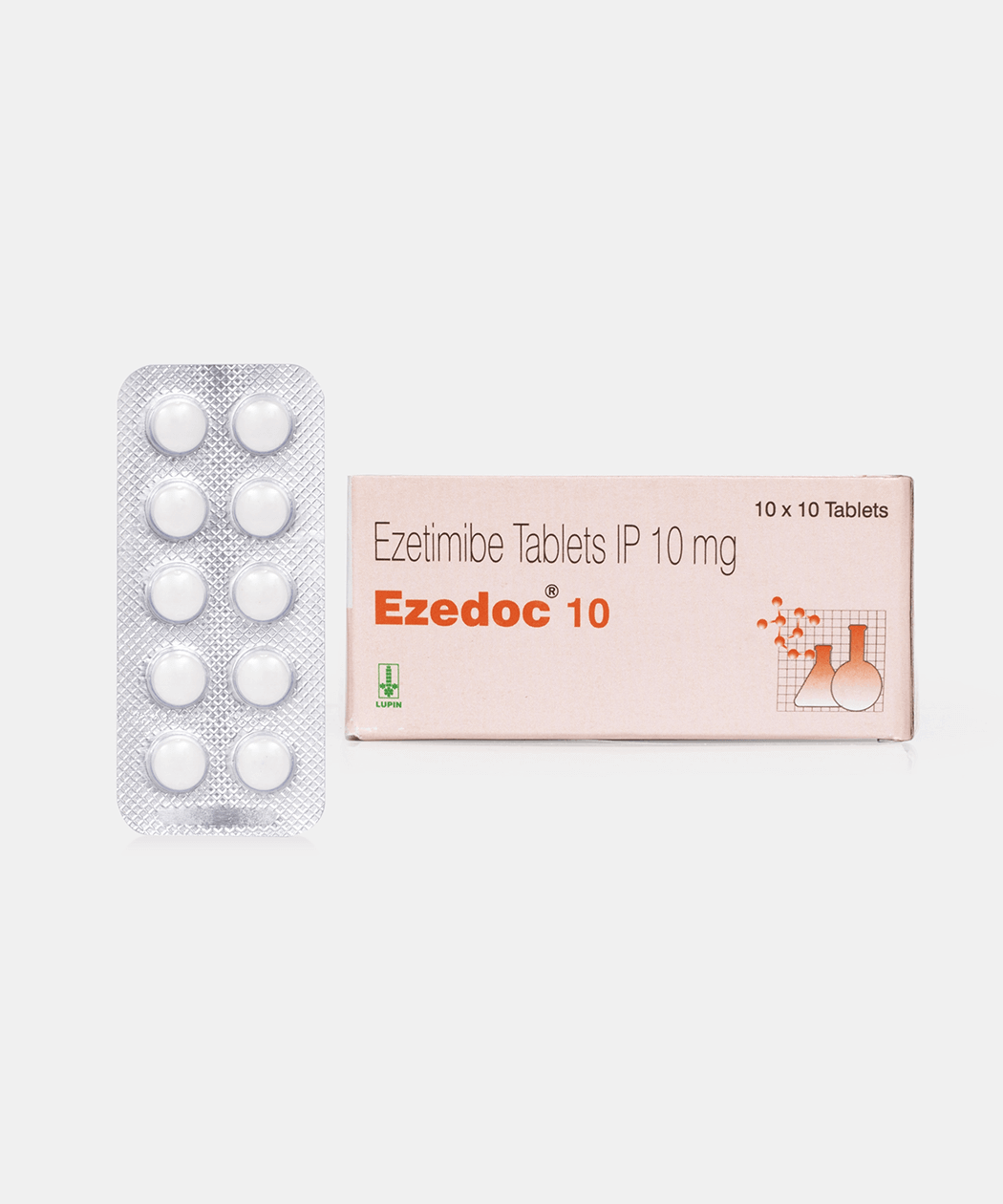
- Ezetimibe was approved in 2002, but its molecular target, the NPC1L1 transporter, was not identified until 2004, meaning the drug reached patients before science fully understood how it worked.
- IMPROVE-IT was the first randomized trial to prove that a non-statin cholesterol drug could reduce cardiovascular events.
- The drug undergoes enterohepatic recirculation, repeatedly cycling back to its site of action in the gut, which supports its long duration and once-daily dosing.
Mechanism
Ezetimibe acts at the brush border of the small intestine, where it blocks the Niemann-Pick C1-like 1 (NPC1L1) protein, the transporter that takes up cholesterol from the gut into the intestinal cells [1][2]. By inhibiting NPC1L1 it reduces the absorption of both dietary cholesterol and the cholesterol delivered in bile, so less cholesterol reaches the liver [1]. The liver responds to this reduced supply by displaying more LDL receptors on its surface, which draw additional LDL cholesterol out of the bloodstream and lower circulating LDL levels [1]. Because this intestinal action is separate from the way statins block cholesterol synthesis inside cells, the two drugs have additive cholesterol-lowering effects when used together [1][2].
receptor fingerprint
NPC1L1 (intestinal cholesterol transporter)inhibits
Intestinal cholesterol absorptionblocks
Dosingtypical ranges, not medical advice
interested in protocols and clinical dosages? make an account to see them! ^_^
Safetyrisks and cautions, not medical advice
Ezetimibe is generally well tolerated. The most common effects are diarrhea, fatigue, and occasional muscle or joint aches; rare liver-enzyme elevations can occur, particularly when it is combined with a statin. It is a prescription medicine best used under medical guidance.
Interactionsdocumented pairs only, not exhaustive
Ezetimibe combined with rosuvastatin showed no significant pharmacokinetic interaction in a steady-state drug interaction study; the AUC and Cmax of rosuvastatin were not meaningfully altered [18]. However, the combination produces a pharmacodynamic synergy on LDL-C lowering; simulations showed LDL-C reductions of 51% for rosuvastatin alone, 25.3% for ezetimibe alone, and 60.7% for co-therapy, supporting additive efficacy rather than a true interaction [18]. The drug interaction literature focuses primarily on statin combinations; interactions with other CYP3A substrates or anticoagulants remain understudied.
Checking a whole stack? Run it through interactions + stacks.
History
Ezetimibe was discovered by scientists at Schering-Plough during a 1990s drug-discovery program aimed at blocking intestinal cholesterol absorption. It emerged unexpectedly from work on acyl-CoA cholesterol acyltransferase inhibitors, revealing itself to act through a distinct and at first unknown mechanism. The Food and Drug Administration approved it in 2002 as the first member of an entirely new drug class, the cholesterol absorption inhibitors.
Two years later, in 2004, researchers identified its molecular target as the Niemann-Pick C1-like 1 (NPC1L1) transporter, finally explaining how the drug worked. A fixed-dose combination with simvastatin, marketed as Vytorin, soon followed. The landmark IMPROVE-IT trial, reported in 2015, was the first to demonstrate that adding a non-statin agent to statin therapy could further reduce cardiovascular events, firmly validating ezetimibe's place in lipid management.
Reputation
Ezetimibe enjoys a strong reputation as a clean, well-tolerated companion to statin therapy, prized for lowering LDL cholesterol through a mechanism entirely separate from the statins. Because it acts in the gut rather than the muscle or liver, it is often a welcome option for patients who cannot tolerate higher statin doses. The IMPROVE-IT trial gave it a rare distinction; it was the first non-statin lipid drug proven in a large outcomes trial to reduce heart attacks and strokes, which cemented clinician confidence. Its once-daily oral dosing, generic availability, and mild side-effect profile make it one of the most accessible cardiovascular tools available. While its LDL reduction on its own is modest compared with high-intensity statins, its additive effect and excellent tolerability keep it a guideline-endorsed mainstay.
Subjective profileweighing the evidence above
A sensible, well-tolerated add-on when a statin alone is not getting LDL low enough, or when statins are not tolerated at all. It does less on its own than a statin does, so it works best as the second drug rather than the first.
Where to buy

Suppliers
Vendors carrying Ezetimibe, with live product details and codes. Links are affiliate links that support the wiki at no cost to you.
PCT.Zone
Ezetimibe
Research
- 2004first citedA multicenter, randomized, double-blind, placebo-controlled, factorial design study to evaluate…
- 2025most recentAlternative LDL Cholesterol-Lowering Strategy vs High-Intensity Statins in Atherosclerotic Card…
- 1.Ezetimibe and Improving Cardiovascular Outcomes: Current Evidence and Perspectives
- 2.Ezetimibe Added to Statin Therapy after Acute Coronary Syndromes.
- 3.Biomarkers and Clinical Cardiovascular Outcomes With Ezetimibe in the IMPROVE-IT Trial
- 4.Niemann-Pick C1 Like 1 protein is critical for intestinal cholesterol absorption
- 5.The target of ezetimibe is Niemann-Pick C1-Like 1 (NPC1L1)
- 6.Niemann-pick C1-like 1 (NPC1L1) protein in intestinal and hepatic cholesterol transport
- 7.Niemann-Pick C1-Like 1 and cholesterol uptake
- 8.Niemann-Pick C1-Like 1 inhibitors for reducing cholesterol absorption
- 9.Long-term efficacy and safety of moderate-intensity statin with ezetimibe combination therapy versus high-intensity statin monotherapy in patients with atherosclerotic cardiovascular disease (RACING): a randomised, open-label, non-inferiority trial
- 10.Combination Lipid-Lowering Therapy in Patients Undergoing Percutaneous Coronary Intervention
- 11.Combination therapy with moderate-intensity atorvastatin and ezetimibe vs. high-intensity atorvastatin monotherapy in patients treated with percutaneous coronary intervention in practice: assessing RACING generalizability
- 12.Alternative LDL Cholesterol-Lowering Strategy vs High-Intensity Statins in Atherosclerotic Cardiovascular Disease: A Systematic Review and Individual Patient Data Meta-Analysis
18 listed here; entry last updated August 2026
Reviews
My notesprivate to this device
FAQ
How does ezetimibe work?
It blocks cholesterol absorption in the small intestine, lowering LDL cholesterol.
Why is it combined with statins?
It works through a different mechanism than statins, so pairing them can lower LDL further.
Is it taken daily?
Yes; it is typically taken once daily as an ongoing cholesterol-lowering therapy.
Can it cause muscle aches?
Muscle aches are reported, though less commonly than with statins.
Adverse effects
- Diarrhea
- Muscle or joint aches
- Fatigue
- Rare liver enzyme elevation when combined with a statin
Notes and cautions
- Abdominal discomfort