
spec sheet12 rows
Rivaroxaban is an oral anticoagulant, or blood thinner, that works by directly inhibiting factor Xa, a key enzyme in the clotting cascade. It was the first orally active direct factor Xa inhibitor to be marketed and is used to prevent and treat blood clots. Developed by Bayer, it is sold mainly under the brand name Xarelto.
- The first oral direct factor Xa inhibitor to market
- Prevents and treats blood clots as a factor Xa inhibitor
- The first orally active factor Xa inhibitor to reach market
- No routine blood tests; fixed dosing every day
- Far fewer food interactions than warfarin
- A genuine upgrade on warfarin for most people
- Increased bruising or bleeding
- Nosebleeds
- Heavier menstrual bleeding
Overview
Rivaroxaban belongs to a class of anticoagulants known as direct factor Xa inhibitors, which are often grouped with related agents under the heading of direct oral anticoagulants. Chemically it is built around an oxazolidinone core and is structurally reminiscent of the antibiotic linezolid, although it has no antibacterial activity of its own [2]. Unlike the older drug warfarin, it acts on a single, specific clotting factor and produces a more predictable anticoagulant effect that does not call for routine blood monitoring [1].
The compound arose from a Bayer research program that identified oxazolidinone derivatives as potent inhibitors of factor Xa, leading to the candidate originally coded BAY 59-7939 [2]. It became the first oral direct factor Xa inhibitor to reach the market, gaining United States approval in 2011, first to prevent clots after hip and knee replacement and then for stroke prevention in atrial fibrillation. It is a prescription-only medicine sold as Xarelto, is now available as a generic in many countries, and appears on the World Health Organization's list of essential medicines [1].
Rivaroxaban is used to lower the risk of stroke in people with nonvalvular atrial fibrillation, to treat and prevent deep vein thrombosis and pulmonary embolism, and to reduce cardiovascular events in some patients with coronary or peripheral artery disease. Its pivotal atrial fibrillation trial, ROCKET AF, found it to be at least as effective as warfarin at preventing stroke and systemic embolism, with less intracranial and fatal bleeding [1]. Later research has examined its use in special populations, including patients with reduced kidney function, where the dose must be adjusted and the benefits weighed carefully against the risk of bleeding [3].
The drug is taken by mouth as tablets. Lower strengths can be swallowed with or without food, but the higher strengths are absorbed reliably only when taken with a meal, so they are given with food to ensure adequate uptake [1].

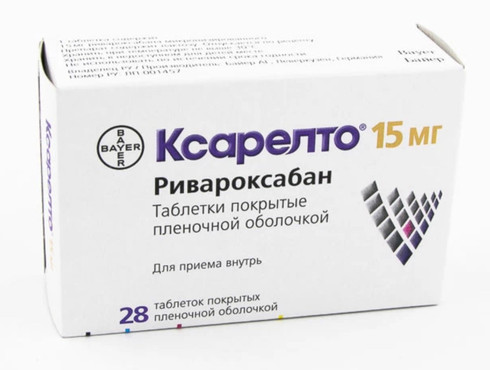
- Rivaroxaban was the first orally active direct factor Xa inhibitor ever brought to market, opening the modern class of direct oral anticoagulants.
- A single molecule of factor Xa can generate roughly a thousand molecules of thrombin, which is why blocking that one enzyme so powerfully dampens clot formation.
- Unlike warfarin, rivaroxaban needs no routine coagulation monitoring, a shift that transformed everyday anticoagulant care.
Mechanism
Rivaroxaban blocks factor Xa, the enzyme that sits at the convergence of the intrinsic and extrinsic arms of the coagulation cascade and that converts prothrombin into thrombin. By binding directly and reversibly to the active site of factor Xa, it inhibits the enzyme both in its free form and when bound within the prothrombinase complex [2]. Because a single molecule of factor Xa drives the generation of many thrombin molecules, inhibiting it strongly dampens the downstream production of thrombin and the formation of fibrin clots [1]. The drug does not act on thrombin itself or directly on platelets, and its anticoagulant effect rises and falls in step with its predictable blood levels [1].
receptor fingerprint
Factor Xa (free)inhibits
Factor Xa within the prothrombinase complexinhibits
Thrombin (factor IIa) generationmodulates
P-glycoprotein transportermodulates
CYP3A4 and CYP2J2 enzymesmodulates
Dosingtypical ranges, not medical advice
interested in protocols and clinical dosages? make an account to see them! ^_^
Safetyrisks and cautions, not medical advice
Rivaroxaban is prescription only, and its main risk is bleeding, ranging from minor bruising and nosebleeds to serious gastrointestinal or brain bleeds. The risk climbs when it is combined with aspirin, anti-inflammatory painkillers or other blood thinners. Strong drugs that block both CYP3A4 and P-glycoprotein, such as certain antifungals and HIV medicines, can raise its levels. It is avoided in severe liver disease, in very poor kidney function, with mechanical heart valves, and in triple positive antiphospholipid syndrome. In an emergency, specific reversal agents can be used.
Interactionsdocumented pairs only, not exhaustive
Rivaroxaban is a substrate of both CYP3A4 and P-glycoprotein, and the interactions that matter most hit both routes at once. Combined strong CYP3A4 and P-gp inhibitors such as ketoconazole, itraconazole, ritonavir and conivaptan raise rivaroxaban exposure substantially; because there is no routine coagulation test used to titrate it, the first sign of excess anticoagulation is often bleeding. Combined strong inducers, notably rifampin, carbamazepine, phenytoin and St John's wort, cut exposure and leave patients under-anticoagulated, which is the more insidious failure because nothing feels wrong until a clot forms.
Pharmacodynamic additions matter just as much. Aspirin, clopidogrel and other antiplatelets, NSAIDs, and SSRIs and SNRIs, which impair platelet serotonin uptake, all raise bleeding risk without altering rivaroxaban concentrations.
Neuraxial anesthesia or spinal puncture during rivaroxaban therapy carries a risk of spinal hematoma and lasting paralysis; this one carries a boxed warning.
Checking a whole stack? Run it through interactions + stacks.
History
Rivaroxaban was discovered by scientists at Bayer HealthCare in Wuppertal, Germany, during the early 2000s, where it was identified under the laboratory code BAY 59-7939 as an orally active, direct inhibitor of factor Xa. It marked a deliberate effort to move beyond warfarin and injectable heparins toward a predictable oral anticoagulant that would not require routine monitoring. Bayer partnered with Janssen Pharmaceuticals, a Johnson & Johnson company, to develop and market it in North America under the brand name Xarelto.
It first gained approval in Europe and Canada in 2008 for preventing venous clots after hip and knee replacement surgery, and the United States Food and Drug Administration approved it in 2011. Its indications expanded rapidly to include stroke prevention in atrial fibrillation and the treatment of venous thromboembolism, supported by a series of large trials including ROCKET-AF. As the first orally active direct factor Xa inhibitor to reach the market, it helped launch the modern era of direct oral anticoagulants.
Reputation
Rivaroxaban is celebrated as a landmark in anticoagulation, offering fixed oral dosing without the frequent blood tests and dietary restrictions that made warfarin so cumbersome for generations of patients. Its predictable pharmacology, and once-daily dosing for several indications, has made it a popular choice for preventing strokes in atrial fibrillation and for treating and preventing venous clots.
Large outcome trials established that it works at least as well as warfarin for these purposes while generally causing fewer intracranial bleeds, a reassurance to both patients and clinicians. The availability of a specific reversal agent for the factor Xa inhibitors has further eased longstanding concerns about managing serious bleeding. It remains a blood thinner with a real bleeding risk that demands respect, but its convenience and strong evidence base have secured its place as one of the most widely used anticoagulants in the world.
Subjective profileweighing the evidence above
A genuine improvement on warfarin for most people, with fixed dosing, no routine monitoring and far fewer food interactions. It is still an anticoagulant, so bleeding is the trade, and it should never be started, stopped or stacked with anti-inflammatory painkillers without a prescriber involved.
Where to buy
1 other outlet
Suppliers
Vendors carrying Rivaroxaban, with live product details and codes. Links are affiliate links that support the wiki at no cost to you.
PCT.Zone
Rivaroxaban
RUPharma🌐
Rivaroxaban
Research
- 2005first citedDiscovery of the novel antithrombotic agent 5-chloro-N-({(5S)-2-oxo-3-[4-(3-oxomorpholin-4-yl)p…
- 2011controlled trialRivaroxaban versus warfarin in nonvalvular atrial fibrillation.
- 2024most recentAnticoagulation in Patients with Chronic Kidney Disease.
- 1.Rivaroxaban versus warfarin in nonvalvular atrial fibrillation.
- 2.Discovery of the novel antithrombotic agent 5-chloro-N-({(5S)-2-oxo-3-[4-(3-oxomorpholin-4-yl)phenyl]-1,3-oxazolidin-5-yl}methyl)thiophene-2-carboxamide (BAY 59-7939): an oral, direct factor Xa inhibitor.
- 3.Anticoagulation in Patients with Chronic Kidney Disease.
3 listed here; entry last updated August 2026
Reviews
My notesprivate to this device
FAQ
Do I need regular blood tests?
No. Unlike warfarin, rivaroxaban is given at a fixed dose and does not need routine clotting checks.
Why take the 20 mg dose with food?
Food greatly improves absorption of the 15 and 20 mg doses, so take them with your evening meal.
What should I do if I miss a dose?
Take it as soon as you remember on the same day, but never double up; ask your pharmacist if unsure.
Is there a reversal agent if I bleed?
Yes. Andexanet alfa and prothrombin complex concentrates can be used in serious bleeding.
Can I use it with a mechanical heart valve?
No. Rivaroxaban is not suitable for mechanical valves; warfarin is used instead.
Adverse effects
- Increased bruising or bleeding
- Nosebleeds
- Heavier menstrual bleeding
- Nausea
- Rare serious internal bleeding
- Uncommon rise in liver enzymes