
spec sheet6 rows
Mezaton is the Russian brand of injectable phenylephrine, a pure alpha-1 agonist used to raise blood pressure during anaesthesia and to prolong local anaesthetic blocks.
- A pure alpha-1 agonist with clean, predictable pharmacology
- Raises blood pressure during anaesthesia
- Prolongs local anaesthetic blocks
- Fast acting and short lived, simple to titrate
- No beta activity, so heart rate is left alone
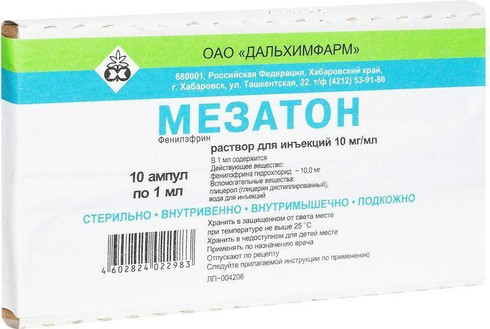
- Phenylephrine is a direct-acting, essentially pure alpha-1 agonist with negligible beta activity, so it raises blood pressure by vasoconstriction alone and characteristically produces reflex bradycardia rather than tachycardia.
- Oral phenylephrine is very extensively metabolised before reaching the systemic circulation by intestinal and hepatic sulfotransferase and monoamine oxidase, leaving little unchanged active drug [1]; the pharmacokinetic reason the oral decongestant fails.
- A randomised placebo-controlled study found oral phenylephrine 12 mg no better than placebo for nasal congestion in seasonal allergic rhinitis [4], consistent with a series of similar negative trials.
- On 12 September 2023 the FDA's Nonprescription Drugs Advisory Committee voted 16 to 0 that current data do not support oral phenylephrine as an effective nasal decongestant at the monograph dose, and in November 2024 the FDA issued a proposed order to remove oral phenylephrine from the over-the-counter monograph.
- Nasal and ophthalmic phenylephrine remain effective by those routes; the efficacy failure is specific to the oral route and is a pharmacokinetic problem, not a receptor problem.
- Phenylephrine has become the preferred vasopressor for spinal hypotension at caesarean delivery because, unlike ephedrine, it crosses the placenta poorly and does not stimulate fetal metabolism, so it avoids the fetal acidosis ephedrine causes (PMID 19672175, PMID 18806043).
Mechanism
Phenylephrine agonises alpha-1 adrenoceptors on vascular smooth muscle with essentially no beta activity, so it raises systemic vascular resistance without stimulating the heart. Blood pressure climbs and the baroreflex answers by slowing the heart, which is the opposite of what adrenaline does.
receptor fingerprint
Alpha-1 adrenoceptors (ADRA1A, ADRA1B, ADRA1D)Direct-acting selective agonist; Gq/phospholipase C/IP3 signalling
Iris dilator (radial) muscle alpha-1 adrenoceptorsAgonist
SULT1A3 (intestinal and hepatic sulfotransferase) and monoamine oxidase ASubstrate; extensive presystemic metabolism
Beta-1 and beta-2 adrenoceptorsEssentially inactive
Alpha-2 adrenoceptorsWeak partial agonist at high concentrations
Safetyrisks and cautions, not medical advice
an injectable vasopressor intended for use under anaesthetic monitoring; a bolus given to an unmonitored person produces severe hypertension and reflex bradycardia, which places it with the emergency injectables
Subjective profileweighing the evidence above
Nothing is wrong with the molecule; the refusal is about the ampoule. As an injectable vasopressor it exists to hold blood pressure up during anaesthesia, where someone is watching a pressure trace and can respond within a beat, and pushed into an unmonitored person it produces a hypertensive spike and a reflex bradycardia with nobody there to treat either. The same alpha-1 agonist in a nasal or oral product is an entirely different proposition; this entry is the emergency injectable, and the site will not point anyone toward a supplier for it.
Resources
No suppliers are provided for compounds like this. This entry is here for reference.
Research
- 1982first citedPharmacokinetics of 3H-phenylephrine in man
- 2008controlled trialA randomized double-blinded comparison of phenylephrine and ephedrine infusion combinations to…
- 2021most recentThe selectivity of α-adrenoceptor agonists for the human α1A, α1B, and α1D-adrenoceptors.
- 1.Pharmacokinetics of 3H-phenylephrine in man
- 2.A randomized double-blinded comparison of phenylephrine and ephedrine infusion combinations to maintain blood pressure during spinal anesthesia for cesarean delivery: the effects on fetal acid-base status and hemodynamic control.
- 3.Placental transfer and fetal metabolic effects of phenylephrine and ephedrine during spinal anesthesia for cesarean delivery
- 4.Oral Phenylephrine HCl for Nasal Congestion in Seasonal Allergic Rhinitis: A Randomized, Open-label, Placebo-controlled Study
- 5.The selectivity of α-adrenoceptor agonists for the human α1A, α1B, and α1D-adrenoceptors.
5 listed here; entry last updated August 2026
Reviews
My notesprivate to this device
Notes and cautions
- Systemic phenylephrine carries no boxed warning, but 10% ophthalmic phenylephrine has caused severe hypertension, arrhythmia, myocardial infarction, subarachnoid haemorrhage and death, particularly in elderly patients and those with cardiovascular disease, and the 2.5% strength should be used instead wherever possible.
- Intravenous extravasation causes local vasoconstriction, ischaemia and tissue necrosis; phentolamine infiltration is the antidote.
- Concurrent non-selective monoamine oxidase inhibitors can precipitate hypertensive crisis, and caution is required with tricyclic antidepressants and with oxytocic drugs.
- Because phenylephrine causes reflex bradycardia and reduces cardiac output, it is a poor choice in patients whose output depends on heart rate, in severe bradycardia or in significant heart block.
- The single most important consumer-facing issue is efficacy rather than toxicity: the oral formulation does not work as a nasal decongestant, and regulatory action to remove it from the over-the-counter monograph is under way in the United States.