
spec sheet13 rows
Mesalamine, also known as mesalazine or 5-aminosalicylic acid (5-ASA), is an anti-inflammatory medication of the aminosalicylate class used to treat inflammatory bowel disease. Chemically related to salicylic acid, it works locally on the lining of the intestine to reduce inflammation and is a mainstay of treatment for ulcerative colitis, where it is used both to bring on and to maintain remission. It is delivered in oral tablets and capsules designed to release the drug in the colon, as well as in rectal suppositories and enemas.
- Brings on remission in ulcerative colitis
- Holds that remission over the long run
- Works locally on the intestinal lining to reduce inflammation
- First line mainstay for ulcerative colitis
- Useful steroid sparing role in flares
- Tablets, capsules, suppositories and enemas to suit the site
- Headache, nausea, abdominal pain, and diarrhea are the most common complaints
- Rarely affects the kidneys, liver, or the lining around the heart
Overview
Mesalamine, spelled mesalazine outside the United States and formally called 5-aminosalicylic acid or 5-ASA, is an aminosalicylate, a family of anti-inflammatory compounds derived from salicylic acid [1][3]. It shares the salicylate backbone with aspirin but differs in its chemistry and, importantly, in acting locally on the gut rather than throughout the body [1][3]. The compound has long been recognized as the therapeutically active portion of the older drug sulfasalazine, in which 5-ASA is joined to a sulfa carrier that produces many of that drug's unwanted effects [1][3].
For decades sulfasalazine was the standard salicylate treatment for ulcerative colitis, but its sulfapyridine component was responsible for much of the intolerance patients experienced [1][3]. The realization that 5-ASA alone carried the benefit led to the development of mesalamine as a drug in its own right, together with related prodrugs such as olsalazine and balsalazide that deliver 5-ASA to the colon by different chemical means [1]. Mesalamine was approved for medical use in the United States during the 1980s and is now available as an inexpensive generic [1].
Mesalamine is used mainly for mild to moderate ulcerative colitis, where it is a first-line agent both for inducing remission and for preventing relapse, and long-term use is thought to lower the risk of colorectal cancer in these patients [1][3]. It is less useful in Crohn's disease, being of value chiefly when the colon is involved, and some authorities question its benefit there [1]. Reviews note that 5-ASA appears to have a fairly specific action on the inflammation of ulcerative colitis rather than a general anti-inflammatory effect on other tissues [3]. In 2022, German guidelines added acute uncomplicated diverticulitis to its approved uses [1]. Research also continues into how the drug interacts with the gut microbiome, and experimental work suggests part of its benefit may come from reshaping the intestinal bacterial community and altering bile acid metabolism [4].
Because the drug must reach inflamed tissue in the lower bowel, it is formulated for targeted delivery: oral delayed-release and extended-release products carry it past the stomach, while suppositories and enemas treat disease in the rectum and left colon directly [1]. It is sold under many brand names, including Asacol, Pentasa, and Lialda, as well as generically [1]. Mesalamine appears on the World Health Organization's Model List of Essential Medicines [1]. It is generally well tolerated, with headache, nausea, abdominal pain, and diarrhea among the more common complaints, while rare serious reactions can affect the kidneys, liver, or heart; it is usually avoided in people with significant kidney impairment or aspirin allergy [1].
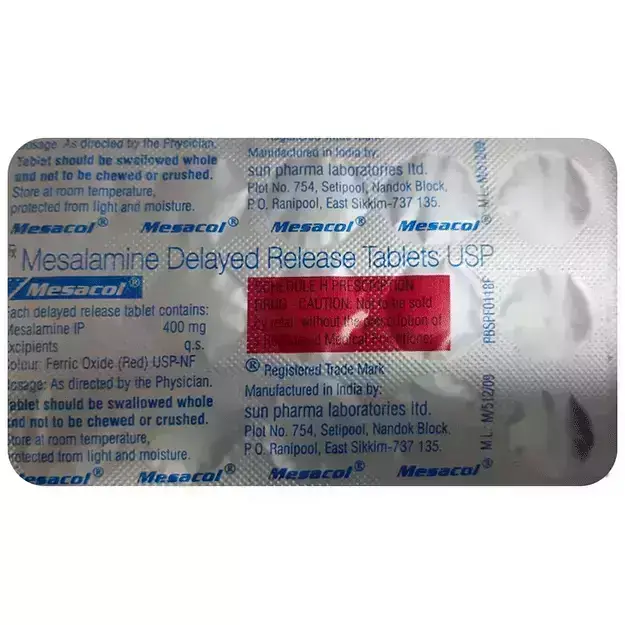
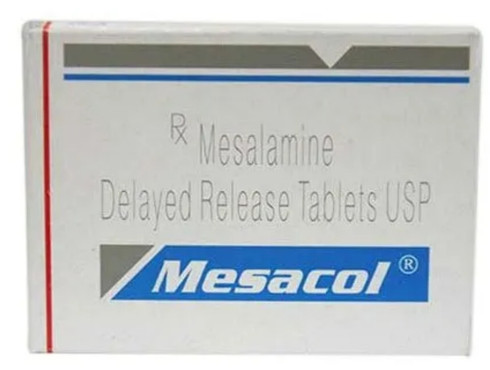
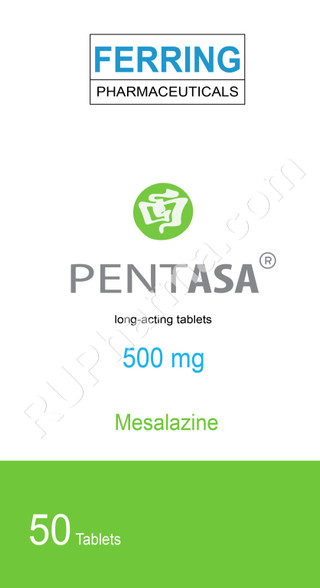
- Mesalamine is the active ingredient that was hiding inside the much older drug sulfasalazine; researchers only pinned down which half did the work in the late 1970s.
- Its tablets and capsules are engineered as tiny delivery systems that hold the drug until it reaches the colon, so it treats inflammation right where it is worst.
- Beyond calming inflammation, mesalamine acts as an antioxidant and can influence the gut microbiome, which may add to its protective effect on the intestinal lining.
Mechanism
The precise way mesalamine calms intestinal inflammation is still not fully defined, but several actions have been described [1][2]. Applied to the mucosa of the colon, it suppresses the production of inflammatory mediators, including prostaglandins and leukotrienes, and dampens the signaling of pro-inflammatory pathways in the gut lining [1][2]. A key part of its effect appears to run through the nuclear receptor PPAR-gamma; laboratory and animal studies show that 5-ASA raises the expression of this receptor in intestinal epithelial cells and promotes its activation, and the drug's anti-inflammatory benefit in models of colitis depends on PPAR-gamma being present [2].
Mesalamine also acts as an antioxidant, scavenging the reactive oxygen species generated during inflammation [3]. Additional research indicates that 5-ASA influences the composition of the gut microbiota and the metabolism of bile acids, which may further contribute to its protective effect on the colonic lining [4]. Because these actions are largely local, mesalamine is formulated to release where inflammation is greatest rather than to be absorbed throughout the body [1][3].
receptor fingerprint
PPAR-gamma (colonic epithelium)agonist
NF-kB signalinginhibits
Cyclooxygenase and lipoxygenase pathwaysinhibits
Reactive oxygen speciesblocks
Mucosal cytokines (TNF-alpha, IL-1)modulates
Dosingtypical ranges, not medical advice
interested in protocols and clinical dosages? make an account to see them! ^_^
Safetyrisks and cautions, not medical advice
Mesalamine is prescription only and generally well tolerated. Common effects include headache, nausea, abdominal pain, diarrhea, and gas. Less common but important risks include inflammation of the kidneys, so periodic kidney function checks are sensible, along with rare pancreatitis, blood count changes, and, rarely, pericarditis. Some people have a hypersensitivity reaction in which their colitis paradoxically worsens. Caution is advised in those allergic to sulfasalazine or other salicylates. It can add to the blood-count suppression of azathioprine or 6-mercaptopurine, and NSAIDs may worsen both kidney risk and colitis.
Interactionsdocumented pairs only, not exhaustive
Mesalamine inhibits thiopurine methyltransferase, the enzyme that methylates azathioprine and mercaptopurine to inactive products. In vitro work shows 5-aminosalicylic acid inhibiting recombinant human TPMT, and an in vivo study in quiescent Crohn's disease found 6-thioguanine nucleotide levels fell measurably once aminosalicylates were withdrawn. The consequence is more myelosuppression than the thiopurine dose alone would predict, and it matters because the two drugs are so often prescribed together in inflammatory bowel disease.
Mesalamine can cause interstitial nephritis in its own right, so NSAIDs and other nephrotoxic drugs raise that risk further.
Delayed-release and pH-dependent formulations liberate drug at a set intestinal pH, so proton pump inhibitors and antacids that raise gastric and small bowel pH can shift where release occurs.
Mesalamine also interferes with liquid chromatography measurement of urinary normetanephrine, producing false positives for pheochromocytoma.
Checking a whole stack? Run it through interactions + stacks.
History
Mesalamine, or 5-aminosalicylic acid, has an origin story rooted in a much older drug. Its parent compound, sulfasalazine, was created in the 1940s by the Swedish physician Nanna Svartz, who joined a salicylate to a sulfonamide antibiotic in the hope of treating rheumatoid arthritis and inflammatory bowel disease. For decades it was unclear which part of that molecule did the work in the gut, until research in the late 1970s, notably by Azad Khan and colleagues, demonstrated that the 5-aminosalicylic acid moiety was the active anti-inflammatory component while the sulfonamide portion was largely responsible for side effects.
This insight led to the development of mesalamine on its own, delivered in specially designed delayed- and controlled-release oral formulations, as well as suppositories and enemas, so that the drug is released where inflammation is greatest in the colon. Marketed under names such as Asacol, Pentasa, and Lialda, it became a mainstay of therapy for ulcerative colitis.
Reputation
Mesalamine is widely regarded as a foundational and reassuringly safe treatment for ulcerative colitis, and it remains a first-line therapy recommended in major gastroenterology guidelines for both bringing on and maintaining remission of mild to moderate disease. Its strong reputation owes much to its favorable safety profile; because it is formulated to act locally on the colon's lining rather than throughout the body, it avoids much of the toxicity of its older parent drug and of systemic immune-suppressing therapies.
Clinicians appreciate that it can be tailored to the site of disease through oral capsules, suppositories, and enemas, and decades of use support its role. It is honest to note that mesalamine is most effective in milder ulcerative colitis and that a meaningful minority of patients ultimately need stronger biologics or other agents; even so, for many people it provides durable, well-tolerated control and helps keep the disease quiet over the long term.
Subjective profileweighing the evidence above
First-line for ulcerative colitis and deservedly so, effective both at bringing on remission and at holding it, with a useful steroid-sparing role and mostly minor side effects. Prescription-only, and the periodic kidney check earns its keep given the rare interstitial nephritis.
Where to buy

Suppliers
Vendors carrying Mesalamine, with live product details and codes. Links are affiliate links that support the wiki at no cost to you.
PCT.Zone
Mesalamine
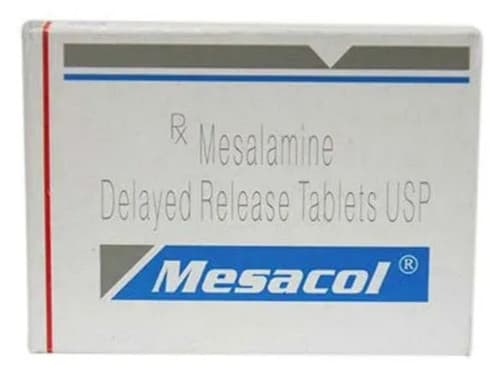
RUPharma🌐
Mesalamine
RUPharma🌐
Mesalamine
Research
- 2005first citedIntestinal antiinflammatory effect of 5-aminosalicylic acid is dependent on peroxisome prolifer…
- 2024most recentThe aminosalicylate - folate connection.
- 1.The aminosalicylate - folate connection.
- 2.Intestinal antiinflammatory effect of 5-aminosalicylic acid is dependent on peroxisome proliferator-activated receptor-gamma
- 3.5-Aminosalicylic acid, a specific drug for ulcerative colitis
- 4.5-Aminosalicylic acid ameliorates dextran sulfate sodium-induced colitis in mice by modulating gut microbiota and bile acid metabolism
- 5.Ulcerative colitis.
- 6.ACG Clinical Guideline: Ulcerative Colitis in Adults
6 listed here; entry last updated August 2026
Reviews
My notesprivate to this device
FAQ
How does mesalamine work in the gut?
It acts locally on the colon lining to calm the inflammation of ulcerative colitis.
What is it mainly used for?
It is the backbone treatment for mild to moderate ulcerative colitis.
Do I need blood tests on it?
Periodic kidney function checks are wise because rare kidney inflammation can occur.
Should I use oral or rectal forms?
It depends on where the disease is; rectal forms suit lower bowel disease and oral forms reach higher up.
Is it a steroid?
No; it is a non-steroidal anti-inflammatory that works only in the gut.
Adverse effects
- Headache, nausea, abdominal pain, and diarrhea are the most common complaints
- Rarely affects the kidneys, liver, or the lining around the heart
Notes and cautions
- Usually avoided in significant kidney impairment or aspirin allergy
- Acts locally in the bowel, so the right formulation and consistent use matter