
spec sheet12 rows
MCT oil is a fat made of medium-chain triglycerides, usually the C8 (caprylic) and C10 (capric) fatty acids fractionated out of coconut or palm kernel oil. Unlike normal dietary fat, these shorter chains skip the lymphatic route and travel straight to the liver via the portal vein, where they're burned fast and partly converted to ketone bodies. That gives a quick alternative fuel for muscle and brain, a small bump in energy expenditure, and a mild satiety effect.
- Raises blood ketones within an hour as clean alternative fuel
- Fat that skips the lymph route and heads straight to the liver
- Small bump in energy burn and fat oxidation
- Mild fullness effect that can trim the next meal
- Carb free energy for fasting and low carb days
- Gentle brain fuel support, clearest when glucose runs low
- Loose stools and diarrhea if dosed too high or too fast
- Stomach cramping and bloating
- Nausea, especially on an empty stomach
Overview
MCT oil is a dietary fat composed of medium-chain triglycerides, most often the C8 (caprylic) and C10 (capric) fatty acids fractionated out of coconut or palm kernel oil. It is distinct from coconut oil itself, which is dominated by lauric acid (C12) and behaves more like a long-chain fat; commercial MCT products are deliberately purified to concentrate the shorter chains that raise ketones. Medium-chain fatty acids of six to twelve carbons are water-dispersible enough that they do not require bile-salt micelles or chylomicron packaging the way long-chain fat does. After cleavage in the gut they are absorbed directly into the portal vein bound to albumin and delivered to the liver, where they enter the mitochondria largely independent of the carnitine shuttle and are oxidized rapidly.
Some of that hepatic flux spills into ketogenesis, raising blood beta-hydroxybutyrate and acetoacetate; those ketones cross the blood-brain barrier through monocarboxylate transporters and supply neurons with a fuel that bypasses glucose metabolism. This is the leading mechanistic explanation for the cognitive signals reported in low-glucose states and mild cognitive impairment. The same fast oxidation shows up peripherally as a modest rise in energy expenditure and fat oxidation, and MCTs appear to stimulate the gut satiety hormones CCK and PYY more strongly than long-chain fat, which can reduce how much people eat at the following meal.
The human evidence is real but generally modest. A systematic review and meta-analysis found that MCTs acutely increase satiety and lower subsequent food intake relative to long-chain fat [1], and a randomized trial in young healthy adults reported that a C8:C10 30:70 blend enhanced cognitive performance and blunted the cognitive decline seen after prolonged exercise [2]. In people with mild cognitive impairment, a randomized controlled pilot established feasibility and safety and pointed to early cognitive effects, though it was small and framed as preliminary rather than definitive [3]. A controlled study in overweight men found that substituting MCT for other dietary fat increased energy expenditure and decreased adiposity over the trial [4]; the body-composition benefit depended on MCT replacing other fat rather than being added on top, and the cognitive data in healthy people remain limited and inconsistent. MCT oil is not an established treatment for Alzheimer's disease despite marketing to that effect.
MCT oil is generally recognized as safe as a food ingredient and has been used clinically since the 1950s to nourish patients who could not absorb ordinary fat. Its main drawback is dose-dependent gastrointestinal upset; loose stools, cramping, nausea, and bloating are common when it is taken in large amounts or on an empty stomach, and these usually settle when the dose is reduced and taken with food. The calories still count at roughly eight to nine kilocalories per gram, so it offers no weight benefit when simply added to the diet. People with significant liver disease should be cautious because MCTs are metabolized heavily in the liver, and anyone at risk of ketoacidosis, such as those with poorly controlled type 1 diabetes, should consult a clinician before deliberately raising ketones.
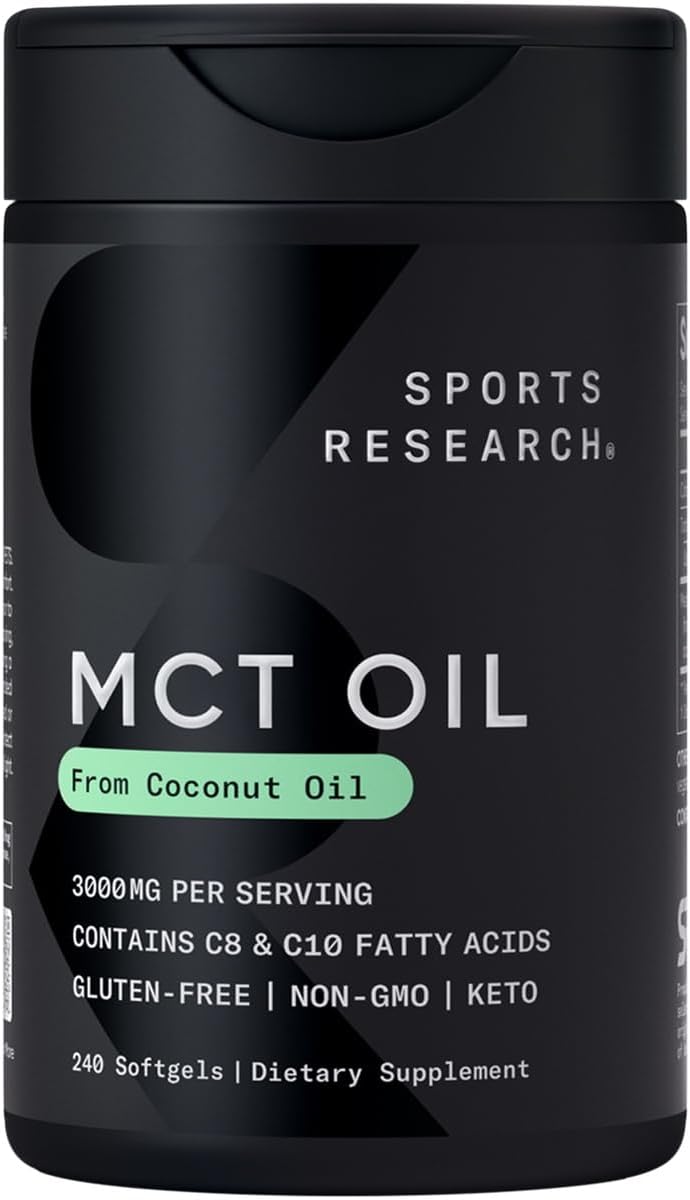
- The 'MCT' in coconut oil is overstated; most of coconut oil's fat is lauric acid (C12), which behaves more like a long-chain fat and is a poor ketone-raiser. real MCT oil is fractionated to concentrate the C8 and C10 that actually spike ketones.
- MCTs were first used medically in the 1950s to feed people who couldn't absorb regular fat, like those with pancreatic or intestinal disorders; the biohacker coffee trend came decades later.
- C8 (caprylic acid) raises blood ketones more per gram than C10 or C12, which is why premium 'brain octane' style products are pure C8.
- Because MCTs skip the lymph system and go straight to the liver, they show up in the blood as ketones far faster than a normal fatty meal; you can measure the bump within about an hour.
Mechanism
Medium-chain fatty acids (6 to 12 carbons) are water-dispersible enough that they don't need bile-salt micelles or chylomicron packaging like long-chain fat does. after cleavage in the gut they're absorbed directly into the portal vein bound to albumin and delivered to the liver, where they enter mitochondria largely independent of the carnitine shuttle and are oxidized rapidly. some of that flux spills into ketogenesis, raising blood beta-hydroxybutyrate and acetoacetate. those ketones cross the through monocarboxylate transporters and give neurons a fuel that bypasses glucose metabolism, which is the leading explanation for the cognitive signals seen in mild cognitive impairment and low-glucose states. the rapid hepatic oxidation also shows up as a modest rise in energy expenditure and fat oxidation, and MCTs appear to trigger gut satiety hormones (CCK, PYY) more than long-chain fat, which can lower how much people eat at the next meal.
As a carrier, MCT oil works on the opposite principle from every other solvent in this catalogue. DMSO, PEG-400 and ethanol are polar solvents that work by making an aqueous phase less hostile to a poorly soluble compound. MCT oil is a triglyceride, and it takes up what a fat takes up. The published survey of solubilizing excipients in marketed oral and injectable products draws exactly this divide, grouping medium-chain triglycerides of coconut and palm seed oil with the water-insoluble lipids such as castor, corn, olive and soybean oil, and separating that group from the water-soluble organic solvents PEG-300, PEG-400, ethanol, propylene glycol, glycerin, dimethylacetamide and dimethylsulfoxide [8]. Which side a compound belongs on is decided by that compound's own polarity and partition coefficient. A strongly compound will usually go into an oil and a salt or a highly polar compound generally will not, and the only reliable check is the one run on the actual material rather than on the class it belongs to.
A lipid vehicle does not simply hold a compound; it changes how the gut handles it. Lipid-based formulations raise the oral of poorly water-soluble drugs through a chain of steps that runs from dispersion, through digestion of the triglyceride, to solubilisation of the digestion products into intestinal mixed micelles and finally absorption, so the outcome depends on the drug's lipophilicity, the type of lipid, the mean emulsion droplet size and how digestible the vehicle is rather than on the oil alone [7]. For medium-chain oils in particular that chain has a weak link in the stomach. Comparing oral with intraduodenal dosing of cinnarizine in rats, bypassing gastric processing lowered from every lipid formulation, but the penalty was larger for medium-chain than for long-chain triglycerides, and long-chain formulations gave higher bioavailability overall by both routes, consistent with more drug precipitating out of the medium-chain ones [6]. Medium-chain lipid appears to need efficient dispersion and partial digestion in the stomach to hand its cargo over to intestinal mixed micelles before the compound comes out of solution.
The container is part of the formulation, which is not obvious until it fails. Across 350 isotropic lipid systems built from five oils, five surfactants and three cosolvents and tested in hard capsules, gelatin shells were generally more compatible with lipid formulations than HPMC shells, adding water to the formulation improved compatibility for both shell types, and miscibility was best when the formulation contained monoglycerides and surfactants with a hydrophilic- balance below 12 [5]. An oil sitting in the wrong shell is a slow failure rather than an obvious one.
receptor fingerprint
Hepatic beta-oxidation / ketogenesisRapid carnitine-independent oxidation in liver mitochondria, spilling into ketone production
Solvent polarity as a lipid vehicleA triglyceride solvent: it takes up lipophilic compounds and does not take up polar or ionic ones, which places it opposite DMSO, PEG-400 and ethanol rather than alongside them
Brain monocarboxylate transporters (ketone uptake)Ketones cross the blood-brain barrier and fuel neurons independent of glucose
Whole-body energy expenditure / fat oxidationFast hepatic oxidation raises thermogenesis and fat burning modestly
Intestinal lipid digestion and mixed micelle formationHas to be dispersed and partially digested, largely in the stomach, before a dissolved compound can transfer into intestinal mixed micelles; bypassing gastric processing lowered bioavailability, and did so more for medium-chain than for long-chain lipid
Gut satiety hormones (CCK, PYY)Stimulates satiety signaling more than long-chain fat
Dosingtypical ranges, not medical advice
interested in protocols and clinical dosages? make an account to see them! ^_^
Safetyrisks and cautions, not medical advice
Generally recognized as safe as a food; the main issue is dose-dependent GI upset. loose stools, cramping, nausea, and bloating are common if you take too much at once or on an empty stomach, and they usually settle when you cut the dose and take it with food. the calories are real (about 8 to 9 kcal per gram), so it isn't a free pass. people with significant liver disease should be cautious since MCTs are metabolized heavily in the liver, and anyone with a history of ketoacidosis risk (poorly controlled type 1 diabetes) should talk to a clinician before deliberately raising ketones. it's not a treatment for Alzheimer's despite the marketing; the clinical data are early and mixed. coconut-derived MCT is not the same as coconut oil, which is mostly long-chain and lauric acid.
Dilutionarithmetic only, not dosing advice
dilute a stock solution
C1 x V1 = C2 x V2. Concentrations must share a unit and volumes must share a unit; nothing here converts between them.
Make up to the final volume rather than adding the two numbers together: mixed liquids do not always occupy the sum of their volumes, and ethanol with water measurably contracts.
History
Medium-chain triglycerides entered medicine in the 1950s as clinical nutrition, used to feed people who could not absorb ordinary fat because of pancreatic or intestinal disease. The property that made them useful there, absorption without bile salts or chylomicron packaging, is the same property that later made them interesting as a ketone source and, separately, as a carrier oil.
Their formulation career is quieter and older than the supplement one. Medium-chain triglycerides of coconut and palm seed oil appear in the published survey of what commercially available oral and injectable solution formulations actually contain, listed among the water-insoluble lipids alongside castor, corn, cottonseed, olive, peanut, safflower, sesame and soybean oils [8]. They are also a standard permeation enhancer in transdermal microemulsions, named there beside oleic acid and isopropyl myristate [9]. The bulletproof-coffee era arrived decades after both.
Reputation
MCT oil has two audiences that rarely talk to each other. One buys it for ketones and cognition. The other buys it as a carrier oil, because it is the liquid that tinctures, fat-soluble vitamins and oil-based supplements are usually suspended in. Both are reasonable, and the second is the less examined of the two.
As a carrier its reputation is that it is the neutral, natural choice. The more accurate description is that it is the fat, and being a fat is a strong constraint rather than a neutral one: it takes up what fat takes up and it does not take up what fat does not. Against the polar carriers in this catalogue, DMSO, PEG-400 and ethanol, that puts it on the opposite side of a line rather than further along the same one [8].
Its second reputational problem is the assumption that medium-chain must be better than long-chain for delivery. That is not what the comparison shows. In rats given the poorly soluble drug cinnarizine, bioavailability from long-chain triglyceride formulations was higher than from medium-chain ones by both the oral and the intraduodenal route, consistent with more drug precipitating out of the medium-chain formulations [6]. MCT oil earns its place as a carrier on handling, stability, absorption without bile and taste, not on being the strongest lipid vehicle available.
Where to buy
1 other outlet
Suppliers
Vendors carrying MCT Oil, with live product details and codes. Links are affiliate links that support the wiki at no cost to you.
Kimera Chems
MCT Oil
Amazon
MCT Oil
Research
- 2003first citedMedium-Chain Triglycerides Increase Energy Expenditure and Decrease Adiposity in Overweight Men
- 2023most recentMedium chain triglycerides with a C8:C10 ratio of 30:70 enhances cognitive performance and miti…
- 1.A systematic review and meta-analysis of medium-chain triglycerides effects on acute satiety and food intake
- 2.Medium chain triglycerides with a C8:C10 ratio of 30:70 enhances cognitive performance and mitigates the cognitive decline associated with prolonged exercise in young and healthy adults
- 3.Pilot feasibility and safety study examining the effect of medium chain triglyceride supplementation in subjects with mild cognitive impairment: A randomized controlled trial
- 4.Medium-Chain Triglycerides Increase Energy Expenditure and Decrease Adiposity in Overweight Men
- 5.Lipid Based Formulations in Hard Gelatin and HPMC Capsules: a Physical Compatibility Study.
- 6.Gastric pre-processing is an important determinant of the ability of medium-chain lipid solution formulations to enhance oral bioavailability in rats.
- 7.Functions of lipids for enhancement of oral bioavailability of poorly water-soluble drugs.
- 8.Solubilizing excipients in oral and injectable formulations.
- 9.Microemulsions as transdermal drug delivery vehicles.
9 listed here; entry last updated August 2026
Reviews
My notesprivate to this device
FAQ
Is MCT oil the same as coconut oil?
No. coconut oil is mostly lauric acid (C12) plus long-chain fats and only a small fraction of true medium-chain C8/C10. MCT oil is fractionated to concentrate the C8 and C10 that actually raise ketones, so it works very differently.
Why does it upset my stomach?
Medium-chain fats hit the gut fast and can pull water into the intestine, causing cramps and loose stools if you take too much or take it on an empty stomach. start with a teaspoon, take it with food, and build up slowly.
Will it put me in ketosis?
It raises blood ketones acutely even if you've eaten carbs, but that's a transient bump, not the same as being in nutritional ketosis from a low-carb diet. it stacks nicely with keto or fasting to push ketones higher.
C8 or a C8/C10 blend?
C8 (caprylic) gives the strongest ketone response per gram and tends to be gentler on the gut for some people, but it costs more. a C8/C10 blend is cheaper and still effective; C10 just converts to ketones a bit less efficiently.
Does it help with weight loss?
Modestly and only as a swap. studies show a small edge in satiety, energy expenditure, and fat loss when MCT replaces other fat in the diet, but adding it on top of everything else just adds calories.
Does MCT oil work as a carrier for a water-soluble compound?
No, and this is the question where guessing does real harm. MCT oil is a triglyceride and takes up what a fat takes up; a salt or a strongly polar compound will not go into it and will instead sit in it as an undissolved suspension, which in a bottle looks exactly like a solution. Water-soluble and polar compounds belong with the polar carriers, PEG-400, ethanol or DMSO, which a survey of marketed formulations keeps in a separate group from the oils for precisely this reason [8]. What decides the answer is the compound's own polarity and partition coefficient, and the only reliable check is on the actual material.
Is MCT better than olive oil or another carrier oil?
Not automatically, and for drug delivery the one available comparison went the other way. In rats dosed with the poorly soluble drug cinnarizine, long-chain triglyceride formulations gave higher bioavailability than medium-chain ones by both the oral and the intraduodenal route, which was attributed to more drug precipitating out of the medium-chain formulations [6]. MCT's real advantages as a carrier are practical: it stays liquid, it resists rancidity well, it has little flavour, and it is absorbed without needing bile.
Does it matter whether I take an oil-based preparation with food?
It can matter a great deal, and for a medium-chain oil the stomach appears to be where it matters most. Dosing directly into the duodenum, which bypasses gastric processing, lowered bioavailability from lipid formulations in rats, and the penalty was larger for medium-chain than for long-chain lipid; efficient dispersion and partial digestion in the stomach appear to be needed before the compound can transfer into intestinal mixed micelles [6]. More generally, how much a lipid vehicle helps depends on the compound's lipophilicity, the lipid type, the droplet size and the digestibility of the vehicle [7].
Why did my oil-filled capsules go soft, hard or leaky?
The shell is part of the formulation. Across 350 lipid systems tested in hard capsules, gelatin shells were generally more compatible than HPMC ones, adding water to the formulation improved compatibility for both, and the formulations that behaved best contained monoglycerides and low hydrophilic-lipophilic balance surfactants [5]. A capsule that softens, hardens or leaks is usually telling you the fill and the shell are exchanging water, not that the fill has gone bad.
Can I put MCT oil on my skin as a carrier?
It is used that way in formulation, though normally as one component of a system rather than on its own; medium-chain triglycerides sit among the common permeation enhancers listed for transdermal microemulsions, beside oleic acid and isopropyl myristate [9]. On its own it is a mild vehicle next to ethanol or DMSO, both of which actively disrupt the skin barrier. A compound that needs to get through skin generally will not do so from plain oil.
Limitations of the evidence
- MCT oil takes up only lipophilic compounds; no source supports using it for polar or water-soluble ones, and an undissolved suspension in oil looks identical to a solution
- A medium-chain oil is not automatically a better vehicle than a long-chain one; in the available rat comparison the long-chain formulation delivered more drug by both routes tested
- The lipid-vehicle evidence here is from rats and from in vitro capsule compatibility work; no human bioavailability trial of MCT oil as a carrier was located
- No source establishes whether any specific compound dissolves in MCT oil; that is a property of the pair and has to be tested on the actual material
- The cognitive and metabolic evidence for MCT itself is modest, and it is a separate question from how well MCT performs as a carrier
- Because a medium-chain oil vehicle depends on gastric dispersion and partial digestion, results from one way of taking it do not transfer to another
Adverse effects
- Loose stools and diarrhea if dosed too high or too fast
- Stomach cramping and bloating
- Nausea, especially on an empty stomach
Notes and cautions
- Calorie load (about 8 to 9 kcal per gram) can offset weight goals if added on top of the diet
- Rare risk of raising ketones too far in people prone to ketoacidosis
- As a carrier it is the lipophilic one; DMSO, PEG-400 and ethanol are the polar carriers, and a compound belongs on one side of that line or the other
- A compound suspended but undissolved in oil looks identical to a solution in a bottle, which is how a carrier mistake stays invisible
- Medium-chain is not automatically better than long-chain for delivery; a long-chain oil outperformed it in the one head-to-head rat comparison available
- An oil-filled capsule and its shell exchange water; gelatin shells were generally more compatible with lipid formulations than HPMC across 350 systems tested