
spec sheet14 rows
L-Histidine is an essential amino acid built around an imidazole ring, which gives it an unusual set of jobs: it is the direct precursor to histamine and (with beta-alanine) to carnosine, it buffers pH near physiological range, and it chelates divalent metals like iron and copper while scavenging singlet oxygen and hydroxyl radicals. It shows up in food protein and is sold as a standalone supplement. Human outcome data is modest but real for skin barrier (atopic dermatitis) and metabolic markers, with most of its antioxidant reputation resting on biochemistry and preclinical work.
- Feeds the filaggrin pathway your skin barrier is built on
- 4g daily eased atopic dermatitis in a placebo controlled pilot
- Lowered insulin resistance and inflammation in a metabolic trial
- Chelates iron and copper; quenches singlet oxygen directly
- The raw material for both histamine and carnosine
- Cheap, safe and genuinely worth a trial for eczema
- possible flare-ups in histamine-sensitive individuals (histamine precursor)
Overview
L-histidine is one of the nine essential amino acids in humans, meaning the body cannot synthesize it in sufficient quantity and must obtain it from dietary protein. Its defining feature is the imidazole side chain, whose ring nitrogen has a pKa close to 6, letting histidine gain or shed a proton near physiological pH; this makes it a physiological buffer and a common metal-coordinating residue in enzymes and hemoproteins. Beyond its structural roles in proteins, free histidine and histidine-rich proteins participate in proton buffering, metal ion chelation, scavenging of reactive oxygen and nitrogen species, erythropoiesis, and the histaminergic system [1]. It is also the metabolic parent of several important derivatives: histamine (via histidine decarboxylase), the muscle and brain dipeptides carnosine and anserine (via combination with beta-alanine), and methylated forms used as markers of protein turnover [1].
The antioxidant reputation of histidine rests largely on its imidazole chemistry. Histidine is an efficient quencher of singlet oxygen and a weaker scavenger of the hydroxyl radical, and it interferes with iron-driven redox reactions by chelating the metal, which is why it has been studied as a protectant in iron-overload settings [7]. In a model of anemia of chronic kidney disease, co-supplementation with histidine reduced markers of oxidative damage and protected against iron-induced toxicity, supporting the idea that its metal-binding and radical-quenching properties translate into a cellular protective effect [4]. Much of the broader antioxidant story for the histidine system is carried by carnosine and related histidine-containing dipeptides rather than the free amino acid, and a systematic review and meta-analysis of those dipeptides found significant reductions in C-reactive protein, TNF-alpha and malondialdehyde alongside inconsistent effects on some other markers, underscoring that the human antioxidant evidence is promising but mixed [5].
Human intervention data on standalone histidine is thin but not absent. In a randomized, double-blind, placebo-controlled trial in obese women with metabolic syndrome, 4 g per day of histidine for 12 weeks lowered insulin resistance and markers of inflammation and oxidative stress, with reductions in fat mass and no reported side effects; the authors attributed the effect to suppression of pro-inflammatory cytokine signaling through the NF-kB pathway in adipose tissue [2]. This fits a wider preclinical literature proposing dietary histidine as a candidate in the prevention of obesity and the metabolic syndrome, though that review is explicit that the mechanisms and clinical relevance are still being worked out [6]. In dermatology, histidine feeds filaggrin, a skin-barrier protein whose breakdown products form part of the skin's natural moisturizing factor; a randomized, placebo-controlled crossover pilot found that 4 g per day of oral l-histidine reduced atopic dermatitis severity by roughly a third over four weeks, with in vitro work showing increased filaggrin formation and barrier function [3].
Taken together, histidine is best understood as a multi-role nutrient rather than a targeted drug. Its buffering, chelation and radical-scavenging chemistry are well established, and it is the obligatory precursor for histamine and carnosine, but the clinical outcomes that would justify supplementation for a healthy person remain limited to small trials and specific populations. It is generally recognized as safe within dietary and studied supplemental ranges, and reported human trials at 4 g per day have not flagged notable adverse effects [1][2].
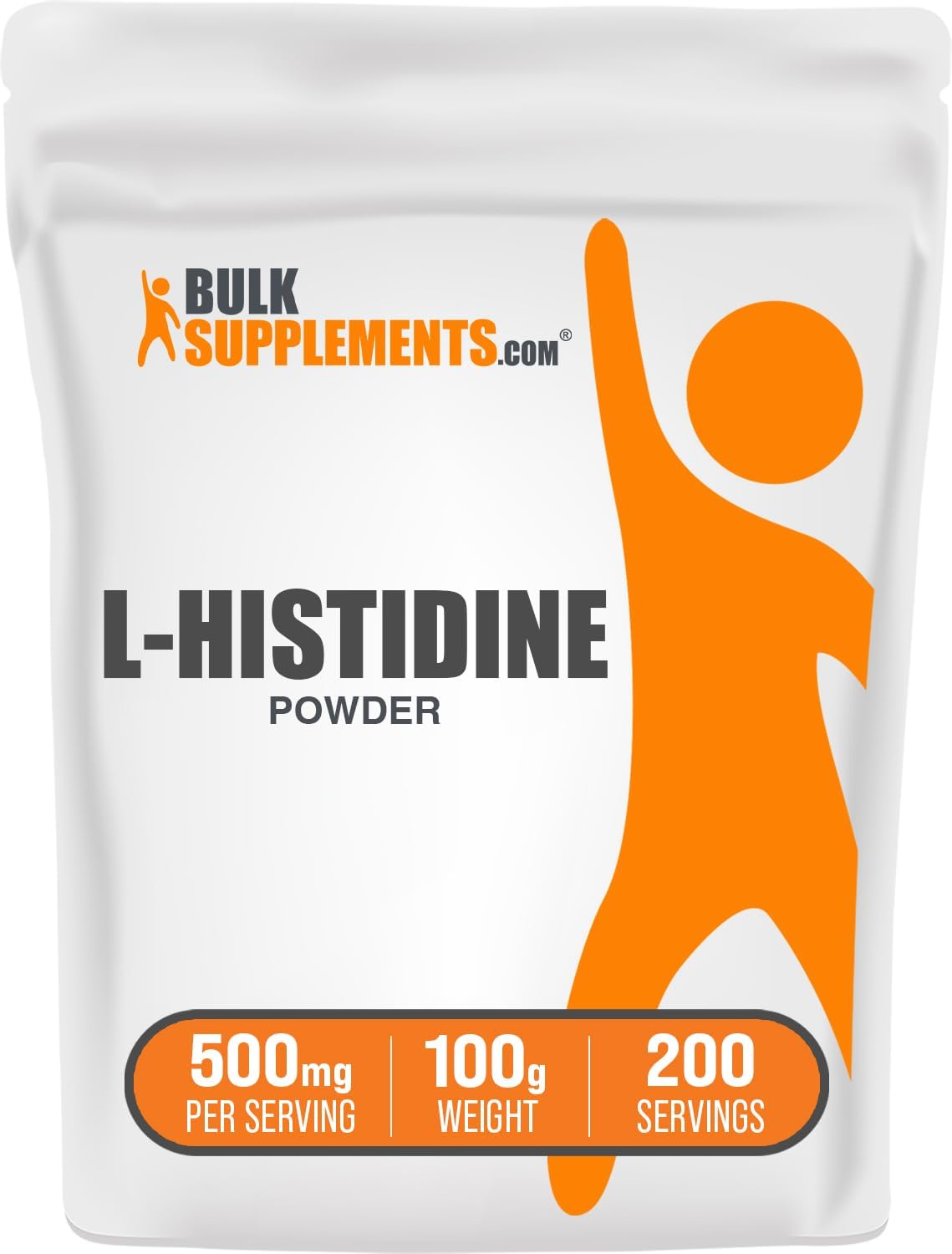
- the single-letter amino acid code for histidine is 'H', and its imidazole ring is why so many enzyme active sites and the oxygen-binding sites of hemoglobin and myoglobin are built around a histidine residue.
- histidine was long considered essential only for infants; it's now recognized as essential for adults too, because we can't make enough of it on our own.
- carnosine, the muscle and brain dipeptide people buy for its antioxidant and anti-aging reputation, is literally histidine bonded to beta-alanine.
- urocanic acid, one of histidine's skin metabolites, absorbs UV light and is considered a natural component of the skin's response to sun.
Mechanism
histidine's imidazole side chain is the whole story. its pKa near 6 lets it pick up and release protons around physiological pH, so it acts as a buffer and as a metal-coordinating residue. free histidine chelates divalent metals like Fe2+ and Cu2+, which blunts Fenton-type reactions that would otherwise generate hydroxyl radicals, and the imidazole ring directly quenches singlet oxygen. metabolically it is a substrate: histidine decarboxylase converts it to , and carnosine synthase joins it with beta-alanine to make the dipeptides carnosine and anserine that buffer and protect muscle and brain. in adipose tissue, supplemental histidine appears to dampen NF-kB signaling and lower IL-6 and TNF-alpha, which is the proposed route for its effect on resistance. in skin it supplies filaggrin, whose breakdown yields urocanic acid and pyrrolidone carboxylic acid, components of the natural moisturizing factor.
receptor fingerprint
Histidine decarboxylase (HDC)substrate / precursor
Carnosine synthase (with beta-alanine)substrate / precursor
Fe2+ / Cu2+ divalent metal ionschelation
Singlet oxygen (1O2) / hydroxyl radicalscavenging / quenching
Filaggrin / natural moisturizing factorsubstrate
NF-kB inflammatory signalingsuppression (indirect, in adipose tissue)
Dosingtypical ranges, not medical advice
interested in protocols and clinical dosages? make an account to see them! ^_^
Safetyrisks and cautions, not medical advice
histidine is an essential nutrient present in normal diets and is generally recognized as safe within dietary and studied supplemental ranges; the two main human supplement trials (4g/day for 8 to 12 weeks) reported no notable adverse effects. the honest caveats: it is a direct histamine precursor, so histamine-sensitive people or those with mast cell issues should be cautious and start low. very high histidine intakes have caused amino acid imbalance effects in animal studies, and rare inborn metabolism issues (histidinemia) exist but are usually benign. anyone with a serious metabolic, kidney, or psychiatric condition, or who is pregnant, should talk to a clinician before supplementing rather than self-dosing at the gram level. this is not medical advice.
Interactionsdocumented pairs only, not exhaustive
The documented interaction record for L-histidine is thin, and saying so is more useful than padding a list. It is a dietary amino acid present in ordinary food in gram quantities, and supplemental amounts sit inside the range the body already handles.
The one reproducible finding involves zinc. Histidine forms a soluble complex that the intestine absorbs more readily than zinc sulfate; in healthy volunteers, zinc given as a zinc-histidine complex produced a serum zinc rise roughly a quarter higher than the same amount as sulfate. That works in favor of a zinc supplement rather than against it, but it means histidine changes how much zinc a given amount actually delivers, and sustained shifts in zinc status raise the usual question about copper displacement.
Everything else is mechanistic inference. Histidine is the substrate for histidine decarboxylase, so large loads are a theoretical source of extra histamine, which could matter to anyone with impaired diamine oxidase activity or on a monoamine oxidase inhibitor. No clinical interaction study supports that, and it reads as a hypothesis rather than a finding.
Checking a whole stack? Run it through interactions + stacks.
Where to buy
Suppliers
Vendors carrying L-Histidine, with live product details and codes. Links are affiliate links that support the wiki at no cost to you.
Amazon
L-Histidine
Research
- 1997first cited[Protective effect of L-histidine (singlet oxygen scavenger) on transient forebrain ischemia in…
- 2024most recentEffects of carnosine and histidine-containing dipeptides on biomarkers of inflammation and oxid…
- 1.Histidine in Health and Disease: Metabolism, Physiological Importance, and Use as a Supplement.
- 2.Histidine supplementation improves insulin resistance through suppressed inflammation in obese women with the metabolic syndrome: a randomised controlled trial.
- 3.Feeding filaggrin: effects of l-histidine supplementation in atopic dermatitis.
- 4.Protective Role of Histidine Supplementation Against Oxidative Stress Damage in the Management of Anemia of Chronic Kidney Disease.
- 5.Effects of carnosine and histidine-containing dipeptides on biomarkers of inflammation and oxidative stress: a systematic review and meta-analysis.
- 6.Role of dietary histidine in the prevention of obesity and metabolic syndrome.
- 7.[Protective effect of L-histidine (singlet oxygen scavenger) on transient forebrain ischemia in the rat].
7 listed here; entry last updated August 2026
Reviews
My notesprivate to this device
FAQ
is L-histidine the same as histamine?
no. histidine is the amino acid; your body uses the enzyme histidine decarboxylase to convert some of it into histamine. taking histidine gives your body more raw material for histamine, which is why histamine-sensitive people should start low.
do i need to supplement histidine if i eat enough protein?
probably not. histidine is common in meat, fish, eggs, dairy, and many plant proteins, so most people eating adequate protein get enough. supplementation makes more sense for specific goals like eczema or under clinical guidance.
is it better to take histidine or carnosine for antioxidant effects?
if the antioxidant/anti-aging angle is your goal, carnosine or beta-alanine is more direct, since carnosine is the active histidine dipeptide most of the human antioxidant data actually studied. histidine is the upstream precursor.
how long until histidine helps with atopic dermatitis?
in the pilot study, oral l-histidine at 4g/day reduced eczema severity within about four weeks. it's not instant; think of it as a slow barrier-support intervention, best done with a clinician's input.
can i take histidine every day?
the human trials dosed it daily for 8 to 12 weeks without notable problems. long-term standalone use beyond that isn't well studied, so ongoing high-dose use is best done under supervision.
Limitations of the evidence
- theoretical amino acid imbalance at very high intakes
Adverse effects
- possible flare-ups in histamine-sensitive individuals (histamine precursor)
Notes and cautions
- generally well tolerated at studied doses (up to 4g/day)
- no notable adverse effects reported in the two main 8 to 12 week human trials